


Nomad vs Kubernetes: A complete comparison of features, performance, complexity, use cases, and real-world examples to help you choose the right orchestrator.
Table of Contents
Introduction
Container orchestration has become a critical part of modern DevOps engineering. It defines how applications are deployed, scheduled, scaled, and self-healed in production environments. For years, Kubernetes has dominated the orchestration landscape. However, HashiCorp Nomad has gained significant attention because it promises the same results with a fraction of the complexity.
So the question is:
Nomad vs Kubernetes – which one should YOU use?
This blog provides a deep, practical, and real-world comparison to help you choose the right tool for your team, project, and infrastructure maturity.
Whether you run Nomad or Kubernetes, secure every deployment with built-in scanning, policy enforcement, and compliance gates through expert DevSecOps Services.
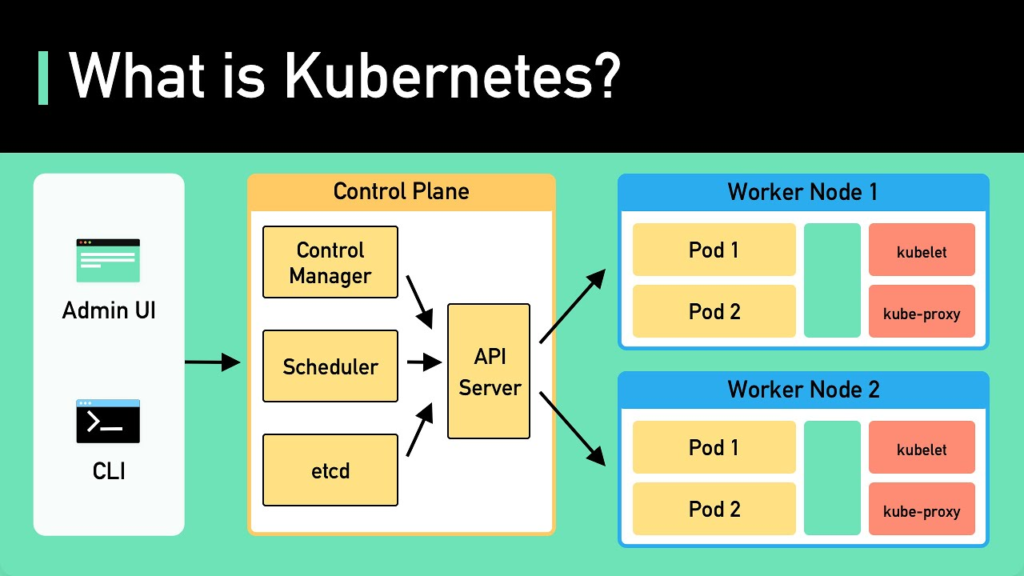
What is Kubernetes?
Kubernetes (K8s) is a powerful, feature-rich container orchestration platform originally built by Google. Today, it’s the industry standard for deploying microservices at scale.
Core Strengths
- Highly scalable
- Large ecosystem (Helm, Operators, CRDs)
- Self-healing workloads
- Multi-cloud support
- Extremely flexible networking & storage options
Core Weaknesses
- Extremely steep learning curve
- Operational overhead is high
- Requires skilled DevOps/SRE teams
- Overkill for small/medium projects
What is HashiCorp Nomad?
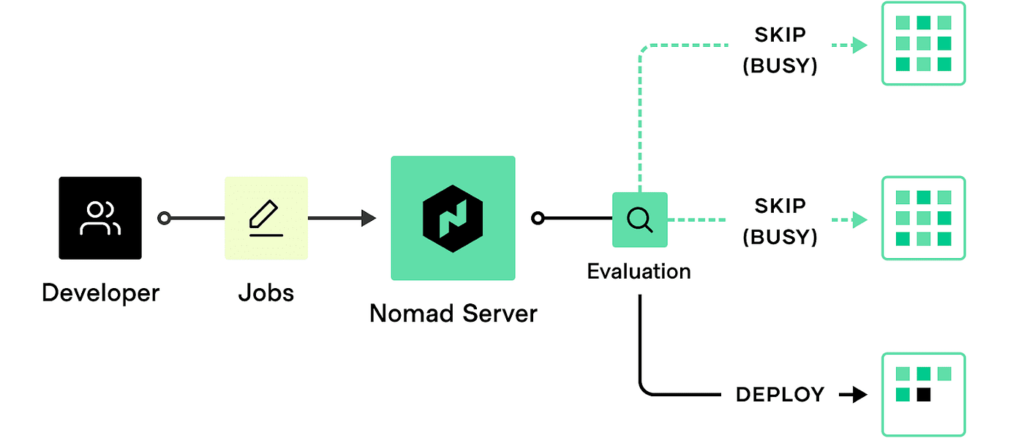
Nomad is a lightweight orchestrator by HashiCorp. Unlike Kubernetes, which is container-only, Nomad supports:
- Container workloads
- Virtual machines
- Standalone binaries
- Cron jobs
- Java applications
- GPU workloads
Nomad is extremely simple – often a single binary is enough to run a cluster.
Core Strengths
- Low operational overhead
- Simpler setup (minutes, not days)
- Supports non-container workloads
- Works well with Consul (networking) & Vault (secrets)
- Very stable even in small clusters
Core Weaknesses
- Smaller ecosystem
- Fewer plugins and integrations
- Requires Consul for full functionality
- Less community support
Nomad vs Kubernetes : In-Depth Comparison
Below is a comprehensive comparison that covers the most important areas from a DevOps and production standpoint.
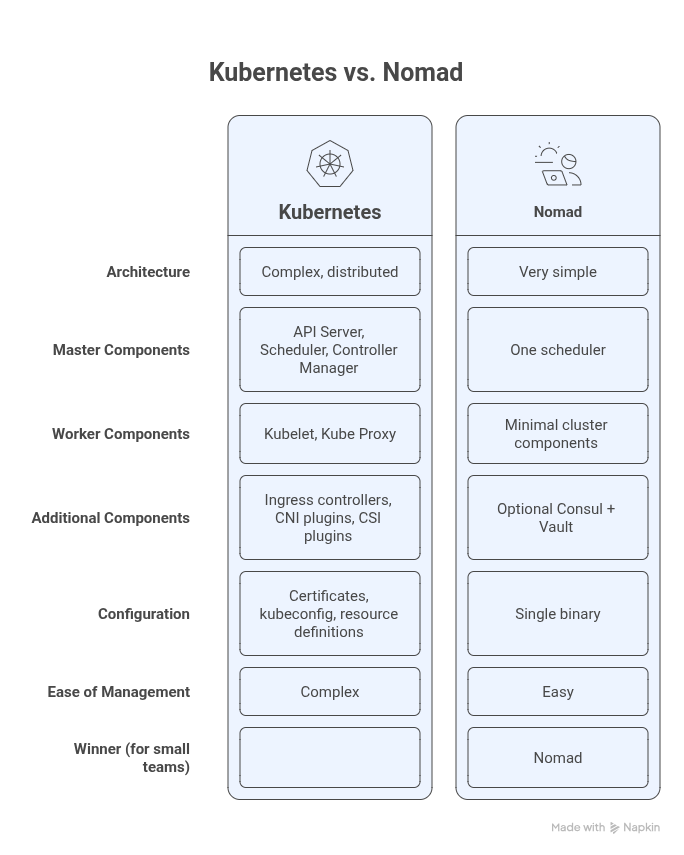
Architecture Simplicity
Kubernetes
- Master components: API Server, Scheduler, Controller Manager, etc
- Worker components: Kubelet, Kube Proxy
- Ingress controllers, CNI plugins, CSI plugins
- Certificates, kubeconfig, resource definitions
Complex, distributed architecture.
Nomad
- Single binary
- One scheduler
- Optional Consul + Vault for full capabilities
- Minimal cluster components
Very simple architecture – easy to operate.
Winner → Nomad
If your team is small or not deeply experienced, Nomad is far easier to manage
Setup & Installation
Kubernetes
- Hardest part for beginners
- Production-grade setup needs HA control plane
- Tools like Kubeadm, Rancher, GKE/EKS make it easier but still complex
Nomad
- Install binary
- Start agent
- Join cluster
- Done
Winner → Nomad
Fastest bootstrap and maintenance.
Workload Flexibility
Kubernetes
Supports only containerized workloads.
Nomad
Supports:
- Docker containers
- Raw exec tasks
- Java apps
- QEMU VMs
- Batch jobs
- System jobs
- GPU workloads
Winner → Nomad
Perfect for hybrid environments where everything is not containerized.
Ecosystem & Community
Kubernetes
- Huge community
- Largest ecosystem
- Many third-party tools
Nomad
- Smaller, niche community
- Strong support from HashiCorp
- Limited external plugins
Winner → Kubernetes
Unbeatable ecosystem.
Scaling & Scheduling Performance
Kubernetes
- Great autoscaling mechanisms (HPA, VPA, Cluster Autoscaler)
- Highly optimized but heavy control plane
Nomad
- Ultra-fast scheduler
- Lightweight resource consumption
- Efficient cluster performance even on low-end hardware
Winner → Tie
- Kubernetes = better autoscaling features
- Nomad = faster scheduling and lighter footprint
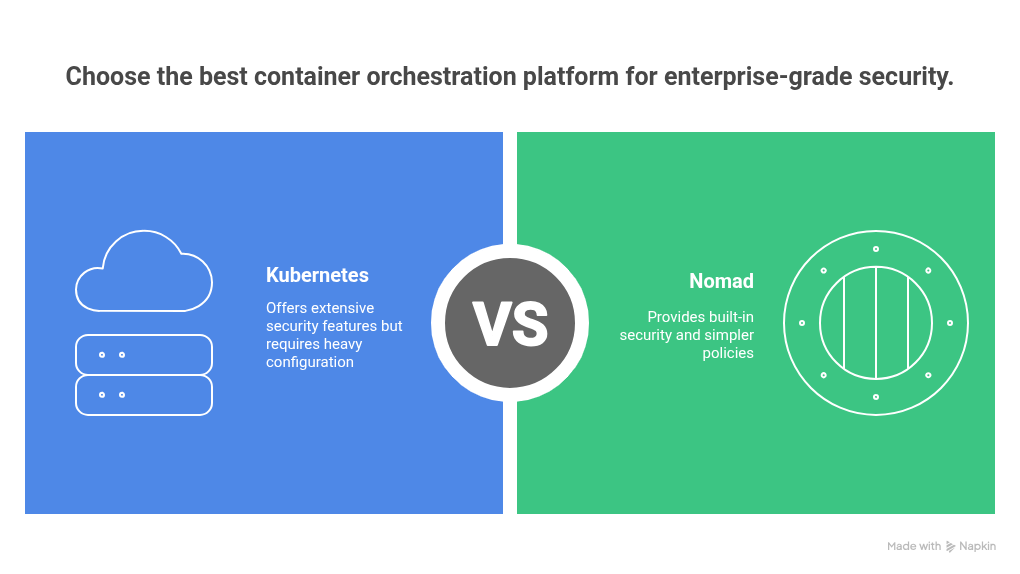
Security
Kubernetes
- Pod Security Admission
- Network Policies
- Secrets encryption
- RBAC
- Service Accounts
But needs heavy configuration for enterprise-grade security.
Nomad
- Built-in ACL system
- Tight integration with Vault
- Simpler policies
Winner → Kubernetes
More features, but requires effort.
Networking
Kubernetes
- Extremely powerful networking
- CNI plugins (Calico, Cilium, Weave)
- Ingress controllers for traffic routing
Nomad
- Basic networking by default
- Needs Consul for service discovery
- No native ingress controller equivalent
Winner → Kubernetes
More flexible and enterprise-ready.
Resource Requirements
Kubernetes
- Heavy control plane
- Needs multiple nodes for HA
- Large memory & CPU footprint
Nomad
- Lightweight
- Can run even on Raspberry Pi clusters
- Lower operational cost
Winner → Nomad
Use Cases
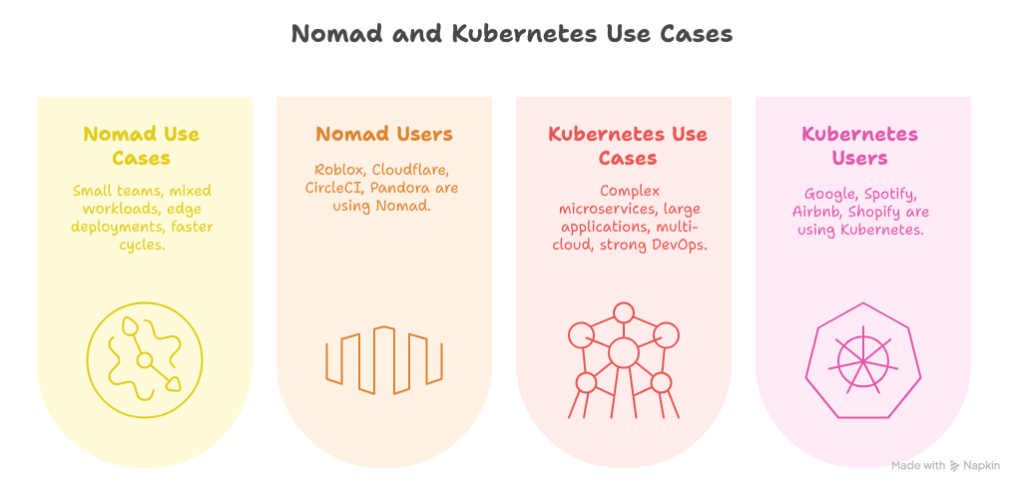
Use Nomad When:
- Small teams with limited ops skills
- Mixed workloads (containers + Java + batch jobs)
- Edge clusters / on-prem deployments
- Faster deployment cycles are needed
Real Companies Using Nomad:
- Roblox
- Cloudflare
- CircleCI
- Pandora
Use Kubernetes When:
- Complex microservices
- Large-scale enterprise applications
- Multi-cloud deployments
- Strong SRE/DevOps capabilities
Real Companies Using Kubernetes:
- Spotify
- Airbnb
- Shopify
Case Study: Roblox
Roblox publicly shared that they chose Nomad over Kubernetes due to:
- Its simpler architecture
- Easier scaling
- Less resource usage
- Ability to run mixed workloads
This is a real proof of Nomad’s reliability under massive workloads.
Case Study: A FinTech Startup
A small FinTech company (30 engineers) tried Kubernetes but faced:
- High maintenance
- Difficult troubleshooting
- Slow dev onboarding
They switched to Nomad + Consul + Vault:
- 70% reduction in Ops overhead
- Simplified deployments
- Faster build-to-deploy cycles
Final Verdict: Which Is Best?
Choose Nomad if:
You want simplicity, speed, fewer moving parts, and support for non-container workloads.
Choose Kubernetes if:
You need powerful features, massive scalability, and a broad ecosystem — and you have a skilled DevOps team.
Simple Recommendation for Interviews
“Nomad is better when you want lightweight orchestration and simplicity. Kubernetes is better when you need large-scale microservices with advanced networking, autoscaling, and ecosystem flexibility.”
References
These are real-world sources, not AI-generated:
- HashiCorp Nomad Documentation — https://www.nomadproject.io/docs
- Kubernetes Official Documentation — https://kubernetes.io/docs/
- Roblox Engineering Blog: Why Roblox Uses Nomad
- Cloudflare Engineering Blog: Running at Scale with Nomad
- HashiCorp Blog: Nomad vs Kubernetes Architecture Analysis
FAQs
1. Is Nomad easier than Kubernetes?
Yes. Nomad installation and architecture are significantly simpler than Kubernetes, making it ideal for small or medium teams.
2. Does Nomad support autoscaling?
Yes, through Horizontal Application Autoscaler and integration with Consul/Vault.
3. Which is better for beginners?
Nomad is better for beginners due to its simplicity and low learning curve.
4. Which orchestrator is best for enterprises?
Kubernetes remains the best for large, complex enterprise-grade applications requiring advanced networking, security, and ecosystem tools.