

In the modern enterprise, data isn’t just an asset, it’s the lifeblood of decision-making. But raw data is like crude oil – it holds immense potential but is unusable in its natural state. It must be extracted, refined and transported to where it can power the business. This is the fundamental role of a data pipeline. For any leader looking to build a truly data-driven organization, understanding and investing in robust data pipeline architecture is not an IT expense, it’s a strategic imperative.
This guide moves beyond the technical jargon to explore why data pipelines are the bedrock of business agility, how to build them effectively and the tangible outcomes they deliver.
What is a Data Pipeline?
Data pipeline architecture refers to the comprehensive design that governs the process of moving data from its source to the users, applications, and models that rely on it. When we speak of “architecture,” we are referring not to the pipeline itself, but to the framework for its planning. This encompasses decisions regarding data flow, transformation points and the tools utilized at each stage.
An effective architecture should be designed based on specific use cases rather than a ‘one-size-fits-all’ approach. For instance, a data pipeline designed for real-time fraud detection differs significantly from one that generates nightly sales reports, even though both transport data from source to destination. This section describes the essential layers common to all pipelines, outlines the prevailing stage model, highlights key architectural patterns, and details best practices for maintaining reliability as pipelines scale.
For a CEO or a VP of Sales, this means the pipeline is what transforms millions of disjointed customer clicks into a clean, unified view in the CRM. For a COO, it’s the system that takes real-time sensor data from factory floors and turns it into a live dashboard predicting maintenance needs. The pipeline is the silent workhorse that makes data actionable.
Looking for reliable Data Pipeline Development Services to power your data-driven decisions?
Why Data Pipelines Are Important?
Without a structured approach to data movement, organizations face a “data swamp” – a chaotic environment where information is siloed, inconsistent and untrustworthy. The strategic importance of data pipelines lies in their ability to:
- Ensure Timeliness and Accuracy: Automated pipelines eliminate manual, error-prone data handling, ensuring that decisions are based on the most current and accurate information.
- Enable Scalability: As data volume, variety, and velocity explode, a well-architected pipeline can scale to meet demand without compromising performance.
- Drive Operational Efficiency: By automating the data flow, your data teams spend less time on mundane data wrangling and more on high-value analysis and model building.
- Unlock Real-Time Capabilities: Modern business moves fast. A pipeline capable of real time data ingestion service allows you to react to market shifts, fraud attempts, or customer behavior as they happen.
Deconstructing Data Pipeline Architecture: The Blueprint for Flow
A typical data pipeline architecture is composed of several logical stages. While implementations vary, the core components remain consistent:
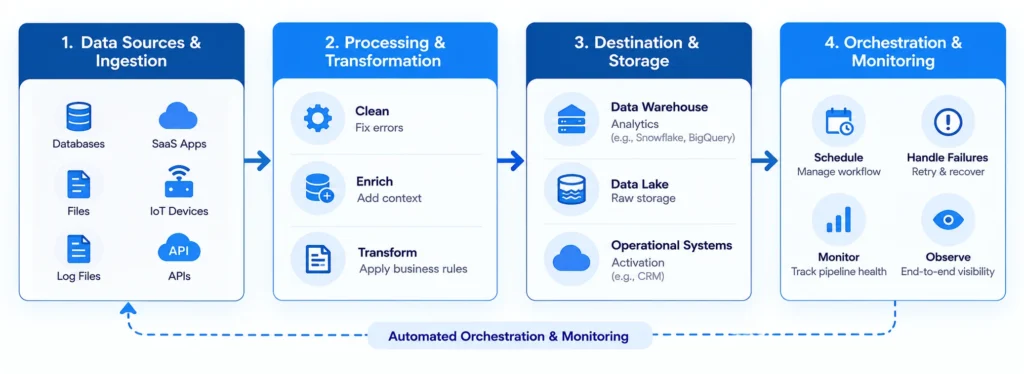
- Data Sources & Ingestion: This is the entry point. Data is pulled from diverse sources like databases, SaaS applications (e.g., Salesforce, Marketo), IoT devices, and log files. Ingestion can be batch (scheduled intervals) or streamed (continuous).
- Processing & Transformation: This is the “refinery.” Here, data is cleaned (fixing errors), enriched (adding context), and formatted to meet business rules. This stage ensures data quality and consistency.
- Destination & Storage: The refined data is loaded into a destination system. This could be a data warehouse (like Snowflake or BigQuery) for analytics, a data lake for raw storage, or an operational system (like a CRM) for activation.
- Orchestration & Monitoring: This is the command center. Tools like Apache Airflow or Prefect manage the workflow, scheduling tasks, handling failures, and providing observability into the pipeline’s health.
Data Pipeline vs. ETL Pipeline: A Strategic Distinction
You’ve likely heard the term ETL. So, what’s the difference between a Data pipeline vs. ETL pipeline?
The simplest way to think about it is that ETL is a specific, traditional type of data pipeline. ETL stands for Extract, Transform, Load – the transformation happens before the data is loaded into the target database or warehouse. This was ideal for structured, batch-oriented data.
Modern data pipelines are a broader category. They include ETL but also embrace ELT (Extract, Load, Transform), where data is loaded first and transformed later using the power of modern cloud data platforms. This is crucial for handling semi-structured data and enabling faster ingestion.
The table below clarifies the key distinctions:
| Feature | ETL Pipeline (Traditional) | Modern Data Pipeline (ELT/Broad) |
|---|---|---|
| Transformation Timing | Transform before loading (T then L) | Often transform after loading (L then T) |
| Primary Use Case | Structured data, batch processing, data warehousing | Diverse data (structured, semi-structured), real-time streams, data lakes |
| Flexibility | Rigid schema, changes can be slow | More agile and schema-on-read approaches |
| Target System | Typically a relational data warehouse | Cloud data warehouses, data lakes, operational systems |
| Business Outcome | Trusted, pre-defined reports and historical BI | Agile analytics, data science exploration, real-time applications |
Also Read: Best Data Engineering Companies in India
What Are the Types of Data Pipelines
Understanding the Types of data pipelines is key to aligning your technology with business goals.
- Batch Processing Pipelines: These process data in large, discrete chunks at scheduled intervals (e.g., nightly). Use Case: Generating end-of-day financial reports or updating a customer segmentation model.
- Stream Processing Pipelines: These handle a continuous flow of data, processing it in near real-time. Use Case: A financial institution detecting fraudulent transactions the moment they occur or an e-commerce site providing live product recommendations.
- Lambda/Kappa Architecture: These are hybrid or stream-first architectures designed to handle both batch and streaming data, providing a comprehensive view.
Use Cases of Data Pipelines: Driving Tangible Business Value
The theoretical is good, but the practical is powerful. Here are concrete use cases of data pipelines delivering ROI:
360-Degree Customer View
Pipelines ingest data from your website, mobile app, support tickets, and marketing campaigns, unifying it into a single customer profile. Outcome: Marketing can run hyper-personalized campaigns, and sales can prioritize leads with a complete history.
Real-Time IoT and Supply Chain Monitoring
Sensors on shipping containers transmit location and temperature data via a streaming pipeline. Outcome: A logistics manager can see delays in real-time and proactively reroute shipments, or a quality manager can ensure perishable goods are maintained correctly.
Predictive Maintenance
A manufacturing company uses a pipeline to stream equipment sensor data. This data is fed into ML models that predict failure. Outcome: Maintenance is performed just before a predicted failure, minimizing costly unplanned downtime.
Unified Business Intelligence
A pipeline consolidates data from ERP, CRM, and HR systems into a central data warehouse. Outcome: Executives have a single source of truth with dashboards that provide a holistic view of business performance.
Navigating the Challenges to Building Data Pipeline
Acknowledging the Challenges to building Data Pipeline is the first step to overcoming them. Common hurdles include:
- Data Complexity: Managing diverse formats and schemas from dozens of sources.
- Data Quality: Ensuring the pipeline produces reliable, trustworthy data (“garbage in, gospel out” is the goal).
- Scalability: Architecting systems that can handle data growth without performance degradation.
- Operational Overhead: The hidden cost of monitoring, maintaining, and troubleshooting broken pipelines.
The key to overcoming these is to treat your data pipeline not as a one-off project but as a core product. This means investing in data observability tools, establishing strong data governance, and choosing managed services that reduce operational burden.
How to Build a Data Pipeline: A Leader’s Blueprint
So, How to build a Data Pipeline? The process is as much about strategy as it is about technology.
- Define the Business Outcome: Start with the “why.” What decision will this data inform? What process will it optimize? This clarity dictates everything that follows.
- Profile Your Data Sources: Understand the quality, structure, and volume of your source data. You can’t build a reliable pipeline on shaky foundations.
- Choose the Right Architecture: Align your architecture (Batch vs. Stream, ETL vs. ELT) with your business requirements for speed and analysis.
- Select Your Technology Stack: Evaluate tools based on your team’s skills, scalability needs, and budget. The market offers everything from open-source (Apache Kafka, Spark) to fully-managed cloud services.
- Implement with Quality and Monitoring: Build with data quality checks at every stage. Implement robust logging and monitoring from day one to ensure reliability.
Conclusion
In the 21st century, a company’s competitive advantage is increasingly defined by its ability to leverage data. The data pipeline is the critical infrastructure that makes this possible. It is the unsung hero that transforms raw data into strategic insight and operational excellence. By investing in a modern, scalable and reliable data pipeline architecture, you are not just building a technical system – you are building the central nervous system of a truly intelligent enterprise.
Frequently Asked Questions
1. What is the main goal of a data pipeline?
A. To automate the process of moving and refining raw data. This turns it into a ready-to-use asset for business analysis and decision-making.
2. What’s the difference between a batch and a real-time pipeline?
A. Batch pipelines process large chunks of data on a schedule for historical reporting. Real-time pipelines process data continuously for immediate, live insights and actions.
3. Is a data pipeline a one-time project?
A. No, it is not a one-time build. It requires continuous monitoring and evolution to keep pace with changing business needs and data sources.
4. What is the biggest challenge in building one?
A. Ensuring consistent data quality and reliability. Without this, the pipeline’s outputs are untrustworthy and can lead to poor business decisions.
5. Should we build a pipeline in-house or use a managed service?
A. A managed service is best for faster deployment and reducing operational overhead. Building in-house is for teams with specialized skills needing deep, custom control.
Related Searches
- How Leading Telecom Enterprise Transformed Enterprise Analytics with Fractal GPT
- Real-Time Banking Data And AI-Powered Mule Detection with Confluent Platform
- Modernizing Healthcare Data Integration with Azure Event Hubs – OpsTree