

A leading fintech platform once experienced a 7-minute outage during peak transaction hours. No data was lost. Systems recovered quickly.
Yet the impact was brutal:
- Thousands of failed transactions
- Merchant trust shaken
- Social media backlash within minutes
- A measurable dip in next-day transaction volume
The issue wasn’t recovery time.
It was the fact that downtime happened at all.
In these days digital economy, customers don’t think in terms of uptime percentages.
They think in terms of “Did it work when I needed it?”
That’s why zero downtime deployment is no longer an engineering goal, it’s a business mandate.
Why Downtime Is a Business Risk (Not Just an IT Issue)
Downtime impacts far more than servers, it directly hits your business outcomes.
1. Revenue Loss
Every second of downtime equals missed transactions. For e-commerce, fintech, and SaaS platforms, even brief outages can translate into massive financial losses.
2. Customer Churn
Modern users have zero patience. If your platform fails once, they quickly switch to competitors.
3. Brand Damage
Frequent outages weaken brand credibility. Trust, once lost, is hard to rebuild.
4. Operational Disruption
Internal teams from support to sales, face chaos during outages, slowing down the entire organization.
DID YOU KNOW?
For nearly 90% of organizations, the cost of just one hour of downtime surpasses $300,000, while 41% of enterprises report losses ranging from
$1 million to over $5 million per hour.
What Is Zero Downtime Deployment
‘Zero-downtime deployment’ is a modern approach to software releases. It enables teams to launch new versions of an application without disrupting users or taking the application offline. Instead of halting the existing application during an update, this method allows for the gradual rollout of the new version while the current version continues to serve live traffic.
This ensures that users can continue browsing, shopping, or using essential business services without interruption (such as maintenance windows, failed requests, or sudden service outages).
‘Zero-downtime deployment’ has become a standard DevOps practice for organizations running customer-facing applications. Whether it is an e-commerce platform processing thousands of orders, a banking application handling financial transactions, or a SaaS product serving customers globally, uninterrupted service availability is crucial for maintaining customer trust and meeting Service Level Agreements (SLAs).
This technology ensures that users can continue browsing, shopping, or using essential services without issues such as maintenance delays, failed requests, or sudden service outages.
For organizations that rely on customer-facing applications, ‘zero-downtime deployment’ has become an essential DevOps practice. Whether it is an e-commerce platform processing thousands of orders, a banking app managing financial transactions, or a SaaS product serving customers globally, maintaining uninterrupted service availability is crucial for retaining customer trust and meeting Service Level Agreements (SLAs).
Instead of completely replacing the entire application at once, modern deployment pipelines employ smart release strategies. These strategies safely manage the shifting of traffic between different versions of the application. This approach reduces deployment-related risks and enables teams to release updates more frequently.
Zero Downtime Deployment Strategies
Blue-Green Deployment
In this approach, two identical production environments are set up. One environment handles live traffic, while the other hosts the new release. Once the updates are verified, traffic can be instantly switched to the upgraded environment. If any issues arise, reverting to the old environment is easy and takes only a few seconds.
Rolling Deployment
Instead of sending updates to all servers simultaneously, rolling deployment focuses on gradual upgrades. Application instances are updated in small batches, allowing the remaining servers to continue serving users and ensuring the application remains available throughout the process.
Canary Deployment
In canary deployment, a new release is initially rolled out to a small subset of users. Teams closely monitor the application’s health, error rates, and performance before gradually increasing the percentage of users accessing the updated version. This approach minimizes the impact of potential issues during deployment.
Feature Flags
In this strategy, new features are deployed to the production environment but remain disabled via configuration flags. Once validated, these features can be activated for specific users or all customers without requiring further deployment. This provides flexibility and control over feature rollouts.
Why Zero Downtime Deployment Matters
Implementing zero downtime deployments offers significant operational and business benefits:
- Deliver software updates without disrupting users or business operations.
- Improve customer experience by eliminating maintenance windows.
- Support continuous delivery and faster release cycles.
- Reduce deployment risk through gradual rollouts and controlled traffic shifting.
- Enable quick rollbacks if unexpected issues occur.
- Meet high availability and SLA requirements for enterprise applications.
- Increase confidence in production releases while maintaining service reliability.
As a trusted zero-downtime deploymentservice provider, OpsTree offers services such as Kubernetes deployment, CI/CD automation, DevOps consulting, and cloud-native engineering to help companies release applications securely, scalably, and without interruption.
In simple terms, zero downtime deployment ensures your business is always open even during change.
Common Scenarios Where Downtime Hurts the Most
Downtime often strikes during critical business moments:
1. Product Releases –New features are meant to drivegrowth but outages during releases can do the opposite.
2. Cloud Migration –Without a proper zero downtime migration strategy, moving to the cloud can disrupt operations.
3. Scaling Infrastructure –Sudden traffic spikes can crash systems if not handled properly.
4. System Upgrades –Routine updates can turn into major disruptions without the right approach.
Strategies That Enable Zero Downtime
Modern organizations use smart deployment approaches to ensure uptime.
1. Blue-Green Deployments
Two environments run in parallel (one live, one updated). Traffic switches only when the new version is ready.
Business benefit: No disruption during releases.
- Canary Deployments
New features are rolled out to a small group first.
Business benefit: Issues are detected early without affecting all users.
- Rolling Deployments
Updates are released gradually across servers.
Business benefit: Continuous availability with minimal risk.
- CI/CD Pipelines
Automated CI/CD pipelines ensure faster, reliable releases.
- Continuous Integration: Code changes are tested automatically
- Continuous Delivery: Updates are deployed smoothly
Business benefit: Faster time-to-market with reduced failure risk.
Downtime vs Revenue Loss
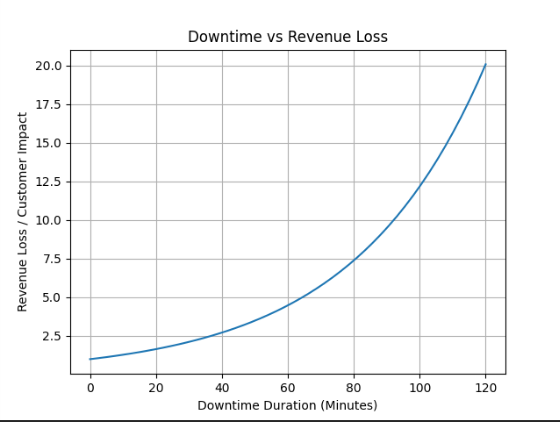
The graph shows that revenue loss doesn’t grow linearly, it accelerates rapidly as downtime increases. While a few minutes may seem manageable, prolonged outages lead to exponential business impact, including lost customers, damaged trust and operational disruption.
Deployment Strategy Comparison Table
| Strategy | Business Benefit | Risk Level | Best Use Case |
|---|---|---|---|
| Blue-Green Deployments | Instant switch with no user disruption | Low | High-stakes releases, critical systems |
| Canary Deployments | Early issue detection with limited impact | Medium | Testing new features gradually |
| Rolling Deployments | Continuous updates without full outage | Medium | Regular updates and scaling |
Role of Cloud & Modern Architecture
Achieving zero downtime is not possible with legacy systems alone.
1. Cloud-Native Architecture –Modern cloud-native architecture enables scalability,flexibility and resilience.
2. Cloud Service Reliability –A robust cloud service ensures high availability and performance.
3. Infrastructure as Code Automation –Using infrastructure as code automation, systems can be deployed and managed consistently.
4. Load Balancer Failover Strategy –Traffic is automatically redirected during failures, ensuring uninterrupted service.
Observability & Reliability Layer
Technology alone isn’t enough, you need visibility and control.
1. Monitoring and Observability
Real-time insights help detect and resolve issues before users are impacted.
2. Site Reliability Engineering (SRE)
Site reliability engineering (SRE) focuses on maintaining uptime and performance.
3. Feature Flags Deployment
With feature flags deployment, features can be turned on/off without redeployment.
OpsTree: Enabling Zero Downtime as a Business Strategy
Achieving zero downtime requires more than tools, it requires expertise.
OpsTree helps organizations shift from reactive IT to proactive business continuity through:
- Enterprise DevOps solutions for uptime
- Cloud migration service without downtime
- Kubernetes consulting services
- Site reliability engineering services
- Observability solutions
Whether you’re modernizing infrastructure or scaling globally, OpsTree ensures your business remains always-on.
Approach:
- Assess current systems
- Design resilient architecture
- Implement automation and observability
- Enable seamless deployment strategies
Conclusion
The conversation around downtime needs to change.
It’s no longer about fixing servers, it’s about protecting revenue, customers and brand value.
Businesses that invest in zero downtime deployment, zero downtime migration and CI/CD pipelines are not just improving IT, they are securing their future.