

Nobody sets out to run an insecure Kubernetes cluster. The gaps that cause real damage in production are rarely dramatic. They are the defaults nobody changed, the permissions nobody audited, the base image nobody updated because the app was working fine.
Security vulnerabilities in containerized environments tend to be quiet, patient, and expensive to discover after the fact. The teams that get hit are not the ones who ignored security. They are the ones who assumed it was handled.
Why Kubernetes Security Is a Different Beast
Traditional application security was built around a cleaner mental model: protect the server, secure the database, patch the OS. Container security in Kubernetes does not work that way. The attack surface is distributed across nodes, pods, namespaces, service accounts, and image registries, all connected through layers of configuration that most teams never review end to end.
What makes this harder is that most security vulnerabilities in Kubernetes environments are not the result of unknown zero-days. They come from things your team made a decision on six months ago and forgot about . Platform security at the Kubernetes layer is really about catching those decisions before they become incidents.
The 6 Gaps That Keep Showing Up in Production
1. Containers Running as Root Without Anyone Noticing
Most teams inherit base Docker images from open-source projects and never question the user context. The default in many images is root, which means the process inside the container has full system-level privileges. Teams assume the container boundary is enough isolation. It often is not. If a workload gets compromised and it is running as root, an attacker can interact with the host filesystem, mount sensitive directories and move laterally across your cluster.
The business consequence is not just a breach, it is a breach with maximum blast radius. Kubernetes provides a clear framework for this through its Pod Security Standards, which define exactly how to restrict container privileges at the cluster level.
2. SAST and DAST Are Not Part of the CI/CD Pipeline
Here is what we have seen more times than we can count: security scanning happens once a quarter, usually before an audit, and usually as a manual process. SAST (Static Application Security Testing) and DAST (Dynamic Application Security Testing) are not just compliance checkboxes. When SAST DAST tools are wired directly into the CI/CD pipeline, vulnerabilities get caught before they ever make it to a container image.
Without this, your production environment becomes the first place a security flaw is discovered, and by then, it has already been sitting in the registry for weeks. The business consequence is straightforward: the later you catch a vulnerability, the more expensive it is to fix, both in engineering hours and in customer trust.
3. Secrets Living in Plain Sight as Environment Variables
Ask most development teams where their API keys and database credentials live and the honest answer is environment variables. It feels clean, it feels standard, and it is taught in almost every beginner cloud tutorial. The problem is that environment variables in Kubernetes are readable by anyone with basic pod access, and they often get logged accidentally by monitoring tools.
One misconfigured log aggregator can expose credentials to every developer on the team. The business consequence here touches compliance directly. If you are handling any form of regulated data, plain-text secrets in environment variables is a finding that auditors flag immediately.
4. No Network Policies Separating Pods
By default, every pod in a Kubernetes cluster can talk to every other pod. Most teams know this on paper, but very few do anything about it because network policies feel like infrastructure work that can wait until after the next launch. The reality is that this open-by-default networking model means a single compromised container can freely probe every other service in your cluster.
There is no internal firewall, no segmentation, nothing stopping lateral movement. The business consequence is that one vulnerable microservice becomes the entry point to your entire backend. A breach that should have been contained to one service instead touches everything.
5. Base Images That Have Not Been Updated in Months
Nobody wants to break a working container. That instinct is understandable and also dangerous. Base images carry operating system packages, and those packages accumulate security vulnerabilities over time. Here is what we have seen: a team locks a base image version at the start of a project because things were working, and then nobody touches it for eight months.
During that time, dozens of CVEs get published against the packages in that image. The workload keeps running fine, but it is quietly vulnerable. The business consequence is that you are carrying known, patchable vulnerabilities in production, which is exactly the kind of thing that shows up in a penetration test or a breach investigation.
6. RBAC That Was Set Up Once and Never Revisited
Role-Based Access Control in Kubernetes cluster management is one of those things teams get right at setup and then ignore. People leave the company. Services get deprecated. New workloads get added with copy-pasted service account permissions from older ones. Over time, the RBAC configuration drifts far from what was intended. Service accounts accumulate permissions they do not need.
Developers retain cluster-admin access that was meant to be temporary. The business consequence here is that your Kubernetes cluster management becomes a liability instead of a controlled environment. One compromised service account with over-permissioned RBAC and the attacker has the keys to the kingdom.
Quick Comparison: What Teams Assume vs. What’s Actually Happening
| Gap Area | Common Assumption | Real Risk | Business Impact |
|---|---|---|---|
| Containers Running as Root | Container isolation is enough protection | Root access enables host filesystem interaction and lateral movement | Full cluster compromise from a single workload |
| No SAST/DAST in CI/CD | Security reviews happen before release | Vulnerabilities reach production undetected for weeks | Expensive late-stage fixes, potential data breach |
| Secrets as Environment Variables | Environment variables are a standard and safe practice | Credentials readable by any pod with access, logged accidentally | Compliance violations, credential exposure |
| No Network Policies | Kubernetes networking is isolated by default | Any compromised pod can freely communicate with all others | Lateral movement across the entire backend |
| Outdated Base Images | If the app runs fine, the image is fine | Accumulation of known CVEs in production workloads | Breach from patchable, documented vulnerabilities |
| RBAC Misconfiguration | RBAC was configured correctly at setup | Permissions drift over time through team changes and copy-paste | Over-privileged accounts become breach entry points |
Working with OpsTree to Close These Gaps
If your team is navigating any of these gaps, you are not alone, and you do not have to reverse-engineer your security posture from scratch . OpsTree has worked with engineering teams across industries to harden their Kubernetes environments without slowing down delivery. The approach is practical: find what is actually exposed, fix what matters most, and build the processes so the same gaps do not reopen six months later.
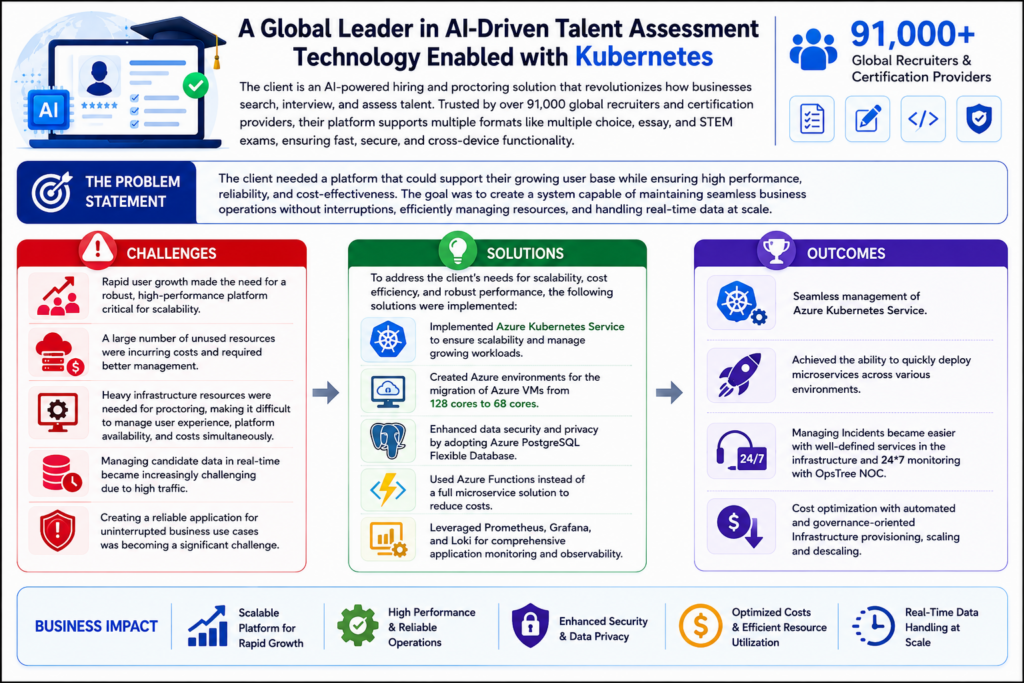
How a Global AI-Driven Talent Assessment Platform Achieved Scalable and Secure Kubernetes Operations with OpsTree
OpsTree helped a global hiring and proctoring platform, trusted by over 91,000 recruiters worldwide, migrate to Azure Kubernetes Service while cutting infrastructure costs significantly. The team moved from 128-core VMs to a rightsized 68-core setup, implemented 24/7 NOC monitoring, and achieved fast, secure microservice deployments across environments, all without disrupting a platform handling real-time candidate data at scale. Read the full case study here.
If you want a clear picture of where your cluster stands today, reach out to OpsTree for a Kubernetes security review before your next release cycle.
What Enterprise Platform Teams Evaluate Before Choosing a DevSecOps Partner
As platform engineering teams work to modernize their Kubernetes environments, security has evolved from a mere afterthought in the selection process into a critical aspect. When large companies evaluate DevSecOps consulting partners, they often assess providers based on their expertise in ensuring ‘security by design,’ container security, Kubernetes hardening, and a secure software supply chain.They also consider CI/CD security automation and cloud-native compliance.Furthermore, many technology leaders look for contributions to open-source projects, experience in transforming DevSecOps practices, and proficiency in implementing SAST, DAST, SBOM, image scanning, secrets management, and policies within the software delivery pipeline. OpsTree Global enables engineering teams to build secure platform foundations right from the start. This helps organizations reduce security risks and accelerate the delivery of cloud-native applications at scale.
FAQs
Q1. What are the most common container security risks in Kubernetes?
The most common risks are over-permissioned containers, plain-text secrets, missing network policies, outdated base images and misconfigured RBAC.
Q2. How does SAST DAST help in Kubernetes security?
SAST scans your code before it builds into an image. DAST tests the running application. Together, they catch vulnerabilities before they ever reach production.
Q3. Why is RBAC misconfiguration dangerous in Kubernetes cluster management?
Permissions drift over time as teams change. Over-privileged service accounts give attackers broad access if even one account is compromised.
Q4. Is storing secrets as environment variables safe in Kubernetes?
No. Environment variables can be read by anyone with pod access and are often accidentally captured in logs. Use a secrets manager instead.
Q5. How often should Kubernetes base images be updated?
At minimum, monthly. Ideally, base image updates should be automated in your CI/CD pipeline so CVEs are patched before they accumulate in production.
Related Blogs
- Your MTTR Is High Because Your Observability Is Fragmented – Here’s the Fix
- Zero Downtime Cloud Migration: Is It Actually Possible? (Yes. Here’s How)
- The Hidden Cost of Building DevSecOps In-House VS. a Managed Partner