
Introduction
Generative AI is moving rapidly from experimentation into business-critical workflows. As organizations deploy copilots, autonomous agents, analytics assistants, and retrieval-based applications, a new architectural challenge appears: how should an AI system access enterprise data safely?
Giving an AI agent direct database credentials may work in a proof of concept, but it creates serious problems in production. Credentials become difficult to govern, access patterns are inconsistent, auditability is limited, and every new AI use case can require another custom integration. An Enterprise MCP Server addresses this gap by acting as a controlled gateway between AI applications and sensitive data systems.
The result is not simply another API layer. It is a reusable AI-data access backbone designed to standardize how agents request context, how permissions are enforced, how results are structured, and how activity is audited.
The Enterprise AI-Data Safety Gap
Without a dedicated protocol and governance layer, AI applications can introduce several operational and security risks:
- Unsafe database access: Direct connections increase the risk of accidental data exposure, unauthorized reads, destructive queries and credential leakage.
- Integration sprawl: Connecting each AI application independently to each data source creates duplicated code, inconsistent controls and high maintenance effort.
- Limited auditability: Teams may struggle todetermine which agent requested data, what it accessed, when it accessed it and which authorization rule permitted the request.
- Inconsistent data contracts: Different tools may return different schemas and formats,increasing prompt complexity and reducing reliability.
- Scaling friction: Every new database, AI agent, or business use case can multiply the number of point-to-point integrations.
Case Study: OpsTree helps enterprises modernize data infrastructure to make AI workloads faster, more scalable and cost-efficient.
Solution: A Centralized Enterprise MCP Server
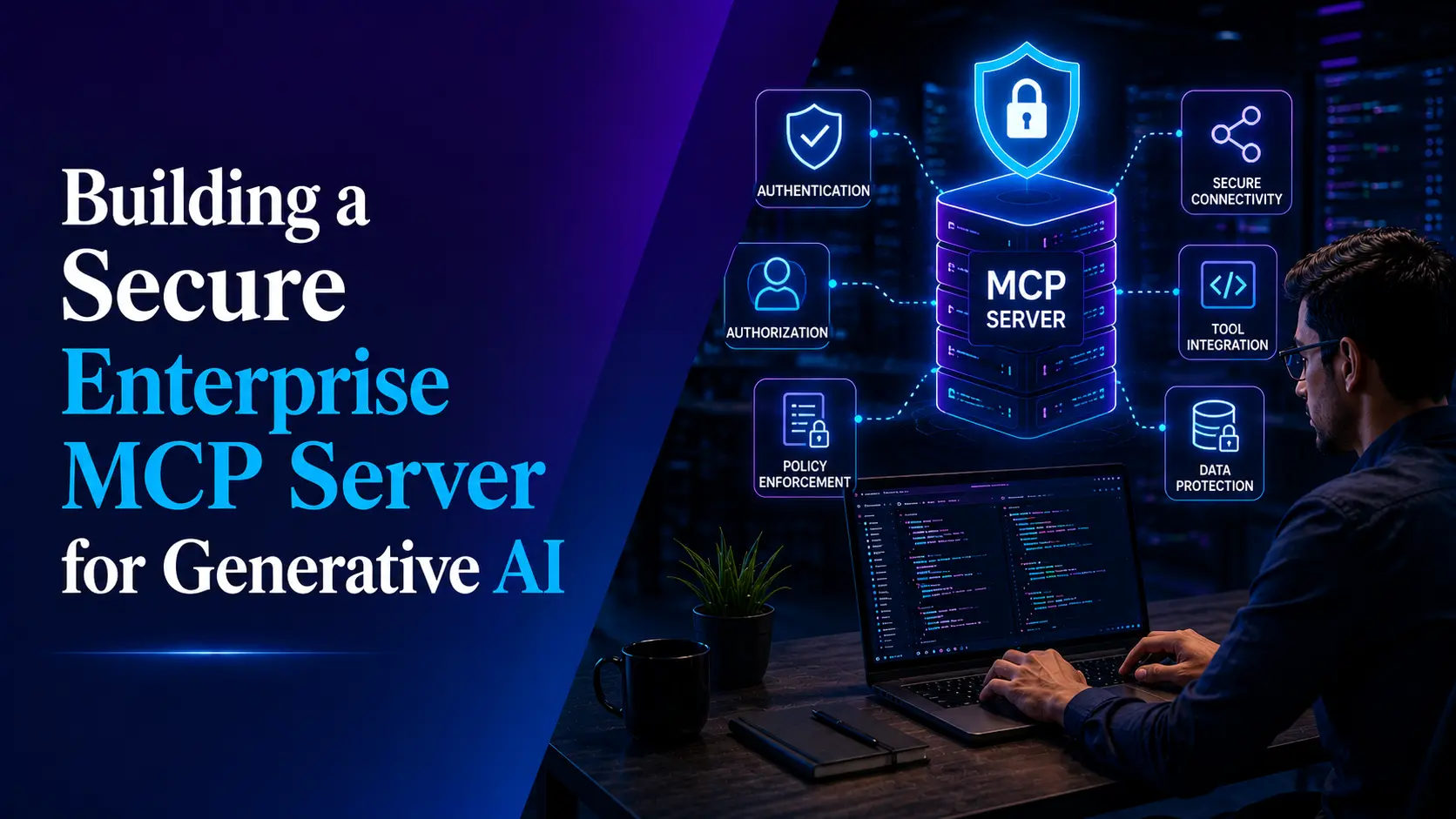
The MCP Server sits between AI agents and enterprise data sources. Instead of exposing entire databases directly, the server provides governed tools and structured interfaces through which an agent can request only the data or operations it is authorized to use.
This creates a clear separation of concerns: the AI application focuses on reasoning and user interaction, while the MCP layer handles connectivity, authorization, validation, policy enforcement, response standardization and observability.
Reference Architecture
| Layer | Primary Responsibility | Typical Capabilities |
|---|---|---|
| AI Applications / Agents | User interaction and reasoning | Copilots, assistants, analytics agents, automation agents |
| MCP Server / Gateway | Governed access to enterprise context | Authentication, authorization, routing, tool exposure, validation |
| Policy & Audit Layer | Control and traceability | RBAC/ABAC, request logging, audit trails, rate limits, approvals |
| Data Connectors | Standardized source integration | SQL databases, APIs, data warehouses, internal services |
| Enterprise Data Sources | Authoritative business data | Operational databases, analytical stores, domain systems |
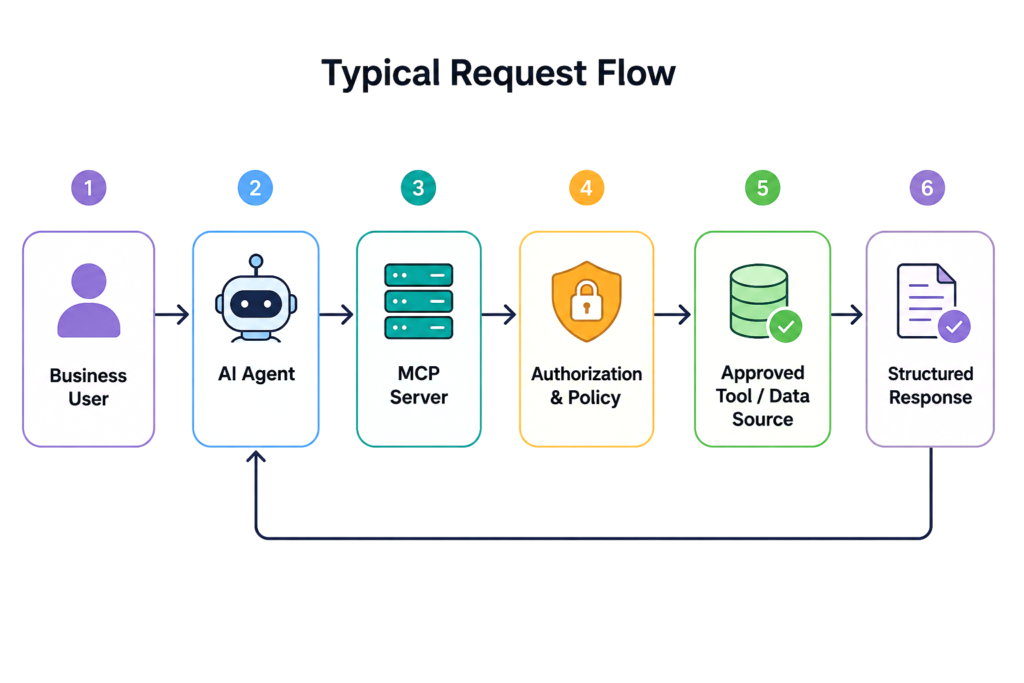
Typical request flow
Core Capabilities
1. Security Backbone
The MCP Server becomes the controlled boundary between AI and data. Authentication verifies the calling application or agent, while authorization determines which tools, datasets, or operations it may access. Sensitive operations can also require additional approval or policy checks.
2. Standardized Tool Interface
Rather than teaching every AI application how to connect to every backend, the MCP layer exposes standardized tools with defined inputs and outputs. This reduces integration complexity and makes AI applications easier to replace or evolve.
3. Multi-Source Connectivity
A single MCP layer can provide governed access to multiple enterprise systems. New data sources can be added behind the gateway without requiring every consuming agent to implement a new connector.
4. Structured Responses
The gateway can normalize outputs into predictable schemas that are easier for AI systems to reason over. This can reduce ambiguity, improve prompt reliability and simplify downstream validation.
5. Real-Time Communication
For interactive use cases, low-latency communication patterns can keep the AI reasoning loop responsive. The source implementation uses WebSockets to support real-time exchange between the AI layer and data-access services.
6. Auditability and Observability
Every request can be logged with the calling identity, requested tool, target system, authorization result, response status, latency and error details. This provides the foundation for operational monitoring, security investigations, and governance reporting.
Security and Governance Controls for Production
A production-grade MCP implementation should treat AI access as privileged application access. Recommended controls include:
- Least-privilege permissions so each agent can access only approved tools and datasets.
- Read-only access by default for analytical and retrieval workloads.
- Explicit allowlists for tools, schemas, tables, APIs or operations exposed through the MCP layer.
- Secrets management so database credentials are not embedded in prompts or agent code.
- Input validation and query guardrails to block malformed or prohibited requests.
- Sensitive-data masking or filtering before responses are returned to the AI layer.
- Complete request and response metadata logging, with appropriate handling of sensitive payloads.
- Rate limiting, timeouts, concurrency controls and circuit breakers to protect backend systems.
- Environment separation for development, testing and production workloads.
Illustrative Success Metrics
Important: The source case study does not provide measured quantitative outcomes. The metrics below are illustrative targets that organizations can use to evaluate an MCP implementation; they should not be presented as achieved results unless validated by production telemetry.
| Metric | Illustrative Target | Why It Matters |
|---|---|---|
| Direct database connections from AI agents | Reduce by 80–100% | Centralizes access through the governed MCP layer. |
| Time to onboard a new AI use case | 30–60% faster | Reusable tools and connectors reduce repetitive integration work. |
| Auditable AI data requests | Target 100% | Every production request should have an identity, policy decision, and trace. |
| Unauthorized tool/data access | 0 tolerated | Policy enforcement should prevent calls outside approved permissions. |
| MCP request success rate | ≥99.5% | Measures platform reliability for production AI workflows. |
| p95 gateway latency | <300–500 ms excluding backend query time | Keeps interactive AI experiences responsive. |
| Connector reuse | 2–5+ AI use cases per connector | Shows whether the platform is reducing point-to-point integration. |
| Mean time to diagnose access failures | Reduce by 40–60% | Centralized logs and traces simplify incident analysis. |
Business Value and Strategic Impact
- Reduced Security Risk: The platform replaces uncontrolled direct access with centralized authentication, authorization, and policy enforcement.
- Faster AI Delivery: Teams can reuse approved connectors and tools rather than repeatedly implementing database connectivity and security logic.
- Lower Integration Complexity: A standardized gateway limits point-to-point coupling between agents and enterprise systems.
- Improved Governance: Centralized audit trails make it easier to investigate activity, demonstrate control, and apply enterprise security standards.
- Future AI Readiness: Once the MCP foundation is established, new agents and AI applications can consume existing tools without redesigning the data-access layer.
- Deployment Flexibility: Containerization supports portable deployment across cloud, hybrid or on-premise environments.
From Proof of Concept to Production
The source implementation is described as operational, containerized, connected to live enterprise databases, and designed for low-latency communication. Moving an MCP Server into production, however, should also include formal service-level objectives, security testing, access reviews, connector health checks, capacity planning, disaster recovery procedures, and continuous monitoring.
Recommended Production Roadmap
Phase 1 – Foundation: Deploy the MCP gateway, establish identity, define tool contracts, integrate one low-risk read-only data source, and enable centralized logs.
Phase 2 – Governance: Add granular permissions, audit dashboards, data masking, rate limits, standardized error handling, and security review workflows.
Phase 3 – Scale: Onboard additional databases and APIs, create reusable domain tools, containerize deployments, and introduce high availability.
Phase 4 – Optimization: Track latency, success rate, connector reuse, access violations, and business adoption; tune policies and infrastructure using observed usage.
Example: How an AI Request Is Governed
- A business user asks an AI assistant for a data-driven insight.
- The AI agent determines that enterprise data is required and calls an approved MCP tool.
- The MCP Server authenticates the calling agent and evaluates its permissions.
- The request is validated against the tool contract and security policies.
- The MCP connector queries only the approved backend data source.
- The response is normalized into a structured format and sensitive fields can be filtered or masked.
- The result is returned to the AI agent, while request metadata is recorded for audit and observability.
- The AI uses the governed result to generate the final user-facing response.
KPIs to Track After Launch
- Total MCP requests by agent, use case, and data source.
- Request success and failure rates.
- p50, p95, and p99 gateway latency.
- Backend query latency and timeout frequency.
- Authorization denials and policy violations.
- Number of AI applications reusing each connector or tool.
- Incidents caused by AI-to-data access.
- Time required to onboard a new agent or enterprise data source.
- Percentage of production AI data requests with complete audit records.
Conclusion
As enterprise AI adoption grows, the challenge is no longer only about building capable models, it is about giving those models safe, controlled, and reusable access to trusted business data. An Enterprise MCP Server provides the governed middle layer needed to achieve that balance.
By centralizing access control, standardizing integrations, improving auditability, and creating reusable connectors, the MCP architecture can turn AI-to-data connectivity from a security liability into a scalable enterprise capability. The strongest implementations will combine protocol standardization with measurable reliability, least-privilege access, complete observability, and clear governance ownership.
Metric Note
All percentage improvements and performance thresholds in this blog are illustrative benchmarking targets, not source-validated business outcomes. They should be replaced with measured production values before external publication.
Related Searches
- How Leading Telecom Enterprise Transformed Enterprise Analytics with Fractal GPT
- Real-Time Banking Data And AI-Powered Mule Detection with Confluent Platform
- Modernizing Healthcare Data Integration with Azure Event Hubs – OpsTree