

A data pipeline might function correctly for months, but as the organization grows, it can become a serious business problem.
As more data flows in and new applications come online, teams introduce dashboards, machine learning models, APIs and real-time scenarios. A pipeline that previously managed a few million records daily might suddenly find itself handling ten times that amount of data. Changes can occur during this process, such as a source system modifying a column, an API being delayed in delivering data, data transformations becoming more resource-intensive or duplicate records being created upon retries.
The pipeline may still show successful. But the business data is no longer reliable.
The real challenge in enterprise data engineering lies in scaling pipelines effectively. It is not merely about processing large volumes of records; rather, it is about maintaining data that is accurate, readily available, timely, traceable, and cost-effective , all while operating in an increasingly complex environment.
According to the 2026 Fivetran benchmark study of over 500 senior data and technology leaders, companies experienced pipeline disruptions an average of 4.7 times per month, and a significant portion of engineering work 53% of the total, was consumed by pipeline maintenance. Furthermore, 97% of respondents reported that pipeline-related issues caused disruptions to their analytics or AI projects. Although these findings are based on a survey rather than general industry standards, they highlight how pipeline reliability can pose significant operational challenges at the enterprise level.
Why Data Pipelines That Work at Small Scale Break at Enterprise Scale
The first version of a pipeline is usually built to solve a specific problem:
“ Get data from point A to point B. ”
Enterprise data engineering has a different requirement:
“ Keep data moving correctly when sources, volumes, users, infrastructure and business requirements keep changing.”
This is where issues often arise in many pipelines.
A pipeline that functions smoothly with 500,000 records might behave very differently when handling 50 million records. A transformation process that takes five minutes could turn into a two-hour task. Even a minor change to the source schema can impact dozens of downstream tables and reports.
Problems rarely stem from a single, massive failure. More often, reliability gradually erodes due to a series of small changes.
1. Data Volume Grows Faster Than the Architecture
Volume is a challenge that can easily be overlooked.
Initially, a pipeline can be built for daily batch processing. However, as the business grows, that same pipeline must adapt to:
- Higher transaction volumes
- Historical backfills
- More source systems
- Larger datasets
- Real-time events
- More concurrent workloads
- Increasing analytical queries
At this stage, simply increasing compute resources will not solve the problem.
Issues such as poor partitioning, inefficient joins, data skew, excessive data movement between systems and poorly designed transformations can create bottlenecks.
For example, a customer analytics pipeline processing 5 million records might complete overnight without interruption. However, when scaled up to 100 million records, the same transformation logic could cause the business reporting deadline to be completely missed.
This highlights that scalability should be incorporated into the data pipeline architecture from the very beginning, rather than being added later when performance issues arise.
AWS also emphasizes the importance of building pipelines with a focus on fault tolerance, incremental processing, reconciliation and the ability to handle growing data volumes.
2. Schema Drift Quietly Breaks Downstream Data
Schema changes are another common cause of enterprise pipeline failures.
The source application team can do the following:
- Rename a column
- Change a data type
- Add a nested field
- Remove an unused field
- Change the meaning of an existing field
From the application team’s perspective, this change might be perfectly valid.
However, for the data team, it could break transformations, dashboards, reports or downstream applications.
The situation becomes even more critical when the pipeline does not fail.
Suppose a source changes the meaning of a field from customer_status = active/inactive to a more detailed status model. The data type hasn’t changed, so the pipeline keeps running. However, the business logic using that field is now producing different results.
That is why enterprise data pipelines require far more than just schema validation. They need data contracts, schema monitoring, lineage and ownership at the pipeline boundaries.
3. A Successful Pipeline Run Does Not Mean Successful Data Delivery
One of the most important distinctions in modern data engineering is the difference between pipeline health and data health.
A job might complete successfully, while:
- A source delivered only half the expected records
- A partition was missing
- A transformation dropped records
- Duplicate events entered the warehouse
- Data arrived several hours late
- A business rule changed
- A downstream table contains stale information
Silent data failures pose significant risks and here is why:
According to Google’s Site Reliability Engineering (SRE) guidelines, simply checking whether processing jobs have completed is insufficient; to understand the health of a service, it is essential to focus on aspects such as the freshness, coverage and accuracy of the data pipeline.
In essence, effective monitoring should aim to answer two distinct questions:
“Did the pipeline run? And Did the pipeline produce the data the business expected?”
Those are not the same question.
4. Point-to-Point Pipelines Create More Operational Debt
Enterprise data environments typically contain multiple pipelines, sometimes numbering in the hundreds. Complexity increases significantly when each source connects to each destination individually. Consequently, each integration can become a separate system:
- Authentication
- Transformation logic
- Retry mechanism
- Scheduling
- Monitoring
- Error handling
- Data-quality rules
At first glance, it appears straightforward.
However, a change in a single source might necessitate continuous updates across multiple pipelines. That is why adopting a modular architecture is crucial.
By avoiding tight coupling between components, organizations can clearly define their core responsibilities:
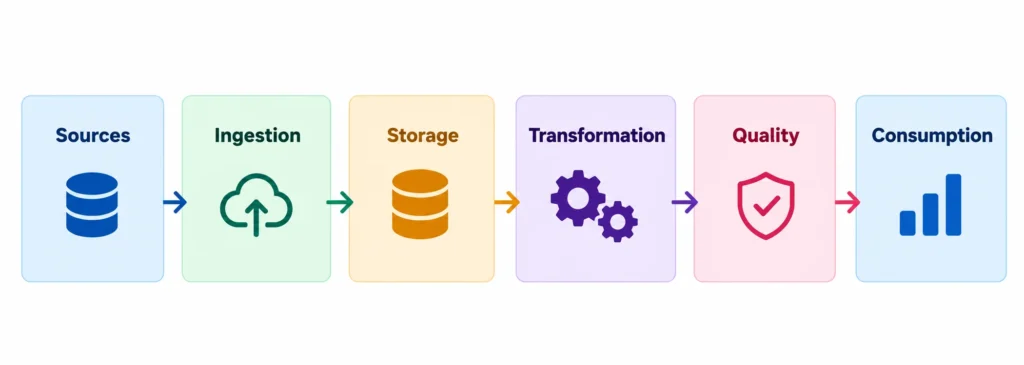
This approach simplifies the process of swapping components, scaling workloads up or down or isolating failures without having to rebuild the entire data platform.
Furthermore, in the context of modern data engineering architecture, AWS emphasizes the importance of principles such as flexibility, reproducibility, reusability, scalability and auditability.
5. Retries Can Create Another Problem: Duplicate Data
Retries are an essential part of any production environment. However, implementing retries without ensuring idempotency can turn a temporary issue into a serious data quality problem.
Suppose an injection process handles 10 million transactions. It successfully completes 90% of the required tasks before failing. When the system resumes operations, if the pipeline fails to correctly identify which records have already been processed, there is a risk that the same records could be inserted multiple times.
That can affect:
- Revenue calculations
- Customer transactions
- Inventory
- Financial reporting
- Machine learning features
- Operational dashboards
A reliable pipeline requires several key components, such as idempotent processing, checkpoints, watermarks, deduplication and robust recovery systems.
AWS identifies idempotency as a crucial mechanism to ensure that retrying an operation does not result in duplicate effects.
6. Data Quality Problems Usually Surface Downstream
A common mistake in business is viewing data quality solely as a reporting-related issue. Often, by the time an analyst spots an anomaly in a dashboard metric, the root cause has already been festering for hours or even weeks.
A more effective approach is to implement quality checks directly within the pipeline. Depending on the nature of the work, these checks might include:
- Null-value checks
- Duplicate detection
- Referential integrity
- Range validation
- Record-count reconciliation
- Schema validation
- Freshness checks
- Distribution monitoring
- Business-rule validation
The goal is clear:
Identify and fix bad data before it impacts others. This becomes even more critical when enterprise data pipelines feed information into AI and machine learning systems. No model can compensate for data that is consistently incomplete or inconsistent.
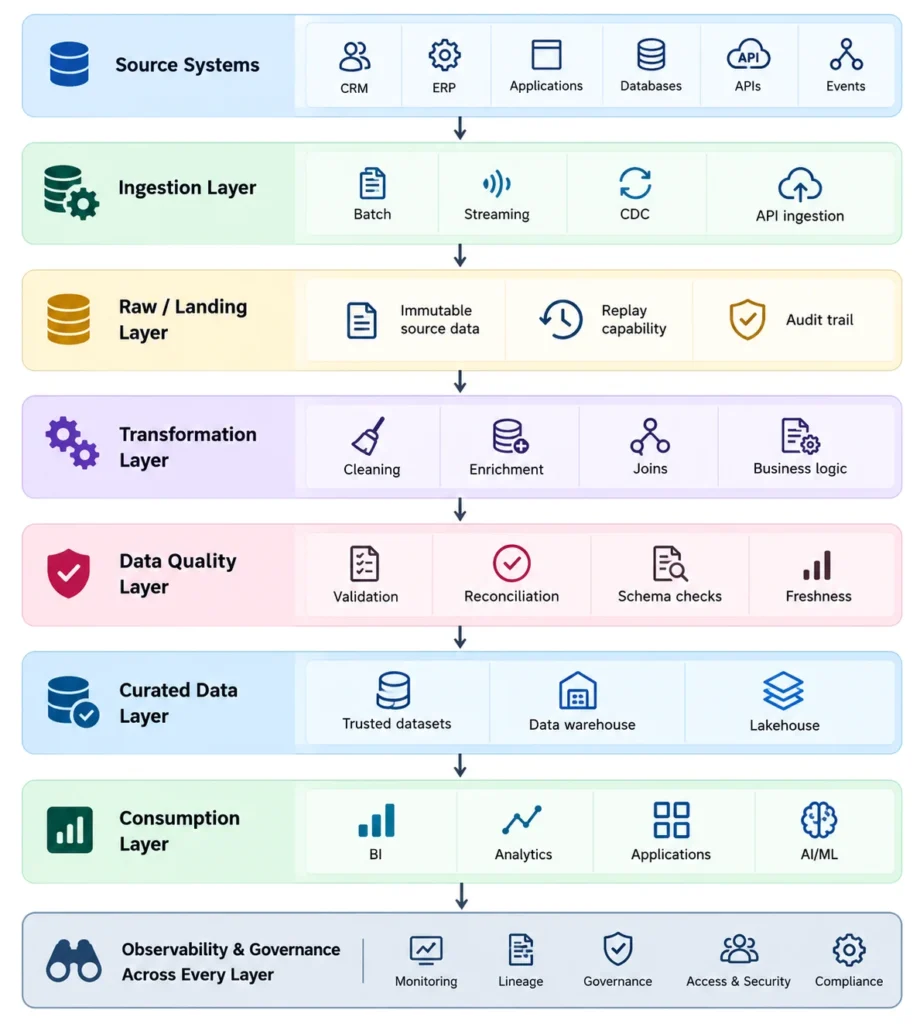
A reliable pipeline is not defined by the number of tools used in it. Instead, it is defined by clear responsibilities at every stage, making it possible to detect, isolate and resolve issues without creating additional problems.
A functional architecture can be illustrated as follows:
The Reliability Controls Enterprise Teams Should Build In
1. Define Data SLAs
Do not simply say that a dataset should be available every day.
Define what that actually means.
For example:
- Inventory data available by 6:00 AM
- Customer events processed within 15 minutes
- Financial data reconciled before reporting
- Critical datasets maintain a defined freshness threshold
This makes it possible to set clear and measurable goals. According to Google’s SRE framework, it is best to set service goals that focus on aspects users truly value, such as the freshness and accuracy of the pipeline.
2. Monitor Data, Not Just Infrastructure
CPU, memory, storage and job status are useful, but they are not enough.
Enterprise data observability should also track:
Freshness: Is the data arriving on time?
Completeness: Did all expected records arrive?
Correctness : Does the output meet business rules?
Volume: Is the data volume behaving normally?
Schema: Has the structure changed?
Lineage: Where did the data come from and what depends on it?
This moves teams from reactive troubleshooting to proactive data pipeline monitoring.
3. Make Recovery Part of the Architecture
Every production pipeline should answer:
“ What happens when this job fails halfway through?”
A good recovery design includes:
- Checkpoints
- Idempotent writes
- Retry policies
- Dead-letter handling where appropriate
- Backfill procedures
- Replayable source data
- Clear runbooks
- Ownership and escalation paths
It shouldn’t be necessary for the original developer to be online at 2 AM to fix or recover a pipeline.
4. Separate Workloads That Scale Differently
Not every dataset requires real-time processing. Some workloads are better handled via batch processing, while others benefit from streaming or Change Data Capture (CDC).
Forcing everything into a single type of architecture can increase costs and complicate operations.
A more important question to consider is:
What freshness does the business actually need?
It is not necessary to use the same pipeline pattern for daily financial reports and real-time fraud detection systems.
A Practical Enterprise Pipeline Reliability Checklist
Before scaling an enterprise data pipeline, engineering teams must be able to answer these questions:
| Area | Questions to Ask |
|---|---|
| Architecture | Can individual components scale or fail independently? |
| Ingestion | Can the pipeline handle late, duplicate, or missing data? |
| Schema | Will upstream schema changes be detected automatically? |
| Transformation | Are business rules version-controlled and tested? |
| Data Quality | Can incorrect data be blocked before reaching consumers? |
| Observability | Are freshness, completeness, volume and correctness monitored? |
| Recovery | Can failed workloads be safely retried or replayed? |
| Governance | Is data ownership and lineage clearly defined? |
| Performance | Can the architecture handle future volume and concurrency? |
| Cost | Can compute and storage costs be measured against workload growth? |
| AI Readiness | Is the data reliable enough for analytics and AI workloads? |
How OpsTree Helps Enterprises Build Reliable Data Pipelines
For enterprises dealing with growing data volumes, fragmented data sources, complex transformations, or unreliable pipelines, the first step is usually not adding another tool.
It is understanding where the existing data architecture is creating operational risk.
OpsTree helps organizations design and modernize data engineering environments across data ingestion, data integration, data processing, cloud data platforms, data quality, analytics and AI-ready data architectures.
The focus is on building data platforms that are scalable, observable, governed, and aligned with the way the business actually uses its data.
If your data engineering team is spending more time fixing pipelines than building new data capabilities, it may be time to rethink the architecture behind them.
Frequently Asked Questions
1. Why do enterprise data pipelines fail at scale?
Enterprise pipelines often face challenges because factors such as data volume, source systems, dependencies, schema changes, transformation complexity, and operational requirements evolve so rapidly that the initial architecture becomes overwhelmed, struggling to handle them effectively.
2. What is the biggest problem with unreliable data pipelines?
The biggest problem is not always a complete pipeline failure. The pipeline might complete successfully, yet still deliver incomplete, outdated, duplicate, or incorrect data to downstream systems.
3. How can enterprises improve data pipeline reliability?
Start by implementing a scalable architecture with well-defined data contracts. Ensure you have automated checks for data quality, idempotent processing, and pipeline observability. Set clear goals for data freshness, maintain lineage tracking, and have well-tested recovery processes in place.
4. What is data pipeline observability?
Data pipeline observability refers to the continuous monitoring of data health and behavior as it moves through its journey, from ingestion to processing, storage, and consumption. It encompasses various aspects such as freshness, volume, completeness, schema changes, quality and lineage.
5. How does data engineering support enterprise AI?
AI systems rely on trustworthy data. Robust data engineering ensures the continuous ingestion, transformation, quality validation, governance, and timely access of datasets essential for analytics, machine learning, and AI applications.
Related Searches
- Top Data Engineering Companies in India In 2026
- Enterprise Data Discovery: Strategy, Tool Selection and DPDP Readiness
- What Is Agentic AI Data Engineering?
- What Is Data Pipeline Architecture? A Complete Guide to Data Pipelines