
Data engineering has long relied on meticulously crafted pipelines, specialized transformations, scheduled workflows, and continuous maintenance. While that approach remains effective, companies today face a vastly different data landscape. Data originates from a wide range of sources, such as applications, APIs, cloud platforms, SaaS systems, databases, documents, event streams, and more and often arrives in diverse formats and at varying speeds.
Agentic AI data engineering brings a flexible new way to automate ETL processes. Instead of strictly adhering to predefined guidelines, an agentic ETL pipeline utilizes AI agents. These agents comprehend data engineering objectives, devise strategies and execute multiple tasks. Furthermore, they interact with data tools, monitor pipeline performance, identify issues related to data or workflows and while ensuring proper governance, either suggest or implement corrective measures.
Enterprises looking into AI data engineering consulting services have an opportunity that goes beyond just automating single ETL tasks. By integrating agentic AI into a broader data platform strategy, you can enhance pipeline development, improve data quality, boost operational efficiency and become more capable of responding rapidly to a changing data landscape.
What Is Agentic AI in Data Engineering?
Agentic AI in data engineering is the use of AI agents that autonomously manage tasks such as planning, creating, executing, monitoring and enhancing data engineering workflows, all with minimal human oversight.
Traditional automation typically follows predefined instructions. An agentic system can work towards a specific outcome and determine the necessary steps to achieve it.
For example, instead of asking an engineer to manually build every stage of the pipeline, an organization could define a requirement like this:
Collect customer transaction data, remove duplicates, verify essential fields, transform the data into an enterprise customer model, and make the prepared dataset available in the analytics warehouse.
An AI agent can understand the objective, examine available metadata and schema, determine necessary changes, construct pipeline logic, verify the results and submit the workflow for human approval.
Pipeline & Data Development
- Pipeline creation
- Transformation generation
- Schema mapping
- Schema evolution
Data Quality & Reliability
- Data quality monitoring
- Anomaly detection
- Root-cause analysis
- Pipeline troubleshooting
Optimization & Governance
- Documentation
- Impact analysis
- Performance optimization
- Cost optimization
The key difference here is that the agent does not merely generate code. It can participate in larger engineering workflows by planning tasks, utilizing available tools, evaluating results, and responding to changing conditions.
Also Read: Top Data Engineering Companies
Key Technologies Used In Agentic AI Data Engineering
AI Agents
AI agents are autonomous systems capable of planning and executing tasks using available tools and workflows. In data engineering, they can understand objectives, break them down into actionable steps, interact with data platforms, and determine when external tools are required.
Natural Language Processing
Natural Language Processing (NLP) enables computers to understand, interpret, and generate human language. In agentic data engineering, NLP allows users to articulate their data requirements in natural language and helps translate those instructions into data engineering tasks.
Machine Learning
Machine Learning (ML) helps systems learn patterns from data and derive predictions or conclusions. In agentic data engineering, ML can assist in detecting anomalies, analyzing data quality, optimizing workloads and making intelligent decisions.
Large Language Models
Large Language Models (LLMs) enable various agentic systems to understand and generate language. They can comprehend data engineering objectives, construct queries or transformations, explain pipeline-related issues and interact with users in natural language.
How AI Agents Automate ETL Pipelines or ETL Workflows
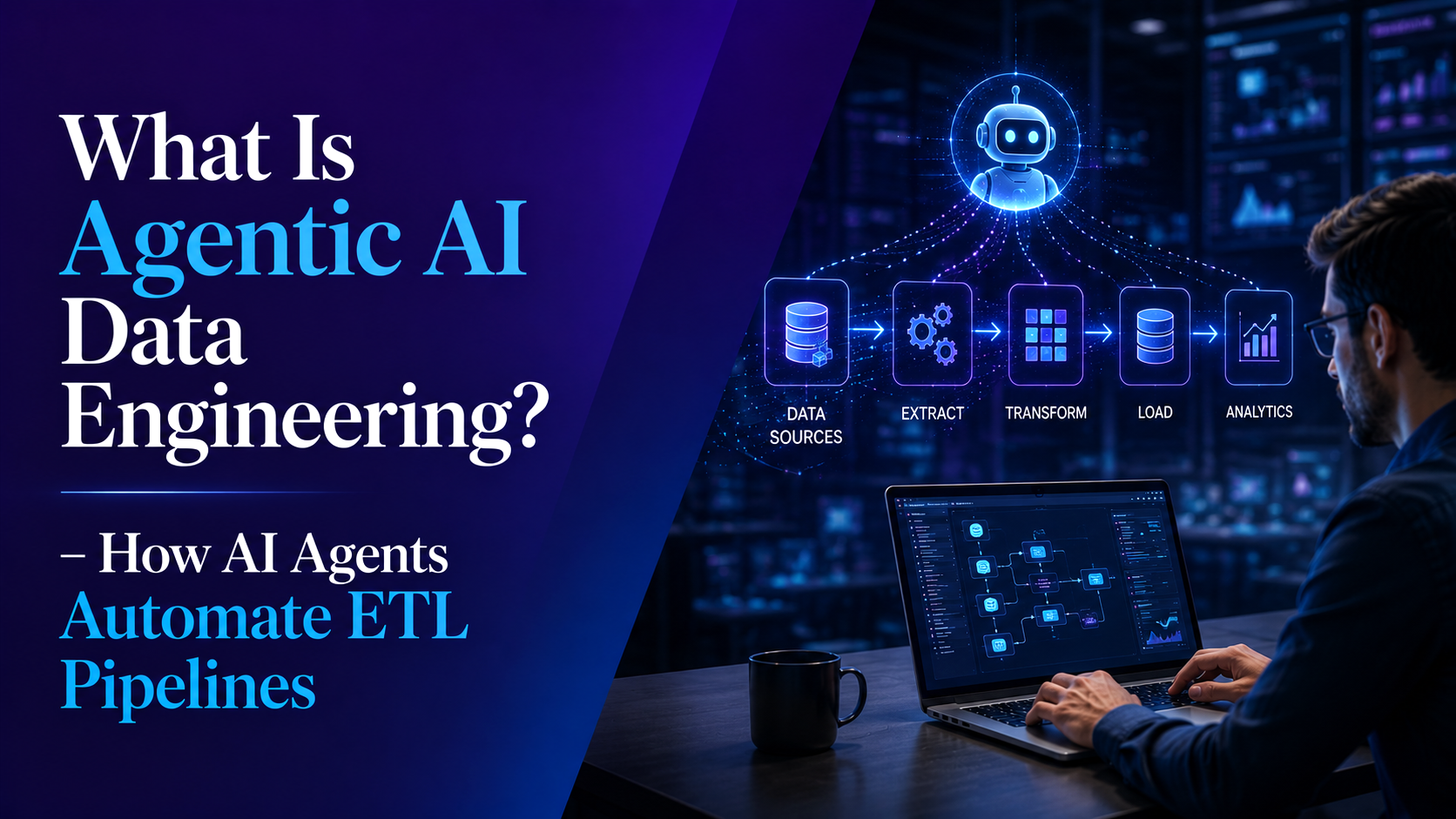
An agentic ETL architecture can operate across several stages of the data lifecycle.
1. Understand the Data Requirement
This journey begins with a clear business or technical objective. An engineer or a designated user defines what the pipeline needs to achieve. The AI agent understands these requirements and assesses the necessary resources and tasks.
Users can start using natural language, while technical staff can refine the input by specifying schemas, APIs, metadata, or specific code requirements.
2. Discover Data Sources
The agent can examine available metadata and identify the relevant databases, APIs, files, streams or other data sources.
Before suggesting an ingestion strategy, it can evaluate schemas, field names, data types, relationships and existing pipeline definitions.
3. Generate the Pipeline
Agents can create pipeline definitions, transformation logic, tests and additional configurations.
In a code-first environment, this means writing code that can be reviewed, rather than embedding logic within a hidden interface. Technologies such as Airflow, Dagster, dbt and other enterprise orchestration and transformation frameworks can be used to build these pipelines.
4. Validate Transformations
Before deployment to production, the system can evaluate the proposed pipeline based on its schema, business rules, existing practices, and expected data quality.
This step is crucial as it establishes a vital control point. High-risk changes should not automatically proceed to production simply because they were generated by an AI agent.
5. Execute the Workflow
Once approved, the pipeline can run on the existing data infrastructure.
Agents can access metadata and perform transformations by interacting with APIs and external tools and select the appropriate processing methods for cloud, on-premises, batch, streaming or hybrid environments.
6. Monitor the Pipeline
After deployment, agents can continuously monitor:
- Pipeline failures
- Schema changes
- Data freshness
- Null-value patterns
- Volume anomalies
- Transformation errors
- Processing time
- Resource utilization
This changes the role of automation from simply executing a workflow to continuously observing its behavior.
7. Diagnose and Remediate Problems
When something goes wrong, the agent can check dependencies, examine logs and metadata, identify potential causes, and suggest remedial actions.
For low-risk scenarios, organizations can authorize automated remediation, such as rerunning failed tasks or modifying processing configurations. For high-impact changes, the agent should propose a remedy and require human approval.
Traditional ETL vs Agentic AI Data Engineering
The biggest difference is how the pipeline responds when conditions change.
| Traditional ETL | Agentic AI Data Engineering |
|---|---|
| Follows predefined workflows | Works toward defined objectives |
| Engineers manually define most transformations | Agents can generate or recommend transformations |
| Schema changes often require manual updates | Agents can detect and analyze schema changes |
| Quality rules are primarily predefined | AI can identify patterns and anomalies |
| Failures typically trigger alerts | Agents can investigate and recommend remediation |
| Pipeline optimization is often manual | Agents can analyze performance and suggest improvements |
| Documentation requires manual maintenance | Agents can generate and update documentation |
| Human engineers handle most troubleshooting | Agents can automate selected troubleshooting tasks |
| Scaling decisions are often rule-based | AI can use workload patterns for optimization |
| Automation is mostly deterministic | Automation can be adaptive within defined guardrails |
Benefits of Autonomous AI in Data Pipelines
Faster Pipeline Development
AI agents can create pipeline structures, transformations, tests and documentation based on high-level requirements. This reduces repetitive development work for data engineers.
Better Response to Schema Evolution
Instead of detecting schema changes after a production job fails, agents can monitor the source structure, assess downstream impacts, and suggest changes before the issue escalates.
Improved Data Quality
Agents can profile data, detect anomalies, create validation checks, and continuously monitor quality. This makes data quality an integral part of the operating process rather than a separate manual task.
Lower Operational Overhead
The engineering team can spend a significant amount of time on day-to-day troubleshooting, documentation, monitoring and maintenance. Automating certain tasks frees up time and capacity for engineers to work on architecture and more critical data initiatives.
Better Pipeline Performance
Agents can analyze execution time, resource usage, throughput and dependencies to identify bottlenecks and suggest optimization opportunities.
Faster Business Access to Data
With governed self-service capabilities, business users can describe the datasets or data workflows they need without waiting for every basic request to be implemented manually by a data engineering team.
Scalable Data Operations
As organizations add data sources and pipelines, agentic automation can help manage the increasing operational workload. Agents can build, monitor, and maintain pipelines, while engineers remain responsible for governance and architecture.
How OpsTree Can Help With Agentic AI Data Engineering
For enterprises considering agentic AI data engineering services, the top priority should be understanding where AI agents can create measurable value within the existing data environment.
At OpsTree Global, our expertise in AI and data engineering is designed to help organizations modernize their data pipelines, implement AI-driven automation, optimize data processing workflows, and develop scalable enterprise data platforms. Where traditional automation suffices, instead of simply adding AI, it is essential to focus on actual engineering challenges, ranging from pipeline automation and data integration to governance, observability, security, and operational efficiency.
For enterprises looking to modernize their AI data pipelines, adopting an engineering-based strategy enables the identification of high-value workflows, the design of suitable agent architectures, the establishment of governance controls, the integration of existing data platforms and the incremental implementation of solutions.
Conclusion
Agentic AI is making data engineering more adaptive by helping AI agents design, automate, monitor, and improve ETL workflows. By combining traditional data engineering with intelligent automation, enterprises can improve data quality, reduce pipeline maintenance, and respond faster to changing data needs. With the right governance and human oversight, agentic AI data engineering consulting, AI data pipeline modernization services and enterprise AI agent ETL pipeline implementation can help businesses build more efficient and future-ready data platforms.
Related Searches
- A Leading Logistics Platform Achieved 30% Faster Incident Resolution with AI-Driven Observability
- Driving 40% Faster Resolution with AI Across One of Asia’s Largest Digital Businesses
- 3× Faster Issue Resolution Through Smarter Operational Intelligence