
Is Your Business Growing Faster Than Your Data Strategy?
Every growing organization reaches a point where success creates an unexpected challenge – its data becomes difficult to manage.
What starts as a few business applications quickly evolves into dozens of systems supporting sales, finance, operations, customer engagement, marketing and supply chain functions. Each system generates valuable information, but very little of it is connected.
As a result, organizations often find themselves asking simple questions that have surprisingly complicated answers:
- Why do finance and sales report different revenue numbers?
- Why does preparing a weekly management report take two days?
- Why are dashboards slow when everyone needs them the most?
- Why are analysts spending more time preparing data than analyzing it?
The problem isn’t a lack of data.
The problem is fragmented data.
The Hidden Cost of Fragmented Data
Most organizations don’t notice fragmentation when they’re small.
As the business grows, new applications are introduced, departments purchase specialized software, cloud platforms expand and reporting requirements become more sophisticated.
Over time, data begins to exist in multiple places:
- CRM platforms
- ERP systems
- E-commerce applications
- Finance systems
- Marketing tools
- Customer support platforms
- Third-party APIs
- Operational databases
Each system becomes a source of truth for one department, but not for the business as a whole.
Eventually, the organization reaches a stage where leadership spends more time validating numbers than making decisions.
Common Symptoms of a Fragmented Data Environment
Organizations facing this challenge often experience similar operational issues:
Multiple Versions of the Same Report
Sales, finance and operations generate reports independently, often producing conflicting numbers for the same business metric.
Manual Data Preparation
Analysts export spreadsheets from multiple systems, clean the data manually and combine it before any meaningful analysis can begin.
Slow Reporting Cycles
Business reports that should be available in minutes take hours or even days to prepare.
Limited Business Visibility
Executives struggle to obtain a unified view of business performance because information is distributed across disconnected systems.
Increasing Infrastructure Costs
As data volumes grow, inefficient processing and reporting workloads consume more cloud resources than necessary.
Declining Confidence in Data
When stakeholders encounter inconsistent numbers, confidence in analytics decreases, leading teams to rely on intuition rather than evidence.
Why Traditional Reporting Approaches Stop Working
Many organizations attempt to solve reporting problems by building additional dashboards or hiring more analysts.
Unfortunately, neither approach addresses the root cause.
A dashboard is only as reliable as the data powering it.
If the underlying data is fragmented, inconsistent, or delayed, visualization tools simply display those same problems more quickly.
The real solution lies in modernizing the data platform itself.
What Is a Modern Data Platform?
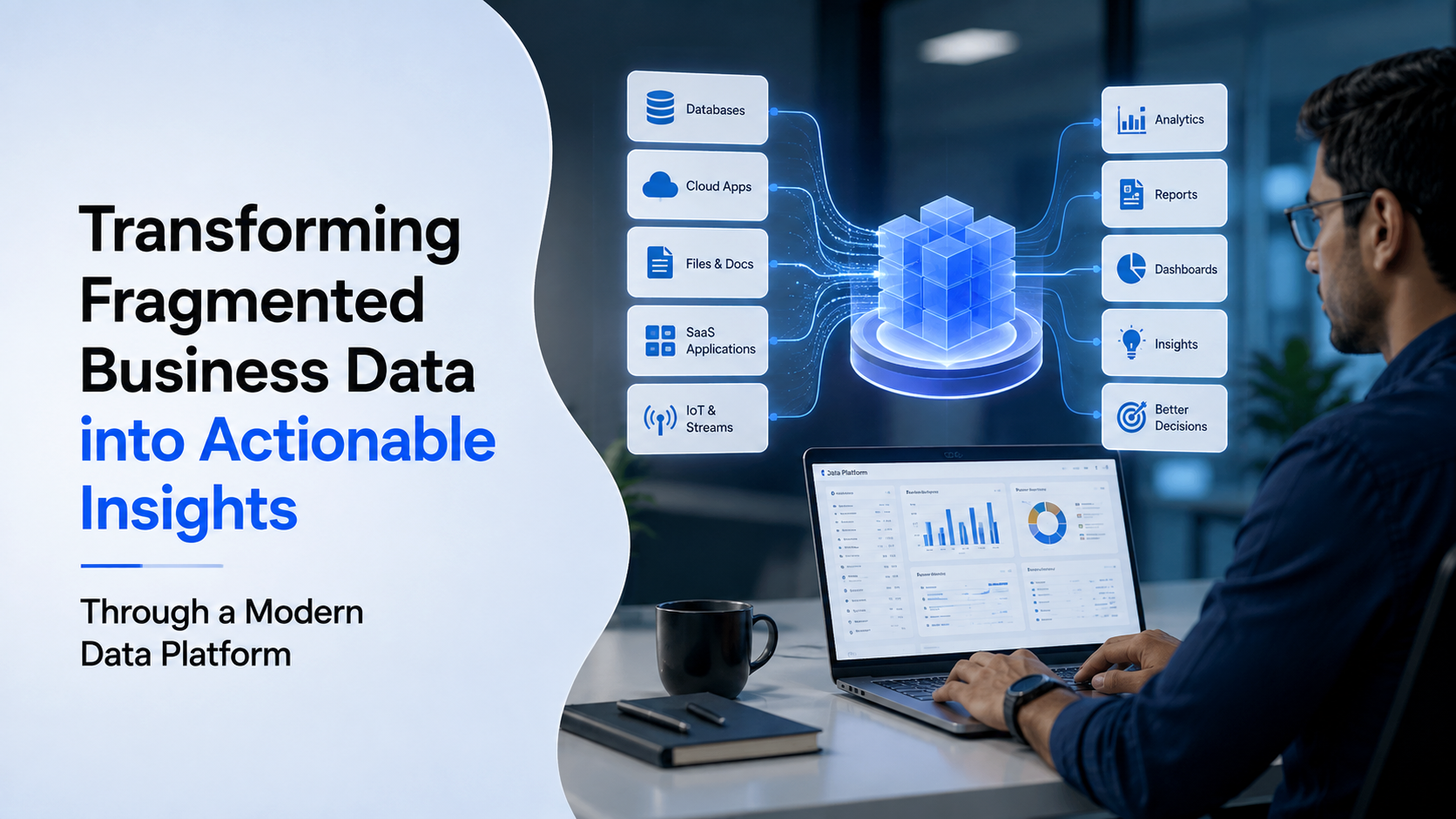
A modern data platform creates a single, trusted foundation where data from every business system is collected, standardized, governed, and transformed into analytics-ready information.
Rather than moving from application to application to answer business questions, decision-makers access consistent, curated data from one centralized environment.
A typical modern data platform includes:
- Automated data ingestion from multiple systems
- Centralized cloud-based storage
- Scalable ETL and data transformation pipelines
- Curated business-ready datasets
- Real-time dashboards and analytics
- Automated monitoring and data quality validation
This architecture enables organizations to spend less time preparing data and more time using it.
Building the Foundation for Better Decisions
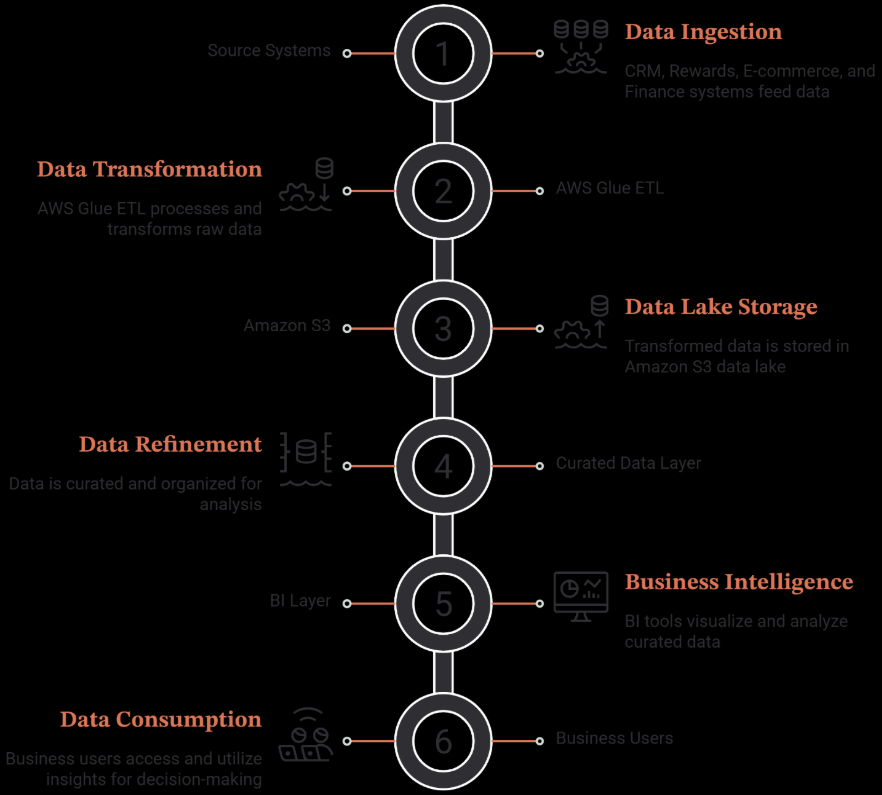
Modern data platforms generally evolve through six stages.
1. Data Ingestion
Business data is automatically collected from operational systems rather than manually exported.
This reduces manual effort while ensuring consistent and timely data availability.
2. Centralized Data Storage
Raw information is consolidated into a secure, scalable cloud repository where historical and current data coexist.
This creates a single source of truth for the organization.
3. Data Transformation
Business rules, validations, cleansing and enrichment processes convert raw information into standardized datasets that can be trusted across departments.
4. Data Refinement
Curated datasets are optimized specifically for reporting, analytics and decision-making.
Rather than every team building its own reports, everyone works from the same trusted business definitions.
5. Business Intelligence
Dashboards, KPIs, and analytics tools consume curated datasets to deliver meaningful business insights in near real time.
6. Monitoring and Governance
Automated validation, monitoring, and alerting ensure data quality while identifying issues before they impact business users.
Business Benefits Beyond Better Reporting
Organizations often begin modernization projects with the goal of improving reporting performance.
However, the benefits extend far beyond dashboards.
A modern data platform enables organizations to:
- Improve decision-making with trusted, timely information
- Reduce manual reporting effort
- Eliminate duplicate data preparation across teams
- Increase confidence in business metrics
- Scale analytics as the organization grows
- Reduce cloud infrastructure waste through optimized processing
- Support AI and predictive analytics initiatives using high-quality data
Most importantly, it transforms data from a technical asset into a business asset.
Architecture
A Practical Transformation Journey
One organization facing these challenges modernized its reporting environment by implementing a cloud-native data platform.
The initiative focused on:
- Integrating multiple operational systems into a centralized data platform
- Automating data ingestion and transformation processes
- Establishing a single source of truth for enterprise reporting
- Delivering business-ready datasets for analytics
- Automating monitoring and governance across the platform
The results included:
- 75% reduction in manual reporting effort
- 90% improvement in report generation time
- 60% faster access to business insights
- A single trusted source of data across reporting teams
These outcomes demonstrate that improving analytics is not simply about implementing better dashboards—it starts with building a stronger data foundation.
The Future Belongs to Data-Driven Organizations
As organizations continue to grow, the complexity of their data environments will only increase.
Businesses that continue relying on disconnected systems, manual reporting, and inconsistent metrics will struggle to make timely, informed decisions.
Those that invest in modern data platforms gain something far more valuable than faster reports.
They gain the ability to trust their data, respond to change quickly, and make decisions with confidence.
In today’s competitive landscape, that capability is no longer optional, it is a strategic advantage.
Frequently Asked Questions
1. What is a modern data platform?
A modern data platform centralizes data from multiple business systems, automates data processing, and provides trusted datasets for analytics and decision-making.
2. When should an organization modernize its data platform?
Common indicators include slow reporting, inconsistent business metrics, rising cloud costs, manual reporting processes, and limited scalability.
3. Does every organization need a data lake?
Not necessarily. The right architecture depends on business goals, existing systems, data volumes, governance requirements, and reporting needs.
4. What business outcomes can organizations expect?
Organizations typically aim to reduce manual reporting effort, improve decision-making speed, enhance data quality, optimize infrastructure costs, and increase confidence in analytics.
Related Searches
- A Leading Logistics Platform Achieved 30% Faster Incident Resolution with AI-Driven Observability
- Driving 40% Faster Resolution with AI Across One of Asia’s Largest Digital Businesses
- 3× Faster Issue Resolution Through Smarter Operational Intelligence