

Table of Contents
Introduction
Generative AI assistants are every where, but most still stop at talking instead of doing.
Amazon Q, AWS’s generative AI assistant, is already powerful at answering questions , writing code, and guiding developers. But when paired with Model Context Protocol (MCP) servers, Amazon Q evolves from a helpful chatbot into an actionable , enterprise-grade AI assistant that can interact with real systems, APIs, and workflows.
In this post, we’ll explore how Amazon Q and MCP servers work together and how you can use them to build smarter, more autonomous AI experiences.
What Is Amazon Q?
Amazon Q is AWS’s generative AI assistant designed for:
- Developers (Amazon Q Developer)
- Cloud operators
- Business and enterprise users
It helps with:
- Writing and reviewing code
- Understanding AWS architectures
- Troubleshooting infrastructure
- Querying enterprise data securely
Unlike generic AI tools, Amazon Q is deeply integrated into AWS, respects IAM permissions, and operates securely within your environment.
The Problem with AI Assistants Today
Most AI assistants:
- Generate text
- Explain concepts
- Suggest solutions
But they can’t directly interact with your systems.
That’s where MCP (Model Context Protocol) comes in.
What Is MCP (Model Context Protocol)?
MCP is an open protocol that standardizes how AI models connect to external tools and services.
An MCP server acts as a controlled gateway between the AI model and the real world.
It can expose:
- APIs
- Scripts
- Databases
- Cloud services
- Internal enterprise tools
MCP enables AI assistants to:
- Discover tools dynamically
- Call functions safely
- Exchange structured data
Why MCP Is a Perfect Match for Amazon Q
- Amazon Q is great at reasoning.
- MCP servers are great at execution.
- Together, they form a complete AI system.
Key Benefits
Real Actions, Not Just Answers
Amazon Q can trigger workflows, fetch live data, and perform operations.
Enterprise-Grade Security
MCP servers enforce validation, authentication, and authorization.
Modular Architecture
Add new tools without retraining models.
Standardized Tooling
Avoid fragile, custom integrations.
High-Level Architecture
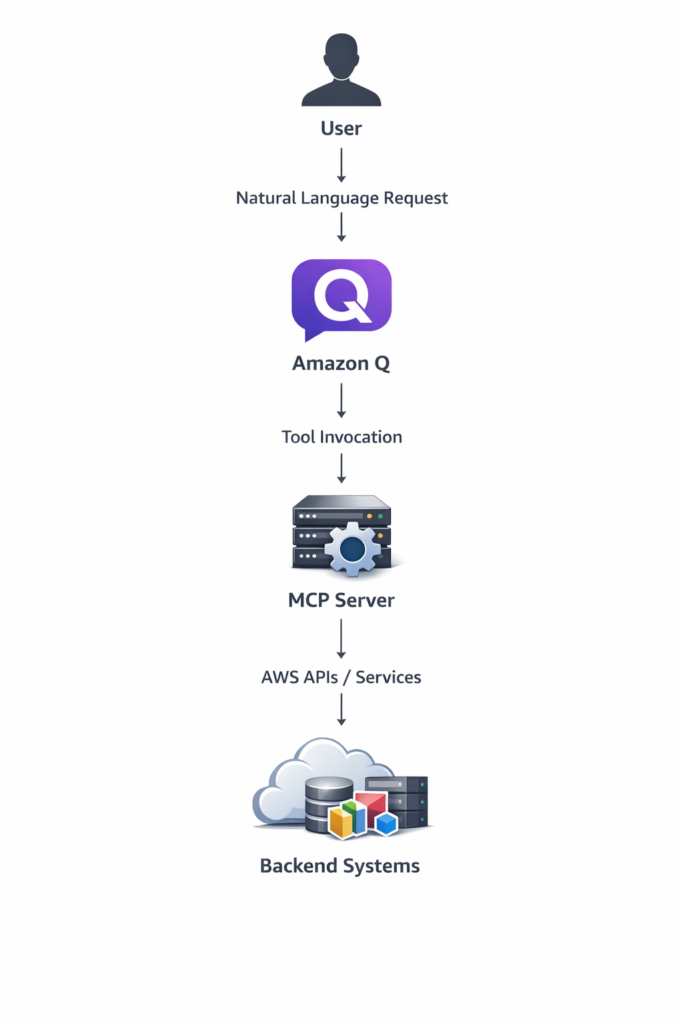
- Amazon Q decides when to call a tool.
- MCP decides how that tool is executed
Real-World Example: Cloud Cost Intelligence
User asks Amazon Q:
“Why did my AWS bill spike last month, and what should I optimize?”
What Happens Next?
- Amazon Q understands the intent
- It calls an MCP tool like
get_cost_breakdown - MCP server:
- Queries AWS Cost Explorer
- Returns structured data
4. Amazon Q:
- Explains the spike
- Suggests cost-optimization steps
- Generates a remediation plan
Now the AI is data-driven, not speculative.
Building an MCP Server (Concept)
An MCP server typically includes:
- Tool definitions
- Input schemas
- Execution logic
- Security controls
Example Tool Definition
{
  "name": "list_idle_ec2_instances",
  "description": "Returns EC2 instances with low CPU utilization",
  "input_schema": {
    "type": "object",
    "properties": {
      "days": {
        "type": "number"
      }
    }
  }
}
Behind the scenes, the MCP server translates this into AWS SDK calls and returns structured JSON.
Integrating MCP Servers with Amazon Q
Key Integration Steps
1. Deploy the MCP server
- Lambda, ECS, EKS, or EC2
2. Expose tools securely
- HTTPS + authentication
3. Describe tools clearly
- Accurate schemas help Amazon Q choose the right tool
4. Map responses
- Return structured, machine-readable data
5. Enforce permissions
- Use IAM roles and least-privilege access
Security Best Practices
- Run MCP servers in private VPCs
- Validate all inputs
- Log every tool invocation
- Restrict IAM permissions
- Never expose raw credentials
Security is what makes MCP viable for enterprises.
Best Practices for Production
- Keep tools small and focused
- Prefer JSON outputs
- Avoid long synchronous executions
- Version your tools
- Cache frequently requested data
Why This Matters
When combined, Amazon Q + MCP servers unlock:
- Autonomous DevOps assistants
- Intelligent cloud governance
- Secure enterprise copilots
- AI-driven operational workflows
This isn’t just chat-based AI, it’s AI that acts.
Final Thoughts
Amazon Q gives you the brain.
MCP servers give you the hands.
Together, they allow you to build AI assistants that don’t just answer questions, but take meaningful, secure actions inside your cloud and enterprise systems.
If you’re building the next generation of AI-powered tools on AWS, MCP is the missing link.
Related Searches
- AWS DevOps Agent: A Complete Guide to AI-Powered Cloud Automation
- Top AWS Consulting Partner in India
- Streamline Your Business with n8n