
AWS cloud environments offer scalability and flexibility, however, default configurations can lead to security vulnerabilities, performance bottlenecks and unnecessary infrastructure costs. From excessive IAM permissions and publicly accessible resources to unmanaged workloads and unverified backups, even minor configuration flaws can pose significant risks to an enterprise.
Most AWS incidents and most slow systems, trace back to the same root cause: defaults.
- The default VPC puts everything in a public subnet with a routable IP.
- Security groups ship open and stay open.
- Backups exist but have never once been restored.
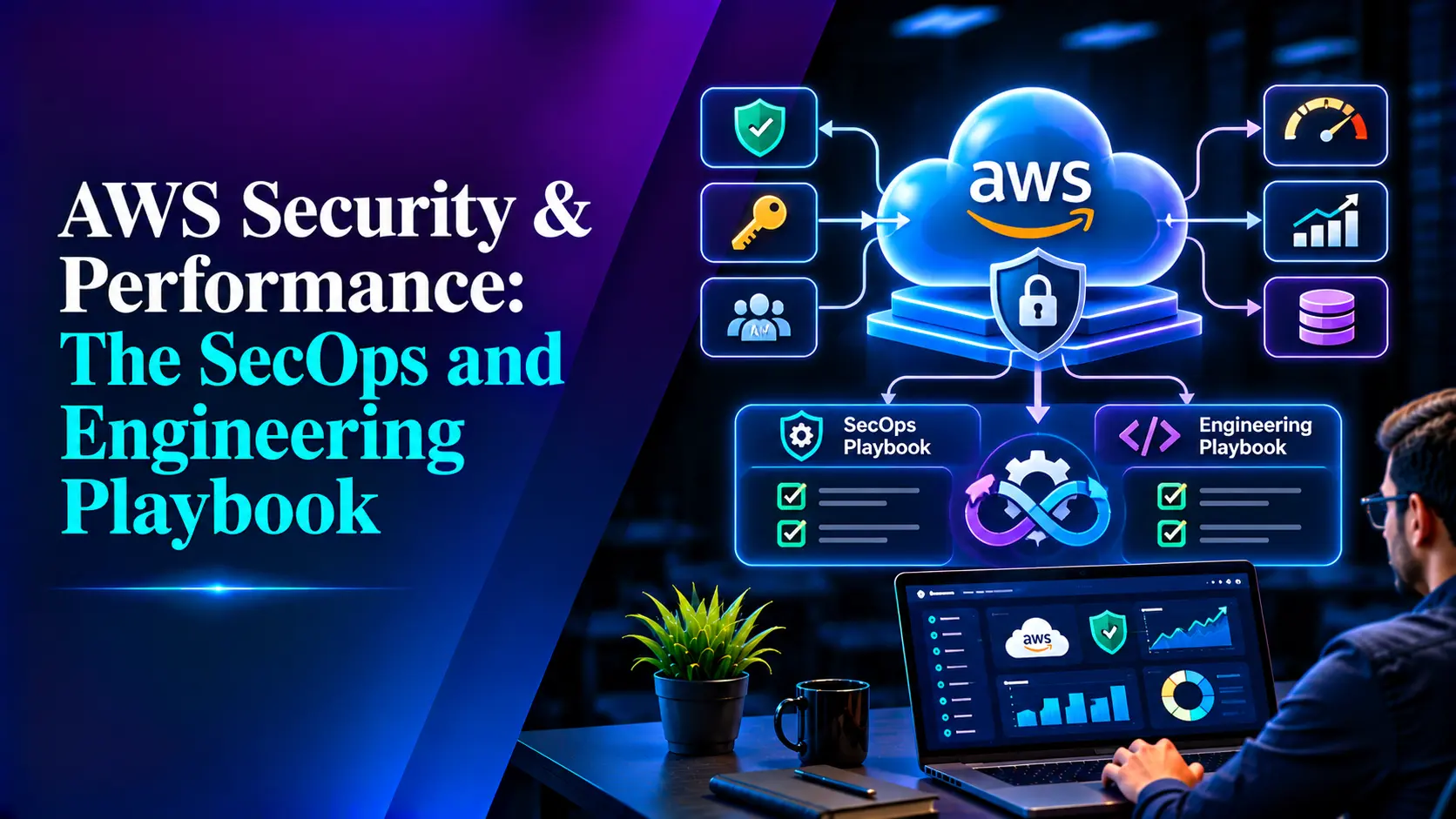
Defaults exist to get you from zero to a running workload in ten minutes. They’re a starting point, not a posture. This playbook covers the operating discipline , identity, network, encryption, detection, incident response, and the engineering practices that keep systems fast while staying safe.
The unifying theme: in AWS, safety and speed are not a trade-off. Most of the controls worth enabling also remove cost, because risk and waste concentrate in the same place — things you forgot you were running.
Cost-focused optimization is covered in our companion post: “AWS Cost Optimization: The Complete FinOps Playbook.”
Identity: Roles, Not Keys
- Delete all IAM user access keys. Humans federate through IAM Identity Center; workloads assume roles. Static keys are the single most common path from a leaked repo to a live incident.
- Scope policies to specific resources and actions. A * in a production policy is a finding, not a shortcut.
- Enforce org-wide guardrails: permission boundaries on roles, and SCPs that deny non-approved regions and expensive instance families — a security control that doubles as a cost control.
Network: Private by Default
- The default VPC is for tutorials. Build real subnets: private for workloads, public only for load balancers.
- No bastion hosts, no SSH keys. Use SSM Session Manager instead — no open port 22, no key sprawl, every session logged to S3/CloudWatch. It also deletes an EC2 instance you were paying $10–30/month to keep around as a jump box.
- Security groups should default-deny, and reference by security group name, not CIDR, so rules stay correct as infrastructure changes underneath them.
Encryption: Before It Matters
- RDS encryption can only be enabled at creation – you cannot retrofit a live database. Plan it at provisioning, or pay for a snapshot-copy-restore migration later.
- S3 Block Public Access at the account level – one setting blocks every current and future bucket from ever going public.
- Use SSE-KMS for sensitive data and SSE-S3 for the rest And enable S3 Bucket Keys, same security posture, up to 99% fewer KMS requests, lower cost and lower latency. A rare setting that’s strictly better with no trade-off.
Also Read: Migrating from On-Prem to AWS with Enhanced Observability, Security, and Cost Optimization
Logging: One Trail, One Place
- A single org-wide CloudTrail (the first copy of management events is free) writing to a centralized, write-protected logging account. Per-account trails are how evidence gets lost.
- Set retention on every CloudWatch log group – 30 -90 days hot, then archive. The default of never expiring is a growing bill and a compliance liability at the same time.
- Centralized logs are also your cost-forensics foundation: every surprise charge has an API call behind it, and that call is sitting in the trail.
Detection: Turn It On
- GuardDuty on every account , it analyzes the CloudTrail, VPC flow, and DNS logs you’re already centralizing.
- Security Hub with the AWS Foundational Security standard as the score to drive toward zero.
- Route findings to a channel people actually watch , Slack or PagerDuty , not an inbox nobody reads.
Patching & Secrets on Rails
- SSM Patch Manager with maintenance windows, so patch state is a reported metric rather than a quarterly surprise.
- Secrets Manager with rotation for database credentials. Hand-rotated credentials don’t get rotated, they get a calendar reminder that’s ignored for eleven months.
Backups: An Unrestored Backup Is Just a Hope
- AWS Backup with cross-account and cross-region copies. Cross-account is the line that actually matters against ransomware, it strips the compromised account of any ability to delete its own backups.
- Quarterly restore tests into a scratch VPC. The test is the backup , anything else is unverified.
Incident Response: Decide Before the Incident
Keep a one-page runbook per scenario, a compromised key, an exposed bucket, a cryptomining instance, with pre-staged actions: who revokes access, who snapshots for forensics, who isolates the network interface.
During an incident is the wrong time to design incident response. And worth noting: cryptomining is a FinOps incident as much as a security one, the first symptom is almost always the bill.
Performance: Speed Is Cheap When It’s Designed In
- Cache before you scale. CloudFront for HTTP, ElastiCache for reads, RDS Proxy for chatty applications. Serving from cache costs next to nothing compared to spinning up another app server and another database connection.
- Target-tracking autoscaling, not step policies. Scale on a metric that represents actual user pain — latency, queue depth, not raw CPU. Step policies on CPU guarantee you scale after users have already noticed.
- Database connection storms are the invisible killer. Every instance opens its own pool, the database hits max_connections, and everything times out right at peak. RDS Proxy or app-level pool limits fix the exact problem that scaling the app tier makes worse.
- Latency is a placement decision. Co-locate app and database AZs, use gp3 provisioned throughput where the workload is disk-bound, and measure p95/p99, never averages – an average hides every problem worth finding.
- Observability drives capacity. The teams with the best cost-performance curves are the ones with the fastest feedback loop between “a metric moved” and “infrastructure changed.”
The Cross-Domain Wins
These decisions pay off in security, performance, and cost simultaneously, prioritize them above any single-domain fix:
| Decision | Security | Performance | Cost |
|---|---|---|---|
| SSM Session Manager, kill the bastion | No open port 22, sessions logged | Faster incident access | −1 EC2 instance |
| Private subnets, no auto-assign public IP | Massively reduced attack surface | — | −$3.65/mo/instance |
| CloudFront in front of origin | Shield Standard + WAF + TLS | Global edge caching | Cheaper egress |
| Gateway VPC endpoints | Traffic stays on the AWS backbone | More consistent latency | NAT fees → $0 |
| Delete idle assets | Smaller exposure surface | Cleaner inventory | Direct savings |
| Centralized CloudTrail | Evidence preservation | — | Cost forensics |
| Autoscaling (target tracking) | Smaller steady-state footprint | Scales ahead of pain | Pay for load, not peak |
| RDS Proxy / connection pooling | — | Kills connection storms | Fewer DB connections billed |
The pattern to notice: risk and waste concentrate in the same place, the things nobody remembers is still running. Delete it, lock it down, or monitor it; every one of those moves is both safer and cheaper.
The Priority List
| # | Action | Effort | Why first |
|---|---|---|---|
| 1 | Org-wide CloudTrail → centralized logging account | 1 hr | Management events are free; foundation for everything else |
| 2 | Root MFA, zero root access keys, Identity Center | 30 min | Cheapest risk reduction available on the platform |
| 3 | S3 Block Public Access, account level | 10 min | One setting, every bucket, forever |
| 4 | GuardDuty + Security Hub on all accounts | 1 hr | Detection on logs you’re already collecting |
| 5 | Kill bastions → SSM Session Manager | Half-day | Security win and a deleted instance |
| 6 | Delete all IAM access keys → roles | Ongoing | Closes the #1 breach path |
| 7 | Secrets Manager rotation for DB credentials | 1 day | Hand-rotation simply doesn’t happen |
| 8 | Retention on all CloudWatch log groups | 30 min | Fixes the bill and a compliance gap at once |
| 9 | AWS Backup with cross-account copies | Half-day | Survives a compromised account |
| 10 | Quarterly restore test | Half-day / quarter | Turns backups from a hope into a system |
| 11 | RDS Proxy on chatty applications | 1 day | Kills connection storms |
| 12 | p95/p99 dashboards, retire the averages | Ongoing | Averages hide every real problem |
The Bottom Line
AWS doesn’t have a security problem or a performance problem, it has a defaults problem. The well-run cloud environment isn’t the one with the most sophisticated tooling; it’s the one where every trail is centralized, every key is a role, every mode is chosen deliberately, and every backup has actually been restored once.
That operational surface is too wide to watch by hand, which is why we built UnitEconPro: continuous inventory ingestion, drift detection on every control worth having, and change tracking that tells you who changed what, when, and what it cost. Because in a well-run account, the security story and the cost story are the same story.
Related Searches
- Top AWS Consulting Partner in India 2026
- AWS For Beginners: What Is It, How It Works, and Key Benefits
- AWS DevOps Agent: A Complete Guide to AI-Powered Cloud Automation