
Enterprise data teams are expected to deliver accurate data rapidly, while simultaneously managing increasingly complex data pipelines, cloud infrastructure and analytics workloads. However, engineers still spend a significant amount of time fixing pipeline failures, resolving data quality issues, updating transformations and maintaining legacy ETL processes.
This is where Agentic AI comes into play, offering a revolutionary solution to these persistent challenges. Unlike traditional methods, which rely heavily on pre-defined automation rules, AI agents can intelligently analyze pipeline data, identify potential issues, suggest corrective measures and execute approved tasks within established parameters.
For enterprises, the goal is not merely to automate data engineering – rather, the objective is to enhance the reliability of data pipelines, reduce repetitive engineering tasks, streamline cloud data operations and build a robust foundation for AI-driven initiatives.
This guide explores practical applications of agentic AI in enterprise data engineering, discusses the challenges associated with its implementation, and provides a clear roadmap for its secure adoption.
What Is Agentic AI in Enterprise Data Engineering?
In enterprise data engineering, agentic AI refers to AI agents capable of understanding a defined objective, gathering necessary context, planning tasks and interacting with data systems to execute established workflows.
These agents can assist with data ingestion, ETL/ELT development, data quality monitoring, schema change management and pipeline troubleshooting.
For example, when the schema of a source database changes, a traditional pipeline might fail and trigger an alert. An AI agent can examine execution logs, compare schemas, identify the affected transformations and suggest an appropriate solution. Following validation and the receipt of necessary approvals, this change can then be implemented.
The key difference is that traditional automation follows pre-defined instructions, whereas agentic AI can determine the next best step by using context.
Why Enterprises Are Adopting Agentic AI for Data Engineering
Managing enterprise data environments is becoming increasingly complex, as organizations aggregate data from diverse sources such as databases, APIs, CRM and ERP systems, cloud warehouses and streaming applications.
Three challenges make agentic AI particularly relevant:
- Pipeline maintenance – Engineers spend a significant amount of time fixing recurring faults and resolving day-to-day issues, which leaves them with less scope to innovate or create new data products.
- Data quality and reliability – Issues such as missing records, schema changes, and inconsistent transformations can have a detrimental impact on business reporting and AI-based applications.
- Cloud data costs – Infrastructure costs can increase significantly due to inefficient queries, excessive processing and misconfigured computing resources.
Agentic AI addresses these challenges by linking operational context with controlled and automated tasks. Its success depends on high data quality, effective system integration, and robust security measures established by the engineering team.
6 Practical Use Cases of Agentic AI in Enterprise Data Engineering
1. Self-Healing Data Pipelines
AI agents can analyze failed pipeline runs by closely examining logs, upstream dependencies and recent changes. Once they identify known failure patterns, they can suggest or even execute , approved actions, such as retrying a job or initiating a targeted backfill.
Business Result – Faster incident resolution, less manual troubleshooting and improved data pipeline reliability.
2. Automated ETL and ELT Development
AI agents can simplify and streamline the process of creating SQL, Python, transformation logic, validation tests and pipeline documentation based on defined requirements. Engineers can review the code before deploying it to production.
Business Result – Faster pipeline development and reduced repetitive coding effort.
3. Intelligent Data Quality Monitoring
Agents can monitor aspects such as data freshness, completeness, duplicate entries, unexpected values and schema consistency. When an issue arises, they can identify its root cause and suggest measures to resolve it.
In the case of sensitive business data, corrective measures must follow established protocols, data should not be altered or missing values added in an arbitrary manner.
Business Result – Earlier detection of data quality problems and more reliable analytics.
4. Schema Drift Detection and Management
Changes made to source applications can disrupt downstream transformations and reports. AI agents can detect discrepancies in schemas, assess affected dependencies, and suggest relevant updates for engineers to consider.
Business Result – Fewer avoidable pipeline disruptions and more controlled schema evolution.
5. Metadata and Data Lineage Management
Agents can help provide details about datasets, ownership information and metadata, as well as documentation regarding lineage (the source and flow of data). This support assists engineering and analytics teams in understanding where data originates and which systems depend on it.
Business Result – Better data discovery, easier impact analysis and stronger data governance.
6. Cloud Data Cost Optimization
AI agents can examine query history, processing time, storage usage and compute utilization to identify shortcomings. They can suggest query improvements, resource reallocation and better processing schedules.
Business Result – Opportunities to reduce cloud data costs while maintaining performance and data delivery commitments.
How Agentic AI Fits Into an Enterprise Data Architecture
Agentic AI should complement existing data infrastructure, rather than replace established systems for data processing and orchestration.
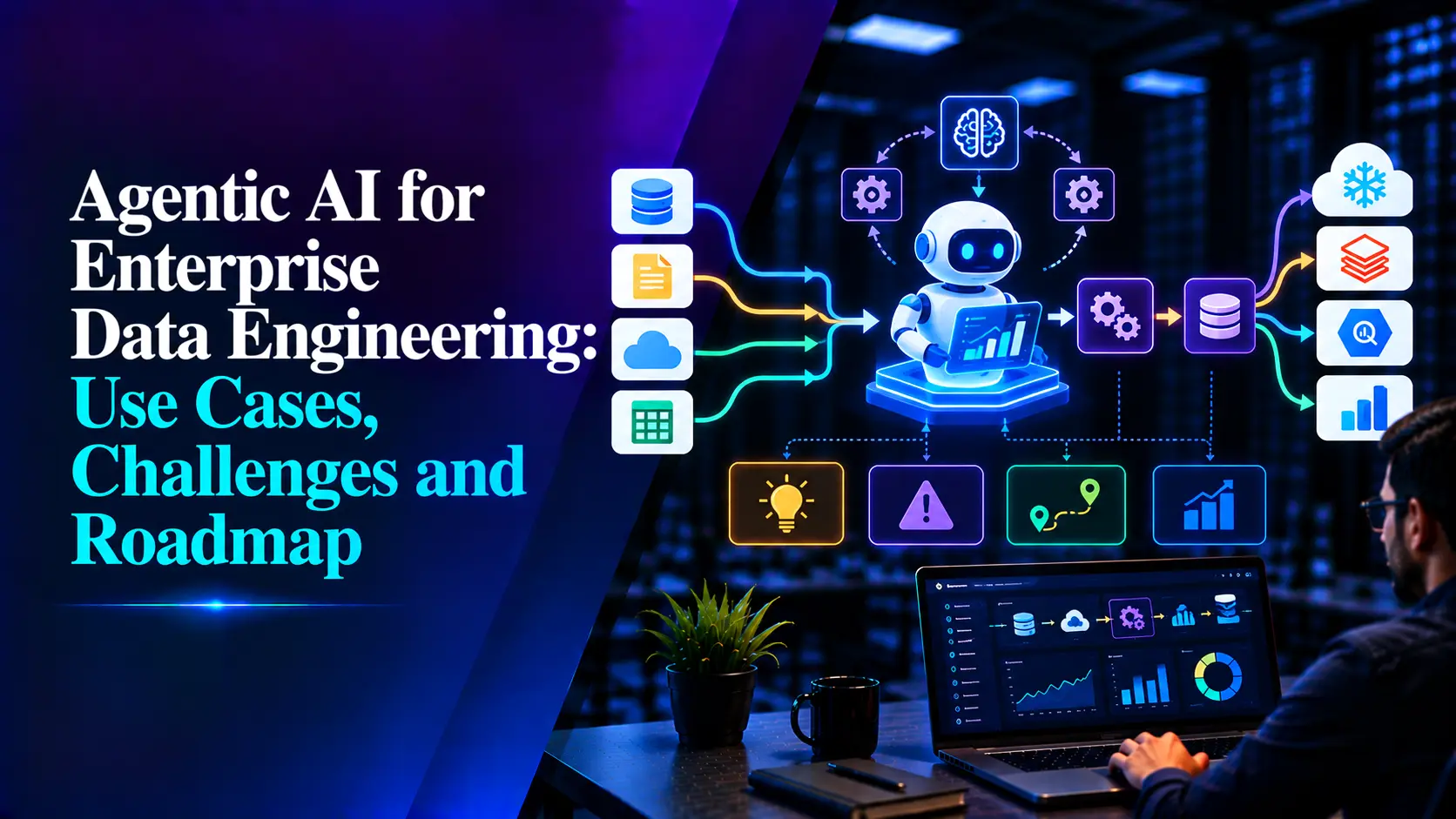
A practical enterprise architecture includes:
- Source systems: Databases, CRM, ERP, APIs and event streams.
- Data ingestion and processing: Batch pipelines, streaming, CDC and ETL/ELT transformations.
- Orchestration: Workflow scheduling, dependency management and job execution.
- Metadata and observability: Data catalogs, lineage, execution logs and quality metrics.
- Agentic AI layer: Agents investigate issues, plan actions, generate changes and interact with approved tools.
- Governance and control: Access permissions, validation, human approvals, audit logs and rollback procedures.
- Business consumption: Analytics, reporting, machine learning and enterprise AI applications.
This architecture enables AI agents to utilize operational context, while keeping production execution within the scope of established security and governance controls.
Key Challenges of Implementing Agentic AI
Despite its potential, agentic AI presents several challenges that enterprise data teams must address during implementation.
| Challenge | Recommended approach |
|---|---|
| Legacy system integration | Start with a limited workflow and use supported APIs or controlled adapters. |
| Incomplete metadata | Improve data catalogs, lineage, ownership, and data contracts. |
| Data security | Apply least-privilege permissions and restrict access to sensitive information. |
| Incorrect AI-generated code | Require automated tests, business-rule validation, and code review. |
| Uncontrolled execution costs | Define retry limits, resource budgets, and execution policies. |
| Governance and accountability | Maintain audit logs, approval workflows, and rollback mechanisms. |
The goal is not to grant agents unlimited autonomy; rather, it is to provide them with sufficient context and authority to perform useful tasks in a safe manner.
Implementation Roadmap for Enterprise Data Engineering
A phased approach helps organizations verify the business value of agentic AI before implementing it at scale across their data platforms.
Phase 1: Identify High-Impact Workflows
Review pipeline failures, manual quality checks, repetitive transformation tasks and inefficiencies in cloud costs. Select a use case where outcomes can be measured and risks can be controlled.
Phase 2: Prepare the Data Foundation
Document the requirements regarding data ownership, pipeline dependencies, metadata, validation rules, and operational monitoring.
Phase 3: Establish Governance
Determine which tasks agents can perform independently, which tasks require human approval, and which tasks should be prohibited.
Phase 4: Build and Test a Pilot
Test the agent in a controlled environment, using historical events and representative scenarios. Evaluate its accuracy, reliability, operational costs and its ability to identify situations that require escalation.
Phase 5: Deploy and Measure Results
Implement controlled access to production, monitor agent activities, and compare performance against the original baseline.
Useful metrics include the average time to recovery, pipeline failure rate, engineering hours saved, data quality-related issues, cloud processing costs and the percentage of agent tasks that require improvement.
Expand to other workflows only when reliable and measurable improvements are evident in the pilot project.
Measuring the Business ROI of Agentic AI
For enterprise technology leaders, the importance of agentic AI should be measured not merely by the number of automated tasks, but by the operational and financial outcomes achieved.
| KPI | What it measures |
|---|---|
| Mean time to recovery | How quickly pipeline failures are resolved |
| Engineering effort | Time spent on repetitive maintenance |
| Data quality | Frequency of defects and time to remediation |
| Pipeline delivery time | Time required to build and release new workflows |
| Cloud cost per workload | Efficiency of data processing resources |
| Agent reliability | Correct actions, escalations, and rollback frequency |
Organizations should establish baseline criteria prior to implementation and calculate the net benefit by accounting for costs related to integration, infrastructure, model usage, testing and governance.
This provides a more reliable basis for determining whether agentic AI should be expanded across the enterprise data platform.
How OpsTree Supports Enterprise Data Engineering Modernization
Successfully adopting agentic AI requires a reliable data foundation, well-integrated pipelines, robust operational visibility and appropriate security controls.
OpsTree data engineering and cloud engineering capabilities can assist organizations that are working to modernize their data workflows, improve pipeline reliability, optimize cloud environments and prepare their infrastructure for enterprise AI initiatives.
Depending on the project requirements, this work can include:
- Data engineering – Building and improving ingestion, transformation, and orchestration workflows.
- ETL/ELT modernization – Improving pipeline maintenance capability, testing, and processing efficiency.
- Cloud engineering – Supporting cloud data infrastructure and workload optimization.
- Observability – Improving monitoring, troubleshooting and operational visibility.
- Enterprise AI readiness – Strengthening the foundations of data integration, metadata and governance.
For organizations considering agentic AI, a practical way to get started is to identify a recurring problem related to data engineering, assess existing infrastructure and implement a controlled pilot project with measurable success criteria.
Conclusion
Agentic AI has the potential to take enterprise data engineering teams beyond traditional automation toward dynamic workflows that can solve problems, adapt to changing conditions and complete assigned tasks. However, having an AI model alone is not enough for a successful implementation. It is essential to have robust data pipelines, quality control, metadata, security measures, and governance processes in place.
Starting with a specific use case and tracking the results helps companies understand where agentic AI can deliver real value. At the same time, it lays a solid foundation for future AI-enabled data operations.
Frequently Asked Questions
1. What is agentic AI in enterprise data engineering?
It uses AI agents to examine, plan, and execute approved data engineering tasks, these include pipeline development, data quality monitoring, failure resolution, and schema management.
2. How does agentic AI differ from traditional ETL automation?
Traditional ETL automation follows predefined rules, whereas agentic AI can understand context, investigate unexpected situations and suggest or implement approved corrective actions.
3. Can AI agents automatically fix data pipeline failures?
When established resolution procedures and appropriate authorizations are available, they can handle certain known types of failures. Issues that are complex or have serious implications should be escalated to engineers.
4. What are the main use cases of agentic AI in data engineering?
Its common use cases include self-healing pipelines, ETL/ELT code generation, data quality monitoring, schema drift management, metadata enrichment, and cloud cost optimization.
5. How should enterprises get started with agentic AI?
Start with a measurable, low-risk workflow; prepare the necessary metadata, establish governance rules, test the agent in a controlled environment; and deploy it at scale only after confirming its performance.
Related Searches
- How To Reduce ETL Pipeline Costs Without Sacrificing Performance
- Why Enterprise Data Pipelines Fail at Scale and How to Build Reliable Data Engineering
- Top Generative AI Development Companies in 2026
- Top AWS Consulting Partner in India 2026