
How AI agents can transform unstructured customer feedback into themes, sentiment trends, root-cause signals and actionable insights for business leaders.
Executive Summary
Customer feedback contains some of the most valuable information available to an organization.
Every review, complaint, survey response, email, and service comment represents a direct signal about the customer experience. Yet in many organizations, this information remains fragmented across spreadsheets, emails, support systems, online reviews, and other operational repositories.
The challenge is not simply collecting feedback. The real challenge is turning thousands of unstructured comments into a consistent understanding of what is happening, why it is happening, and where action is required.
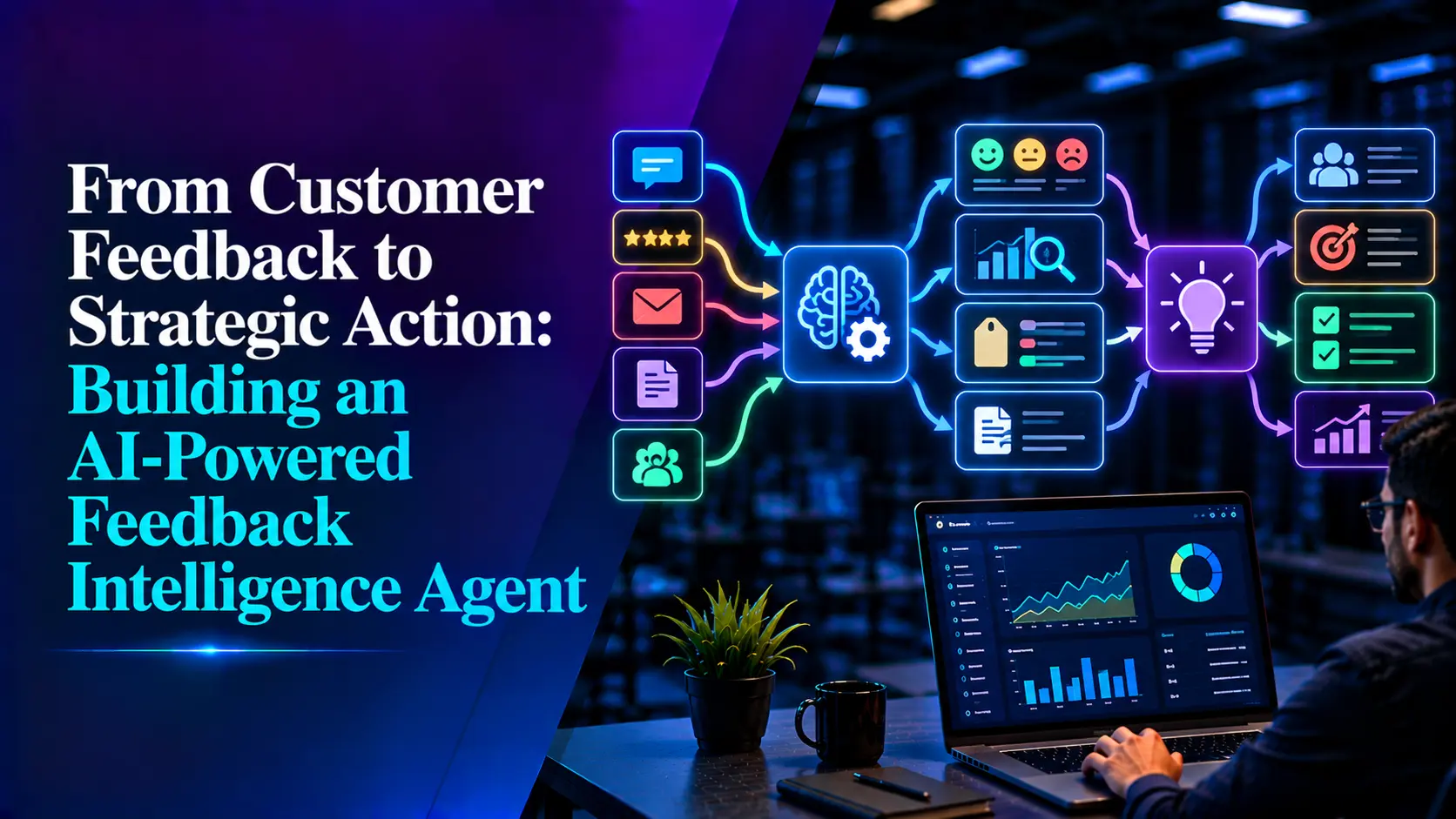
The Feedback Agent, an AI-driven Customer Feedback Intelligence solution, addresses this challenge by creating an analytical layer over unstructured feedback data. It combines controlled data access with AI-based summarization, sentiment detection, theme extraction, categorization, and trend analysis.
Instead of asking business leaders to read thousands of comments, the solution surfaces recurring patterns such as:
- Long waiting times
- Staff behaviour or attitude concerns
- Service-quality issues
- Department-specific complaints
- Location-specific experience problems
- Recurring operational bottlenecks
The result is a shift from feedback collection to feedback intelligence.
Raw feedback tells organizations what customers said. Feedback intelligence helps organizations understand what it means and where to act.
The Business Challenge: When Customer Voice Becomes Unstructured Data
Organizations generate large volumes of customer feedback every day.
The data may come from:
- Customer surveys
- Reviews
- Complaint forms
- Emails
- Support interactions
- Feedback spreadsheets
- Digital forms
- Service comments
- Location-level feedback
- Department-level feedback
A spreadsheet may contain thousands of comments such as:
“Had to wait almost an hour before someone attended to me.”
Another customer might write:
“The staff was not helpful and seemed uninterested.”
A third might say:
“Service was good, but the waiting time was unacceptable.”
Typical questions include:
- What are customers complaining about most?
- Which problems are increasing month over month?
- Is a complaint isolated or systemic?
- Which departments receive the most negative feedback?
- Which locations are experiencing recurring issues?
- Are waiting-time complaints increasing?
- Are complaints about staff behavior concentrated in specific areas?
- Which issues require immediate intervention?
Traditional spreadsheet-based analysis makes answering these questions difficult.
Three Problems Become Particularly Important
1. Manual inefficiency
Teams may spend significant time reading, categorizing, and summarizing feedback manually.
This creates several problems:
- High operational effort
- Slow reporting cycles
- Inconsistent categorization
- Human interpretation differences
- Difficulty processing large volumes
2. Invisible patterns
A single complaint about poor staff behavior may not look significant.
Hundreds of similar complaints across different records tell a very different story.
Without aggregation and classification, organizations can struggle to distinguish between:
3. Slow response to negative experiences
A complaint buried inside a spreadsheet can remain invisible until the next reporting cycle.
By the time leadership identifies the pattern, the organization may already have accumulated significant customer dissatisfaction.
This creates an important opportunity for AI:
Also Read: What Is AI Data Integration? How Generative AI Transforms Data Integration and Transformation
The Solution: An AI-Powered Feedback Intelligence Layer
The Feedback Agent introduces an AI-powered analytical layer between raw customer feedback and business decision-making.
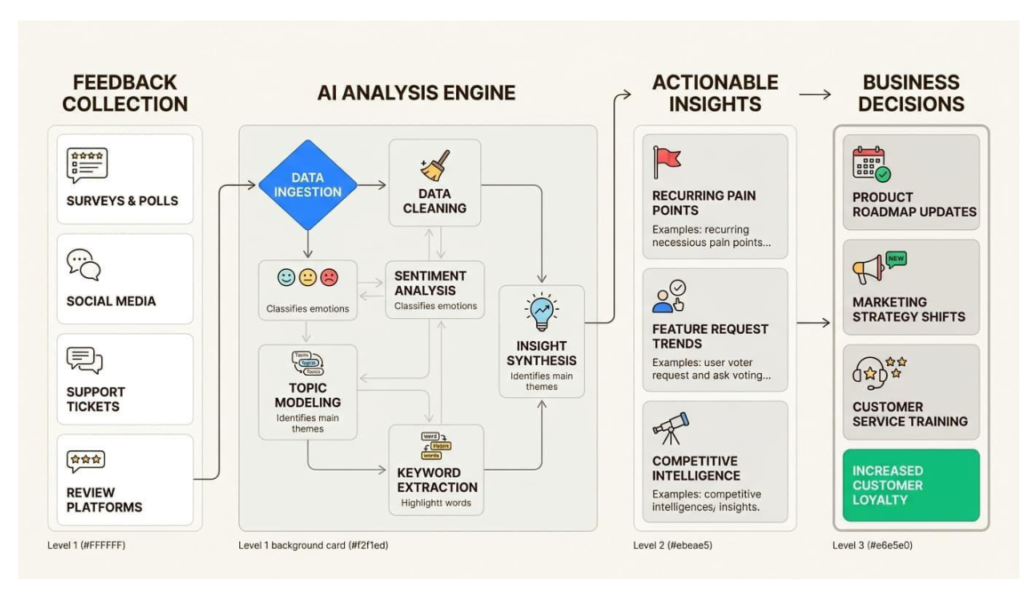
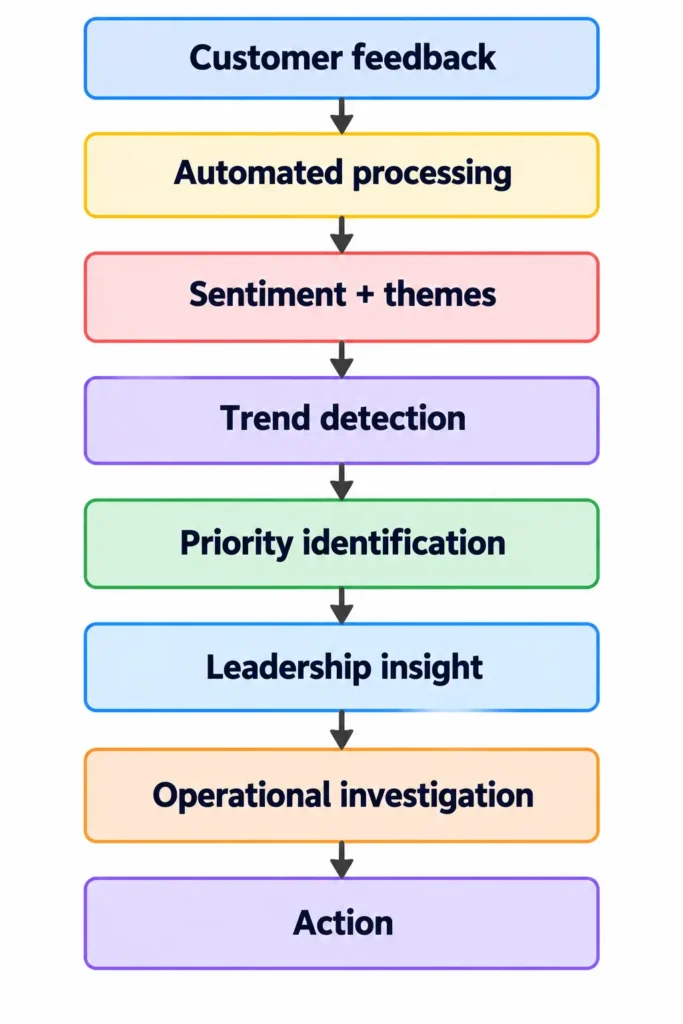
At a high level, the architecture follows this pattern:
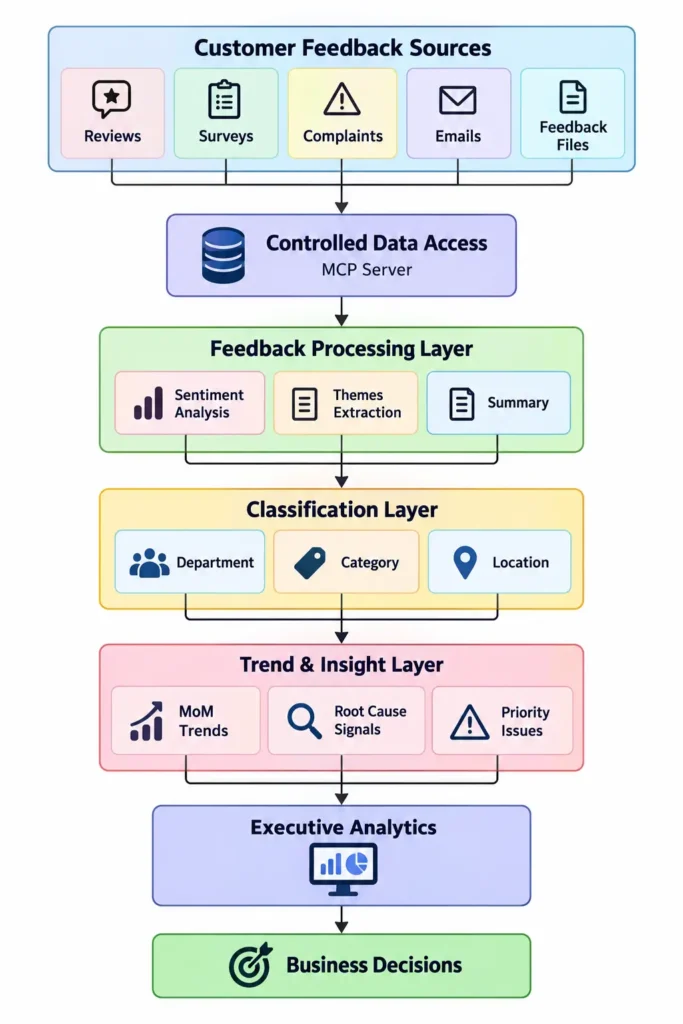
The key architectural principle is that the AI layer does not simply generate a summary.
How the Feedback Agent Works
The solution can be understood as a sequence of five analytical stages.
Stage 1: Controlled Data Access
This provides a structured boundary between the agent and enterprise data sources.
Instead of allowing an AI agent to directly access every underlying system, the MCP layer can expose approved tools and data operations.
This is particularly important for enterprise deployments where access control, auditability, and data governance are required.
MCP supports authorization mechanisms for protected tools, providing a foundation for controlled access to sensitive capabilities.
Stage 2: AI-Based Feedback Understanding
Once feedback is available, AI processing transforms free-form text into structured signals.
The core capabilities include:
Sentiment detection
Feedback can be classified into sentiment categories such as:
- Positive
- Negative
- Neutral
- Mixed
Sentiment alone is not sufficient, but it provides an important signal when combined with themes and operational dimensions.
Summarization
Instead of reading hundreds of individual comments, users can receive concise summaries of the dominant issues.
For example:
Raw feedback
“I waited for a long time before anyone came to assist me.”
“The waiting time was extremely frustrating.”
“Service was good but I waited too long.”
AI-generated theme
Recurring issue: Long waiting times
This converts multiple pieces of unstructured information into a business-readable insight.
Theme extraction
The system identifies recurring topics within the feedback.
Examples include:
| Raw feedback pattern | Extracted theme |
|---|---|
| Had to wait for an hour | Long waiting time |
| Nobody helped me | Lack of assistance |
| Staff was rude | Staff behavior |
| Nobody explained the process | Communication gap |
| Everything took too long | Process inefficiency |
This is where the solution moves beyond traditional sentiment analysis.
The question becomes:
Why are customers dissatisfied?
rather than simply:
Are customers dissatisfied?
From Sentiment Analysis to Root-Cause Signals
Consider this simplified example:
| Dimension | Positive | Negative | Dominant Issue |
|---|---|---|---|
| Department A | 72% | 28% | Waiting time |
| Department B | 81% | 19% | Staff communication |
| Department C | 54% | 46% | Service delays |
A sentiment dashboard alone might tell leadership that Department C has poor sentiment.
The Feedback Agent can take the analysis further:
That is much closer to an operational decision.
Multi-Dimensional Feedback Intelligence
The value of the solution increases when feedback can be analyzed across multiple business dimensions.
Department
Leadership can identify which departments have recurring customer-experience issues.
Complaint category
Feedback can be grouped into categories such as:
- Waiting time
- Staff behavior
- Service quality
- Communication
- Process issues
- Facilities
- Billing
- Other operational concerns
Location
Organizations operating across multiple locations can identify geographical or site-specific patterns.
Time
Month-on-Month analysis makes it possible to understand whether an issue is:
- Improving
- Stable
- Increasing
- Newly emerging
This creates a simple but powerful analytical model:
Sentiment + Theme + Business Dimension + Time
Month-on-Month Trend Analysis
A major advantage of structured feedback intelligence is the ability to move from individual comments to trends.
For example: Feedback Trend
| Theme | Jan | Feb | Mar | Apr |
|---|---|---|---|---|
| Waiting Time | 18% | 21% | 27% | 31% |
| Staff Behaviour | 14% | 16% | 15% | 19% |
| Communication | 9% | 11% | 12% | 10% |
| Service Quality | 22% | 20% | 18% | 17% |
The numbers above are illustrative, not project results.
The important analytical question is:
Which themes are changing over time?
An increase in waiting-time complaints may indicate that the organization should investigate:
- Staffing levels
- Queue management
- Process bottlenecks
- Appointment scheduling
- Workflow design
- Capacity constraints
The AI system does not need to automatically claim the root cause.
This distinction is important for responsible AI:
Dynamic Views: From Raw Records to Executive Intelligence
A strong feedback analytics solution should not hide the underlying data.
The Feedback Agent therefore provides two complementary perspectives.
View 1: Raw feedback
Users can inspect the original feedback records.
This provides traceability.
View 2: Analytical intelligence
Leadership can view:
- Overall sentiment
- Major themes
- Emerging issues
- Department trends
- Category trends
- Location trends
- Month-on-Month movement
- Recurring complaints
This creates a useful analytical hierarchy:
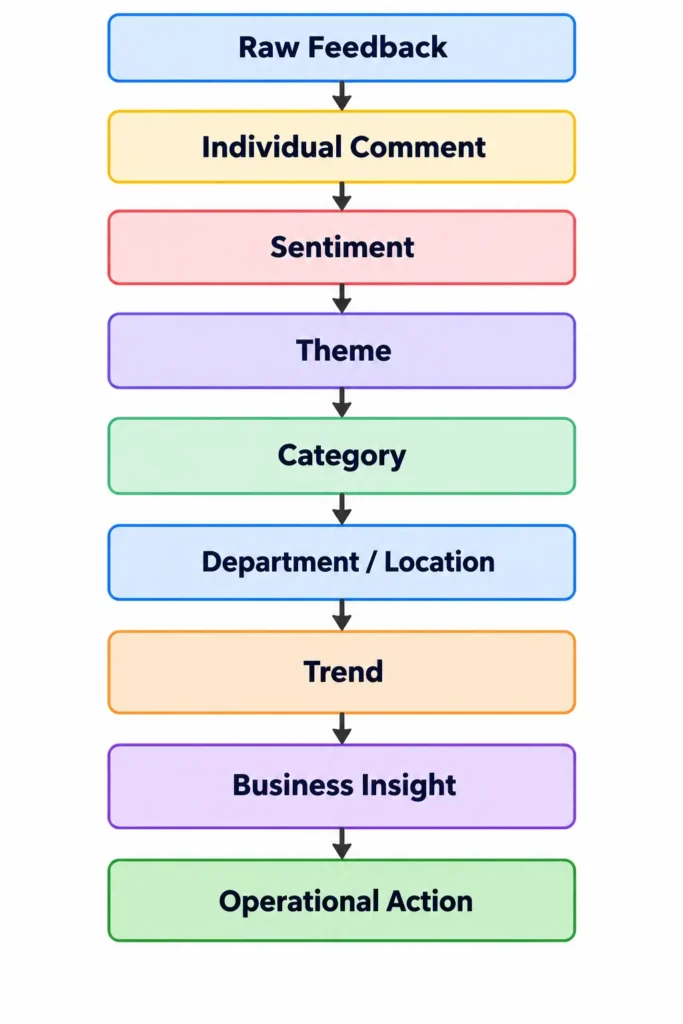
The system therefore does not replace the underlying evidence. It creates a structured path from evidence to decision.
Why Multi-Model AI Can Be Valuable
The business case specifies support for multiple AI models for rating detection and categorization.
This can be useful when different models have different strengths across tasks.
For example, an enterprise architecture may evaluate models independently for:
- Classification
- Sentiment detection
- Summarization
- Theme extraction
- Structured output generation
Rather than assuming that one model is optimal for every task, organizations can evaluate model performance against representative feedback datasets.
This creates an important engineering principle:
For production systems, model evaluation should be treated as an ongoing process rather than a one-time benchmark. NIST’s AI RMF emphasizes testing, evaluation, verification, and validation as part of trustworthy AI development and operation.
From Dashboard to Decision Support
The real value of the Feedback Agent is not the dashboard.
Consider the following progression.
Traditional approach
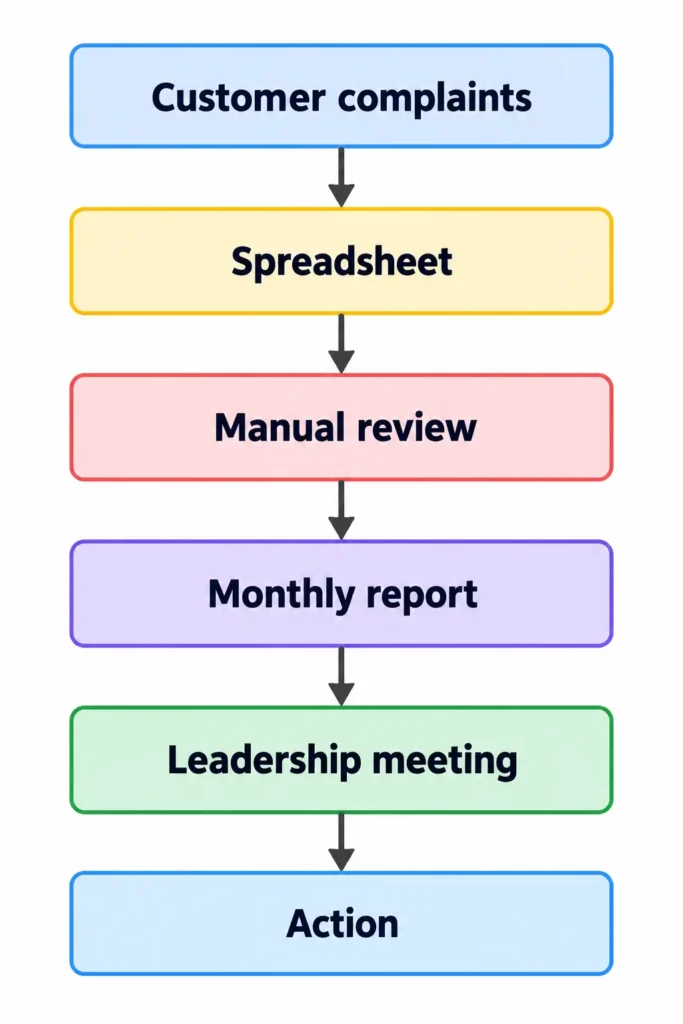
AI-enabled approach
Business Impact
The Feedback Agent creates value across multiple stakeholder groups.
For Leadership
Executives do not need to manually review thousands of comments.
They can focus on:
- What changed?
- Where did it change?
- Why does it matter?
- Which issues are recurring?
- Which areas require attention?
Business value
For Customer Support Teams
Support teams can prioritize negative or high-impact feedback.
Instead of treating every complaint equally, teams can use analytical signals to identify:
- Recurring problems
- Critical negative themes
- Department-level issues
- Location-specific issues
- Emerging complaint patterns
Business value
Better prioritization of customer issues.
For Operations Teams
Operations teams can use recurring themes to investigate process problems.
For example:
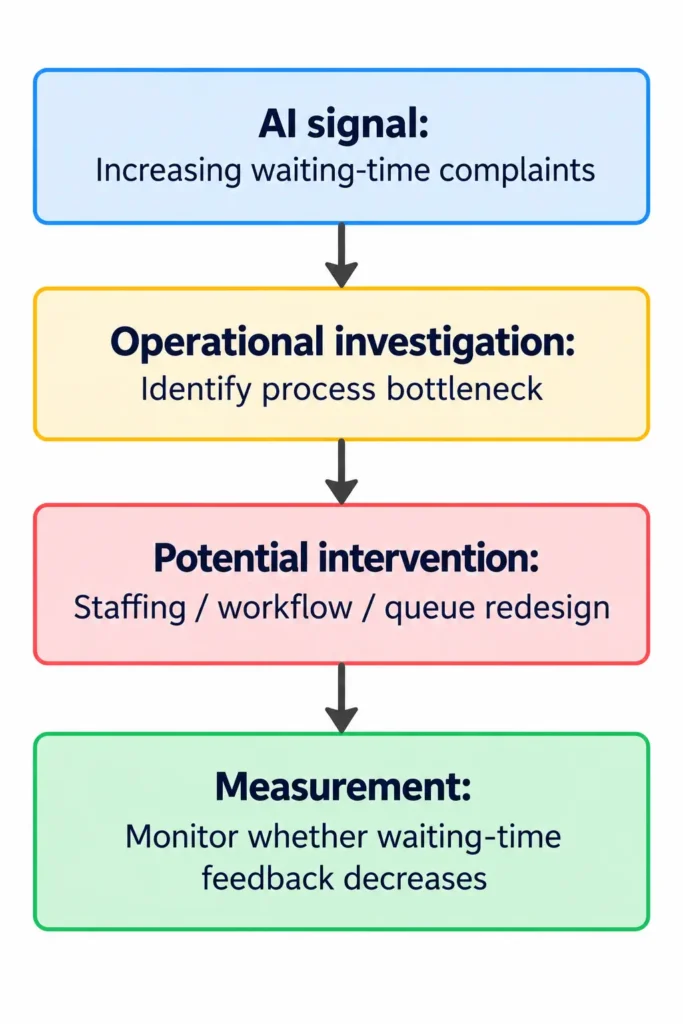
This establishes a feedback loop:
Responsible AI and Data Governance
Customer feedback can contain personally identifiable information, sensitive complaints, employee references, or other confidential information.
Therefore, a production-grade Feedback Agent should not treat AI processing as purely a modeling problem.
It should also address:
Data minimization
Only expose the data required for the analytical task.
Access control
Restrict who can access raw feedback and derived insights.
Auditability
Maintain records of relevant data access and analytical operations.
PII protection
Identify and redact sensitive information where appropriate.
Human oversight
Use human review for high-impact decisions and ambiguous cases.
Evaluation
Regularly evaluate sentiment, classification, summarization, and theme extraction quality.
These principles align with the broader NIST AI Risk Management Framework, which emphasizes trustworthy characteristics including validity and reliability, security and resilience, accountability and transparency, privacy enhancement, and management of harmful bias.
For generative AI specifically, NIST’s GenAI profile highlights governance, pre-deployment testing, content provenance, and incident disclosure as important considerations.
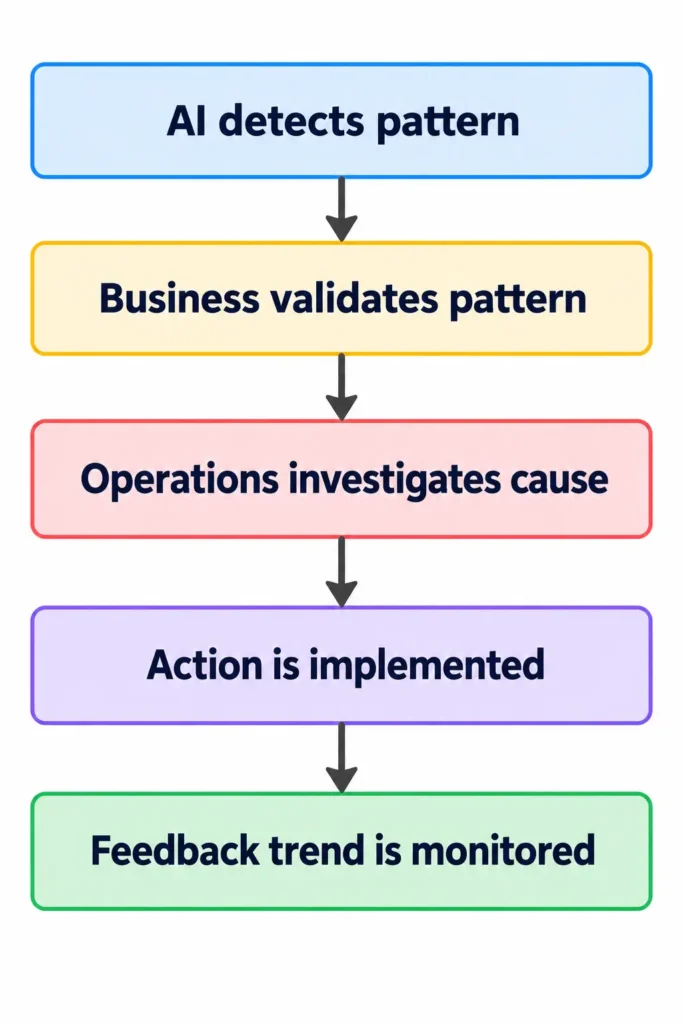
The Importance of Human-in-the-Loop Validation
One of the biggest mistakes in AI-powered feedback systems is assuming that an AI-generated theme is automatically the root cause.
For example:
AI classification: Staff behavior
This does not necessarily mean:
Root cause: Staff training problem.
There could be other explanations:
- Workload pressure
- Staffing shortages
- Process delays
- Communication breakdown
- Customer expectations
- Operational constraints
Therefore, the recommended operating model is:
Measuring the Success of a Feedback Intelligence Platform
A mature implementation should measure more than model accuracy.
A useful measurement framework can include four categories.
| Measurement Area | Example Metrics |
|---|---|
| Data | Feedback volume, processing coverage |
| AI Quality | Sentiment accuracy, classification quality, theme consistency |
| Operations | Time to identify recurring issues, prioritization efficiency |
| Business | Resolution time, recurring complaint rate, customer satisfaction indicators |
This is particularly important for credible enterprise AI case studies.
A useful principle is:
Implementation Roadmap
Organizations considering a Feedback Agent can adopt a phased approach.
Phase 1 – Feedback ingestion
Bring together available feedback sources and establish a consistent data structure.
Phase 2 – AI enrichment
Introduce:
- Sentiment detection
- Categorization
- Summarization
- Theme extraction
Phase 3 – Analytical intelligence
Add:
- Department analysis
- Category analysis
- Location analysis
- Month-on-Month trends
- Emerging-theme detection
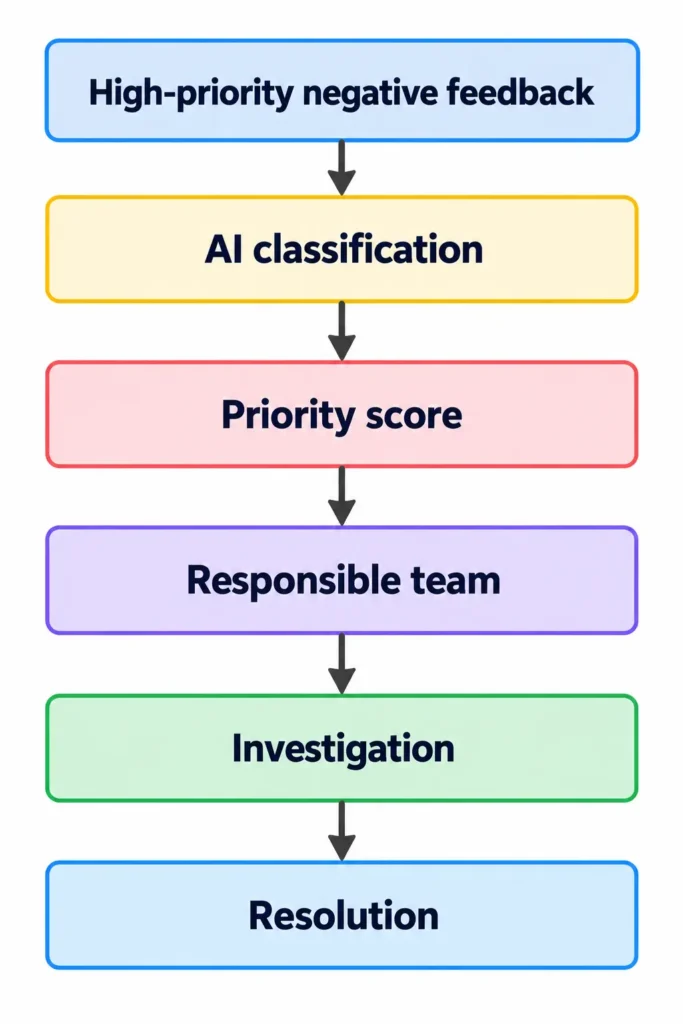
Phase 4 – Operational workflows
Connect insights to operational processes.
For example:
Phase 5 – Continuous evaluation
Establish:
- AI quality evaluation
- Human validation
- Model comparison
- Regression testing
- Monitoring
- Governance reviews
This creates a feedback intelligence system that improves over time rather than remaining a static dashboard.
Key Lessons from the Case Study
Several broader lessons emerge from this implementation.
Lesson 1: Unstructured data is not unusable data
Customer comments contain valuable operational signals. The challenge is creating the analytical layer required to extract them consistently.
Lesson 2: Sentiment alone is insufficient
Knowing that customers are unhappy is useful.
Lesson 3: Context creates business value
A theme becomes much more useful when connected to:
Department + Category + Location + Time
Lesson 4: AI should expose evidence, not just conclusions
The ability to move from an executive insight back to the underlying feedback improves trust and makes investigation easier.
Lesson 5: Human validation remains important
AI can identify patterns quickly, but organizations should validate important conclusions before taking consequential operational action.
Lesson 6: Evaluation must be part of the architecture
AI quality should be measured continuously rather than assumed after deployment.
The Future of Customer Feedback Intelligence
The next evolution of feedback systems is likely to move beyond passive analytics.
Instead of simply showing:
Waiting-time complaints increased.
an agentic system could eventually support a broader workflow:
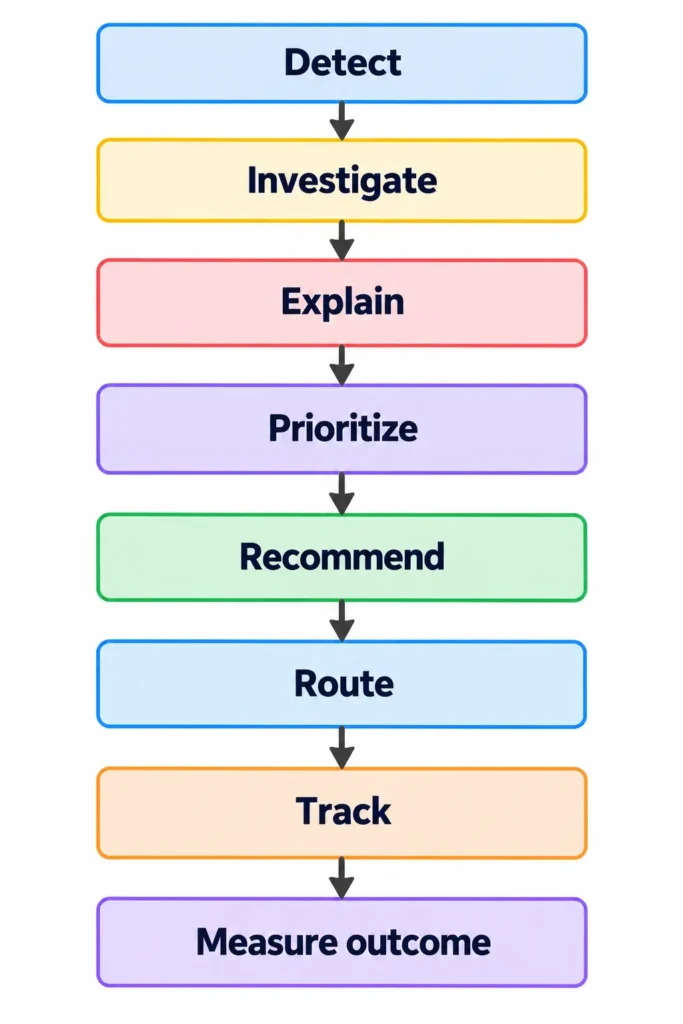
For example, an organization could ask:
The system could analyze feedback, compare trends, surface supporting evidence, and present the highest-priority themes.
With appropriate governance and authorization, future implementations could also connect insights to downstream workflows.
Conclusion
Customer feedback has always been valuable.
The challenge has been converting the sheer volume and variety of qualitative feedback into information that organizations can act on quickly.
The Feedback Agent addresses this gap by creating an AI-powered intelligence layer that transforms:
Its value is not simply in summarizing customer comments.
Its greater value lies in helping organizations understand:
- What customers are saying
- Why they are saying it
- Where the problem is occurring
- Whether the problem is recurring
- How the trend is changing
- Where leadership should focus attention
The most effective Feedback Intelligence platforms will therefore combine AI models with strong data governance, controlled access, evaluation, human oversight, and measurable operational outcomes.
Related Searches
- The Future of Generative AI: Emerging Trends and What’s Next
- Taming The Token Bill: How LiteLLM’s AI Gateway Puts Cost Under Control
- AI Agent Observability: Why 200 OK Doesn’t Mean Your AI Agent Got It Right
- Enterprise Data Discovery: Strategy, Tool Selection and DPDP Readiness
Related Solutions
- Cloud-native data warehouse optimization
- Cloud security posture management implementation
- application modernization services
- FinTech Platform Engineering & Modernization
- Data Engineering Consulting Services