
Agentic AI is moving beyond the trial phase, but there is a vast difference between demonstrating an AI agent and successfully implementing it within a business. When an agent begins interacting with various business applications, databases, APIs and cloud infrastructure, teams must look beyond the model’s performance and consider a range of other factors.
For CTOs, engineering leaders and enterprise IT teams, the real challenge lies in transforming a solid Proof of Concept (PoC) into a secure, scalable, and measurable business capability.
This shift hinges on establishing the right architecture, ensuring reliable data pipelines, controlling system access, maintaining continuous monitoring and clearly defining operational responsibilities. Here is how companies can implement agentic AI while minimizing operational risks and avoiding unnecessary complexity.
Why Agentic AI Projects Struggle to Reach Production
A Proof of Concept typically operates in a controlled environment, utilizing specific data, limited integration and close monitoring. However, when it is moved to production, we encounter various uncertainties, data variations, concurrent workloads, the risk of system failure, security requirements and budget constraints.
Here are some common challenges we face:
- Unreliable data: Agents produce inconsistent results when enterprise data is incomplete, outdated or spread across disconnected systems.
- Integration complexity: Connecting agents to existing applications, databases and APIs requires dependable integration and error handling.
- Security risks: Excessive permissions, exposed credentials and prompt injection can lead to unauthorized actions.
- Limited observability: Traditional application monitoring may not reveal why an agent selected a tool, repeated an action or failed to complete a workflow.
- Uncontrolled costs: Repeated model calls, unnecessary agent loops and inefficient retrieval can increase latency and operating expenses.
The solution is to view agentic AI as an engineered enterprise system rather than as an isolated AI experiment.
A Production-Ready Architecture for Enterprise Agentic AI
A reliable agentic AI framework connects intelligence with the systems, data and controls required to effectively execute business workflows.
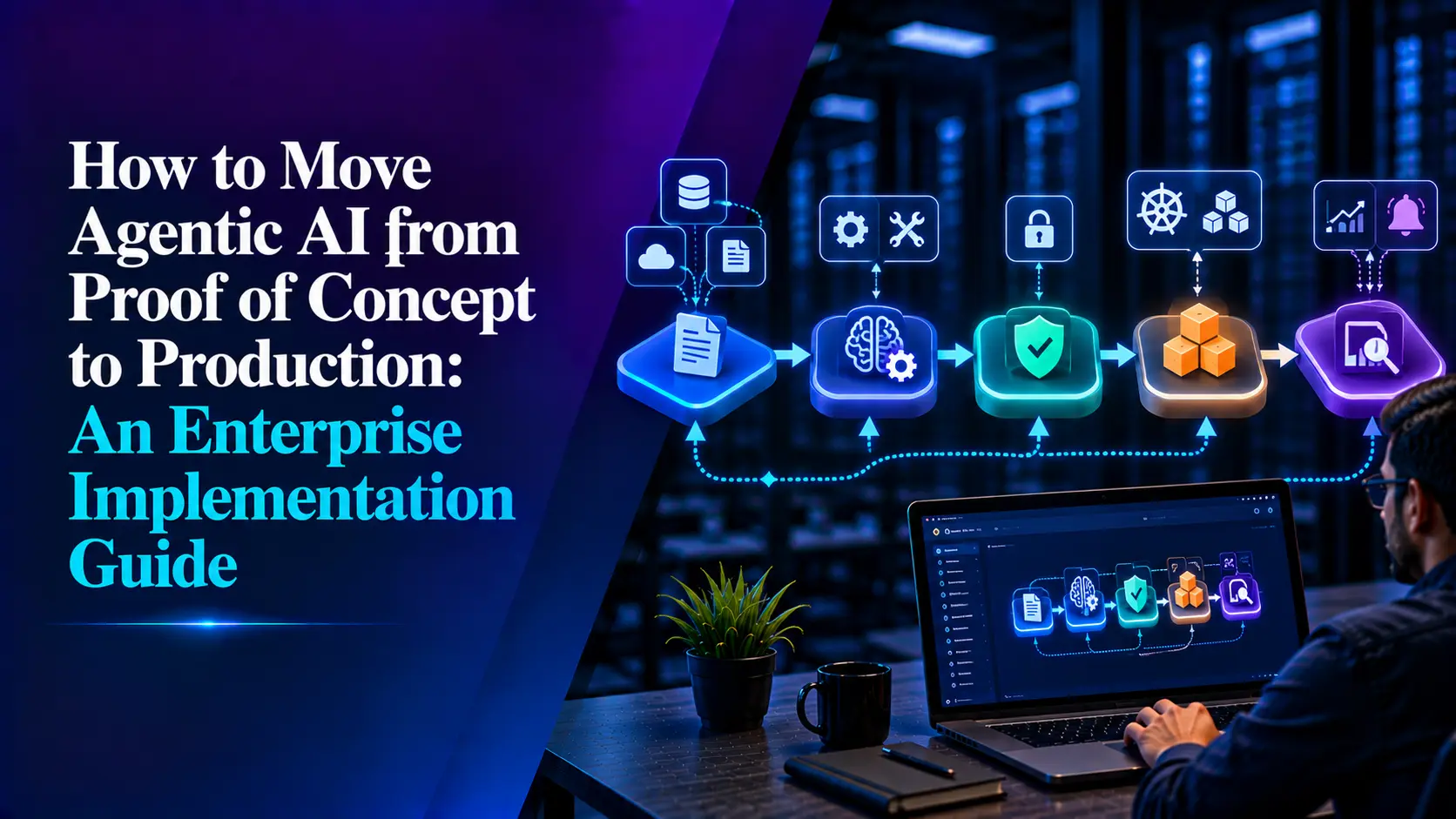
An effective architecture comprises five essential components:
- Data and context layer: It gathers and prepares information from enterprise databases, APIs, documents and operational systems.
- LLM and reasoning layer: Understands the objective and determines the next steps necessary to complete a task.
- Orchestration layer: It handles workflow status, tool selection, retries, approvals, and exceptions.
- Integration layer: It connects the agent to authorized enterprise applications, services and APIs.
- Security and observability layer: It enforces access policies and maintains a record of agent activity, errors, latency, and outcomes throughout the workflow.
Security, governance and monitoring should be integrated into every level of development, rather than being added separately at a later stage. This approach aligns with AWS enterprise architecture guidelines.
How to Move Agentic AI from PoC to Production
1. Start with a Measurable Business Problem
Select a specific workflow where an AI agent can resolve an identifiable operational issue. Good initial options include IT incident triage, data quality checks, support request classification and internal information retrieval.
Before starting development, establish a baseline. Measure key metrics such as processing time, manual workload, error rates and operational costs. Additionally, define acceptance criteria to clearly outline what the agent must achieve for the project to move forward.
Focusing on a single, well-defined workflow simplifies the process of demonstrating business value and identifying technical shortcomings.
2. Prepare Enterprise Data and Integrations
An agent’s effectiveness largely depends on the quality of the information and systems it interacts with. Before connecting the agent to a production application, evaluate data quality, API reliability, access permissions, and inter-system dependencies.
For workflows that rely heavily on data, it may be essential to build reliable data ingestion pipelines, verify records, ensure data accuracy, and facilitate controlled access to critical information.
Use controlled API integration and well-defined tool permissions. The agent should only have access to the data and functions necessary for its assigned tasks.
3. Build for Controlled Execution
Building a production agent involves much more than just creating a reasoning model. The orchestration layer must have the capability to manage state, validate actions, handle timeouts, and gracefully recover from failures without repeating harmful operations.
Clearly distinguish between actions an agent can perform independently and those requiring human approval. For instance, an agent might analyze a database issue and suggest a solution, whereas human approval should be mandatory for any change in the production environment that could disrupt operations.
Before expanding the scope of operations, thoroughly test scenarios involving standard workflows, incomplete inputs, inaccessible APIs, unexpected responses, and various failure conditions.
4. Integrate Security and Human Oversight
When implementing enterprise-level agentic AI, it is crucial to incorporate security measures at every stage of development and deployment.
Implement ‘least-privilege access’ (access limited to what is strictly necessary), secure credential management, input validation, data security protocols, and comprehensive audit logging. Regularly check for risks such as prompt injection, unauthorized tool calls, and attempts to access restricted information.
The level of oversight for a task should be commensurate with its potential impact. Low-risk tasks can be automated within certain limits, whereas sensitive activities, such as those involving finance, security, or changes to production, must adhere to rigorous scrutiny protocols.
5. Establish Observability and Continuous Evaluation
For a successful production deployment, it is essential to have insights into both technical performance and business outcomes.
Key metrics to monitor include:
- Task completion rate: How often the agent completes its assigned workflow successfully.
- Accuracy and correction rate: How frequently outputs require human intervention.
- Latency and reliability: How long tasks take and how often integrations fail.
- Cost per completed workflow: Whether the business outcome justifies model and infrastructure expenses.
- Escalation rate: How frequently the agent needs human assistance.
- Security events: Whether policy violations, unauthorized actions, or suspicious tool calls occur.
Teams can detect issues and enhance system reliability by utilizing distributed tracing, structured logs, metrics and evaluation datasets. Closely monitor agent-related activities, while safeguarding sensitive information and record essential model calls, tool interactions, workflow transitions and outcomes.
6. Scale Through a Controlled Rollout
After ensuring that the initial workflow meets all the necessary approval criteria, implement it in stages rather than granting full autonomy immediately.
Start with a limited user base or controlled traffic. Compare the results against initial expectations, assess any anomalies, verify security measures, and ensure that support teams are prepared to handle any incidents.
Before proceeding with the rollout, establish clear version control, release methods, rollback protocols, monitoring thresholds, and ownership responsibilities. Every new workflow must have a solid business case and undergo a thorough risk assessment.
Enterprise Agentic AI Implementation Checklist
| Area | What to Validate Before Production |
|---|---|
| Business value | Defined baseline, measurable outcomes, and acceptance criteria |
| Data engineering | Data quality, freshness, access controls, and reliable pipelines |
| Architecture | Orchestration, state management, integration, and failure recovery |
| Security | Least privilege, credential protection, and policy enforcement |
| Human oversight | Approval gates, escalation paths, and accountability |
| Observability | Logs, traces, performance metrics, and cost monitoring |
| Operations | Deployment controls, incident response, rollback, and ownership |
How OpsTree Can Support Enterprise Agentic AI Implementation
Bringing agentic AI into production requires coordination among AI engineering, data engineering, cloud infrastructure, security, and operations. Treating these as separate initiatives can lead to integration gaps that become difficult to rectify at scale.
OpsTree capabilities in enterprise AI engineering, data engineering, cloud engineering, DevSecOps and observability can assist organizations that are building the necessary foundation for production AI systems.
From building reliable data pipelines and integrating enterprise systems to strengthening deployment methods and monitoring application behavior, the primary focus should be on making AI workflows reliable, secure, and operationally manageable.
For companies planning their first agentic AI deployment or facing challenges with existing Proof-of-Concept (PoC) initiatives, the priority is to establish a clear path from experimentation to measurable business outcomes.
Conclusion
Transforming agentic AI from a mere ‘proof of concept’ into a fully functional system involves far more than just dealing with AI technology, it is an engineering and operational undertaking. Even the best model can fail when faced with poor data quality, unstable integrations, inadequate security measures, or a lack of clear operational leadership.
The organization should embark on this journey by establishing a scalable workflow, creating a robust architectural framework, implementing controlled autonomy, and continuously assessing performance to ensure reliability. Growth should be based on proven results rather than the promise of a single success.
The goal is not merely to launch an AI agent, but to build a comprehensive enterprise system capable of performing essential tasks consistently, securely, and cost-effectively.
Frequently Asked Questions
1. How do you move agentic AI from proof of concept to production?
Start with a measurable business workflow, assess data and integration readiness, establish controlled agent orchestration, implement security and human approval mechanisms, and verify performance before scaling through a phased rollout.
2. What are the biggest challenges in enterprise agentic AI implementation?
Common challenges include unreliable data, complex system integration, unpredictable agent behavior, security risks, limited observability, rising inference costs and unclear operational accountability.
3. How do you secure AI agents in production?
Use least-privilege permissions, secure credentials, limited tool access, input validation, audit logging, runtime monitoring, and human approval for high-impact actions. Regularly test for prompt injection and unauthorized access.
4. How can enterprises measure the success of agentic AI?
Evaluate task completion, accuracy, processing time, manual effort, exception handling, latency, and cost per completed workflow. Compare these results against an established baseline and monitor them continuously after deployment.
Related Searches
- How To Reduce ETL Pipeline Costs Without Sacrificing Performance
- Why Enterprise Data Pipelines Fail at Scale and How to Build Reliable Data Engineering
- Top Generative AI Development Companies in 2026
- Top AWS Consulting Partner in India 2026