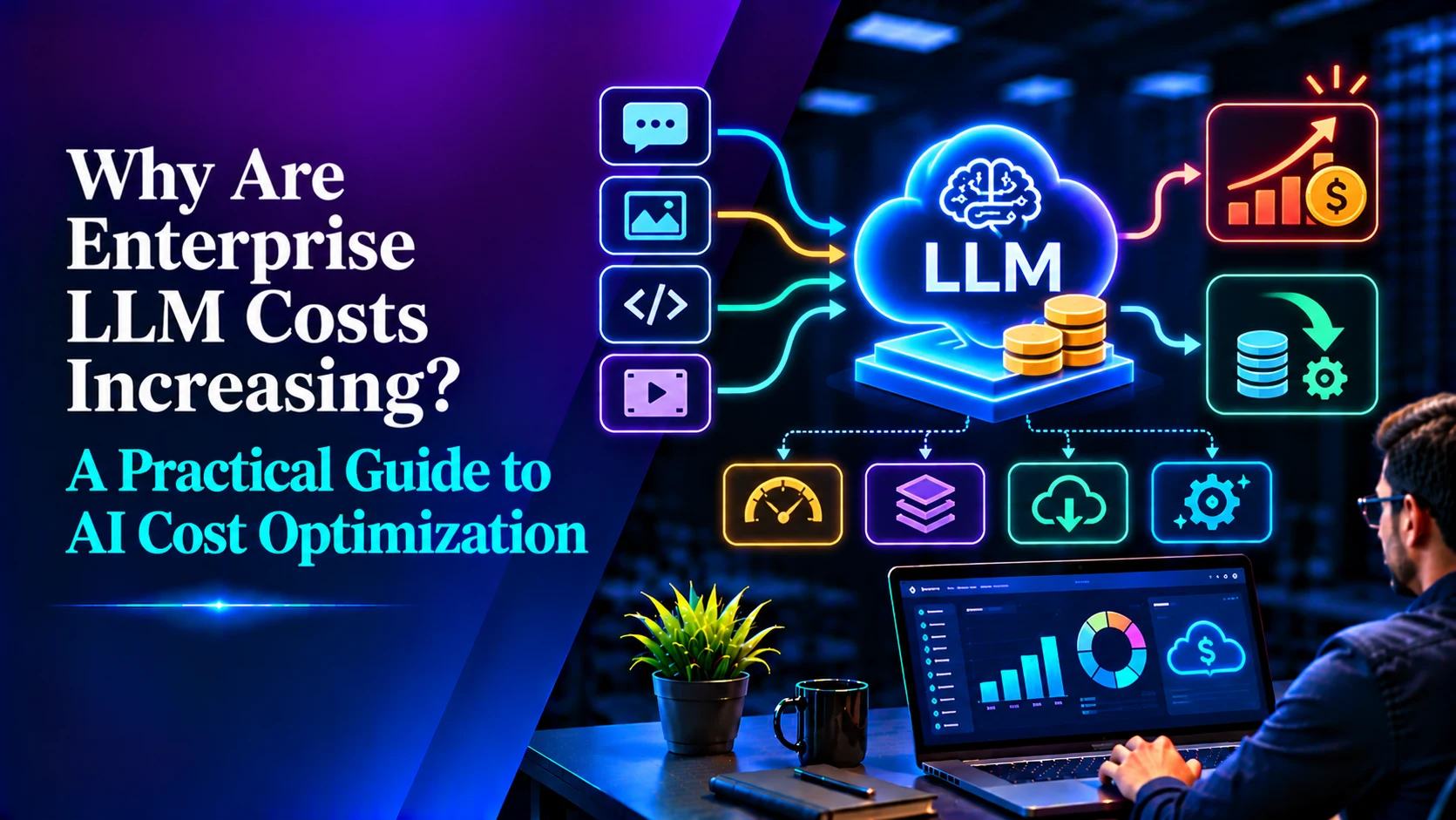

Enterprise adoption of generative AI is accelerating rapidly. Organizations are now integrating large language models (LLMs) into various functions, such as customer support, software development, internal knowledge management, data engineering,and business automation.
An AI application that may appear low-cost during initial testing can become a significant operational expense when used regularly by thousands of employees, customers or autonomous AI agents.
The issue of cost is not limited solely to the price of the model. Several factors, such as long prompts, frequent API calls, inefficient Retrieval-Augmented Generation (RAG) pipelines, unnecessary model usage and unconstrained AI agent execution, can drive up inference costs.
The challenge for CTOs, CIOs and engineering leaders is to keep AI infrastructure costs to a minimum, while simultaneously maintaining application performance, response quality and overall business outcomes.
This is where cost optimization for enterprise LLMs becomes crucial. By refining model selection, managing token consumption, optimizing infrastructure usage and improving visibility into AI workloads, organizations can build AI systems that are not only effective but also more predictable and cost-efficient.
Why Are Enterprise LLM Costs Increasing?
The cost of enterprise LLMs is rising because AI applications are consuming significantly more model resources, infrastructure capacity and execution time than initially estimated. This issue becomes even more pronounced as organizations scale their AI initiatives across various departments and production environments.
Several factors contribute to this increase.
1. Increasing LLM Token Consumption
Most commercial LLM APIs charge based on the number of input and output tokens used. Every command, document, sequence of conversation and generated response adds to the total cost.
As enterprise applications grow in complexity, they often provide the model with far more data than is actually necessary for the specific task at hand.
For example:
- Customer support assistants repeatedly process lengthy conversation histories.
- Document processing applications send entire files instead of relevant sections.
- AI coding assistants include unnecessary code and debugging logs.
- Enterprise knowledge assistants retrieve more context than required.
When operating at scale, even a minor increase in token usage per request can lead to significant additional costs.
What businesses should do: Closely monitor input and output token usage, optimize prompt structures, remove unnecessary context and establish token budgets for frequently used AI workflows.
2. Using Expensive Models for Every Business Task
A common mistake in enterprise AI design is using the same high-end LLM for every task.
However, not every business task requires advanced reasoning capabilities.
For instance, tasks such as extracting data from invoices, categorizing support tickets, verifying structured information and understanding customer sentiment can often be handled easily by smaller, less expensive models.
Using high-end models for such routine, everyday tasks only increases inference costs without delivering any significant improvement in business outcomes.
What companies should do: Adopt smart LLM model routing. Use smaller models for simpler tasks, while reserving advanced models for complex reasoning, decision-making and specialized functions.
This strategy enables organizations to improve model performance, maintain response quality and latency and control inference costs.
3. Uncontrolled AI Agent Execution and Multi-Agent Workflows
AI agents certainly add a layer of complexity to cost management.
Unlike traditional applications that operate along fixed paths, autonomous AI agents may execute multiple reasoning cycles, utilize external tools, gather information and before completing a task, even retry steps that previously failed.
Consider, for example, an AI development agent, which might:
- Understand a development requirement.
- Analyze the existing codebase.
- Generate code.
- Execute tests.
- Identify errors and generate corrections.
- Validate the final implementation.
Every interaction with a Large Language Model (LLM) consumes additional tokens and incurs inference costs.
If these agents operate without any constraints, such as limits on execution, retries or budget, costs can escalate unexpectedly.
Recommendations for businesses: Set a maximum number of iterations, define token budgets, implement execution timeouts and utilize circuit breakers. Wherever possible, opt for deterministic validation for routine checks, rather than repeatedly calling the LLM.
4. Inefficient Retrieval-Augmented Generation (RAG) Pipelines
RAG is a powerful tool that enables companies to generate context-sensitive responses by leveraging their internal documents, databases and knowledge bases.
However, inefficient methods for retrieving information can drive up the costs associated with LLMs.
Consider a scenario where a company’s knowledge assistant retrieves 15 document segments in response to a single query, even though only two of them are actually relevant. Sending all 15 segments to the LLM increases input token consumption and carries the risk of including irrelevant context.
This situation not only impacts inference costs but also compromises the accuracy of responses.
Recommendations for businesses: To improve RAG architecture:
- Semantic search to retrieve relevant information.
- Reranking to prioritize the most useful document sections.
- Metadata filtering to eliminate irrelevant records.
- Efficient document chunking to reduce unnecessary context.
- Hybrid search to improve retrieval relevance.
Instead of flooding a RAG pipeline model with vast amounts of data, a well-structured pipeline provides it with only the relevant information.
5. Underutilized GPU and AI Infrastructure
Costs associated with LLMs are not limited to API token consumption. Organizations that maintain their own hosted models or specialized inference infrastructure must also account for expenses related to GPUs, CPUs, storage, networking and operational overhead.
Ineffective infrastructure strategies can lead to unnecessary costs.
For example, companies might reserve expensive GPU resources for workloads with uncertain demand. During periods of low traffic, these resources remain underutilized, yet the infrastructure costs persist.
Furthermore, inefficient autoscaling, over-provisioned compute instances and misconfigured inference servers can drive up the total cost of ownership.
Recommendations for businesses: Monitor GPU usage, assess workload requirements, implement autoscaling and fine-tune your inference infrastructure based on actual usage patterns.
For certain types of workloads, using a managed LLM API can be more cost-effective than self-hosting. For workloads that are predictable and involve very high volumes, it may be worthwhile to conduct a detailed cost comparison against dedicated infrastructure.
5 Practical Strategies to Reduce Enterprise LLM Costs
Understanding the factors that influence costs is merely the first step. Companies need a systematic AI cost-optimization strategy that can link engineering decisions to measurable business outcomes.
1. Implement Intelligent Model Routing
Model routing directs requests to different LLMs (Large Language Models) based on task complexity, performance requirements and cost.
Instead of using a single, expensive model throughout an entire application, organizations can adopt a tiered model architecture.
| Task Complexity | Model Approach | Example Use Cases |
|---|---|---|
| Low | Small, cost-efficient models | Classification, entity extraction, sentiment analysis |
| Medium | General-purpose enterprise models | Summarization, document analysis, conversational assistance |
| High | Advanced reasoning models | Complex problem-solving, technical analysis, multi-step reasoning |
The objective is simple: use the right model for the right workload. This helps maintain a balance between inference costs, latency and response quality.
3. Optimize Prompts and Reduce Token Consumption
Optimizing prompts is one of the most effective strategies for managing LLM API costs.
In enterprise applications, one often encounters overly detailed system instructions, unnecessary examples, excessively long conversation histories and superfluous information.
Engineering teams should focus on:
- Removing redundant prompt instructions.
- Limiting unnecessary conversational history.
- Using concise system prompts.
- Applying structured output formats such as JSON.
- Filtering unnecessary logs and documents before model invocation.
- Using prompt compression where appropriate.
These improvements reduce token usage while retaining the essential information needed to complete a task.
4. Introduce Semantic Caching
In many enterprise AI applications, users often ask the same questions repeatedly.
For example, employees typically seek information regarding company policies, technical documentation, product details or internal processes.
Without a caching mechanism, every repeated query can trigger the model again.
Semantic caching addresses this issue by storing previous responses and retrieving relevant results for similar or closely related queries.
Technologies such as Redis and vector databases can facilitate caching strategies tailored to specific application architectures.
This approach reduces unnecessary inference requests, improves response times and lowers the operational costs associated with Large Language Models (LLMs). Implementing appropriate expiry policies, access controls and response validation is crucial to ensure that outdated or incorrect information is not provided.
5. Establish AI FinOps and LLM Observability
Traditional cloud cost monitoring often fails to provide clear insights into the resource consumption of individual AI applications.
To address this gap, companies need an AI FinOps strategy that can link expenditures to specific models, teams, applications, and business processes.
A practical cost monitoring framework should track:
| Metric | Why It Matters |
|---|---|
| Input and output tokens | Identifies token consumption patterns |
| Cost per API request | Measures individual inference expenses |
| Cost per application | Identifies expensive AI workloads |
| Model utilization | Highlights inefficient model selection |
| Agent execution count | Detects unnecessary reasoning and tool calls |
| GPU utilization | Identifies infrastructure waste |
| Retry frequency | Highlights inefficient application workflows |
Tools such as OpenTelemetry, Langfuse, Prometheus, and Grafana enable engineering teams to gain insights into the behavior of AI applications and the performance of their underlying infrastructure.
The objective is to detect any cost increases early, preventing them from escalating into a major budgetary issue.
5. Control AI Agent Execution and Measure Cost Per Successful Outcome
As companies begin to integrate agentic AI, monitoring its performance becomes crucial for effective cost management.
Technical teams should set limits on agent iterations, establish caps on tokens and expenditure, restrict the use of tools, enforce execution timeframes, and implement circuit breakers.
It is important to note that reducing the cost of tokens does not necessarily lead to a decrease in overall AI expenditure. A cheaper model might provide incorrect answers, necessitating repeated attempts (retries) or a greater need for human intervention.
Therefore, rather than focusing solely on API pricing, businesses should evaluate the total cost involved in successfully completing a task.
Cost Per Successful Outcome = Total AI Execution Cost / Number of Successfully Completed Tasks
The total cost of implementing AI should encompass all associated expenses, such as those related to inference, infrastructure, retries, and the need for human intervention.
For instance, consider a customer support AI assistant that handles a large volume of inquiries with greater accuracy and fewer required retries. Even if the model calls themselves are somewhat costly, such an assistant can still deliver a better economic return.
This approach enables engineering and finance teams to evaluate AI cost optimization in terms of business value, rather than focusing solely on savings derived from token usage.
How OpsTree Helps Enterprises Optimize AI Infrastructure Costs
Understanding the complexities surrounding enterprise LLM costs goes well beyond simply choosing a cheaper model. It requires an understanding of how AI applications consume resources, the nature of the interaction between models and enterprise data, and how the infrastructure performs under actual workloads.
OpsTree is dedicated to enhancing your organization’s AI engineering and cloud infrastructure through targeted solutions in AI engineering, cloud engineering, data engineering and observability, all tailored to meet the specific needs of enterprises.
Our methodology focuses on empowering engineering teams to evaluate AI architectures, refine LLM integration and data retrieval processes, enhance cloud resource efficiency, and implement observability within production AI workloads.
Whether your organization is launching its first enterprise AI application or enhancing an existing AI ecosystem, our goal is to make your AI infrastructure more scalable, reliable and economically viable.
Are you looking to control the rising costs of enterprise LLMs? Contact OpsTree to leverage our expertise in AI engineering, cloud optimization, and observability. We can help your organization build cost-effective AI solutions.
Frequently Asked Questions
1. Why are enterprise LLM costs increasing?
Enterprise LLM costs rise due to several factors: increasing token consumption, the selection of expensive models, inefficient prompts, frequent API calls, RAG retrieval overhead, the execution of autonomous AI agents, and the underutilization of GPU infrastructure.
2. How can enterprises reduce LLM API costs?
Companies can reduce LLM API costs through intelligent model routing, prompt optimization, semantic caching, efficient RAG pipelines, and the monitoring of token budgets and usage.
3. How does model routing help optimize enterprise AI costs?
Model routing directs requests to different models based on task complexity and performance requirements. Smaller models can be used for simpler tasks, while advanced models are employed for complex logical tasks. This helps avoid unnecessary expenditure on premium inference capabilities.
Related Searches
- How To Reduce ETL Pipeline Costs Without Sacrificing Performance
- Why Enterprise Data Pipelines Fail at Scale and How to Build Reliable Data Engineering
- Top Generative AI Development Companies in 2026
- Top AWS Consulting Partner in India 2026