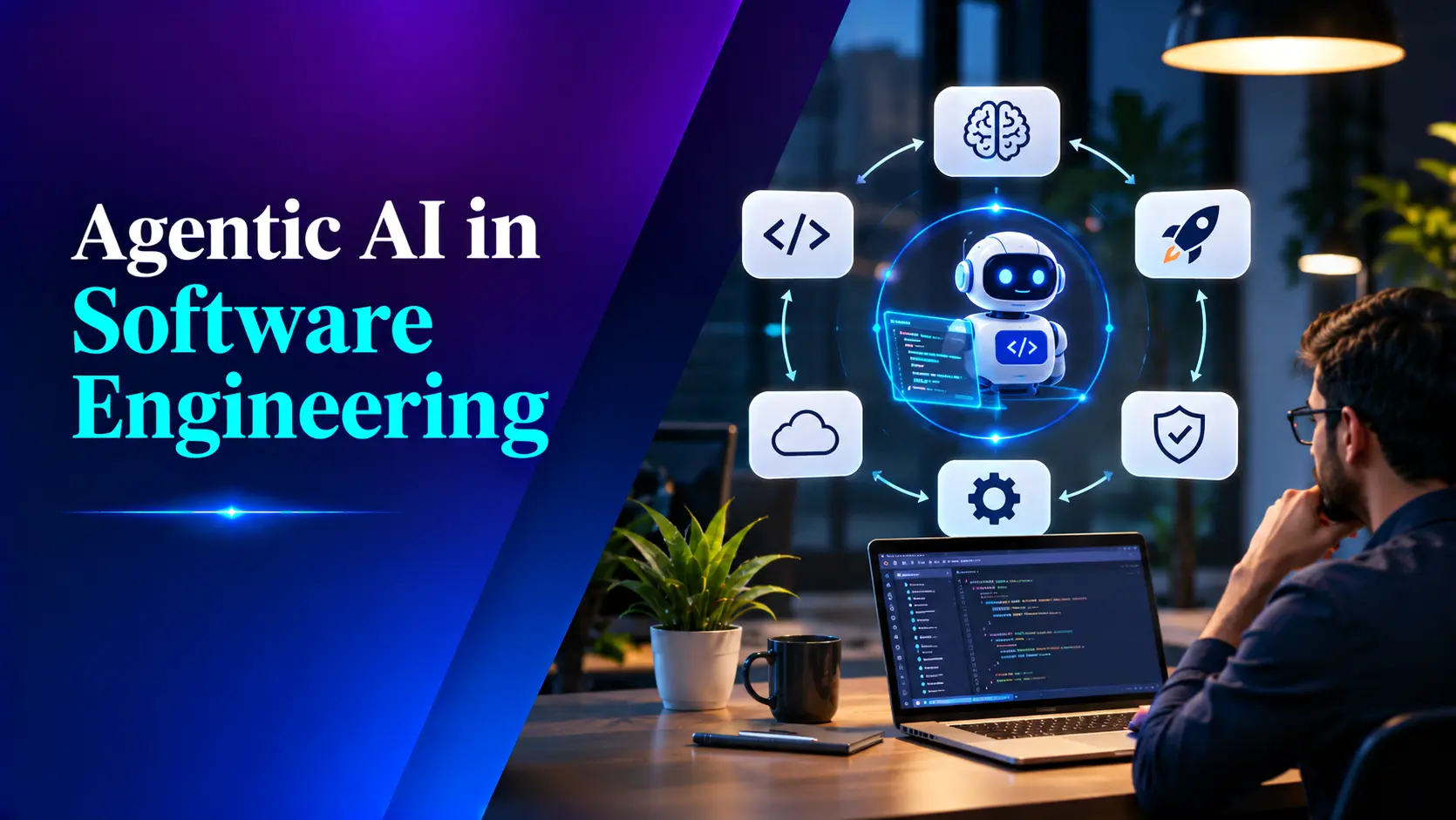

Software development is now evolving well beyond the AI-based code suggestions we have seen in the past. We are entering an era where autonomous AI coding agents can take charge of engineering tasks themselves. These advanced systems can comprehend development requirements, navigate codebases, write code, execute tests, identify errors, and even propose fixes, all while requiring minimal human intervention.
This shift in the field of software engineering is known as agentic AI. Unlike traditional AI coding assistants, which merely respond to a developer’s instructions, these autonomous agents can oversee various stages of the development process. Furthermore, they utilize feedback from development tools to continuously improve their own performance.
For businesses grappling with complex applications, geographically distributed development teams and the requirements of continuous delivery, this shift presents an excellent opportunity to boost engineering productivity and accelerate software launch timelines.
However, adopting autonomous coding agents is not as simple as merely adding an AI tool to a developer’s workspace. Organizations must address several challenges, such as maintaining code quality, ensuring application security, integrating CI/CD processes, managing infrastructure access and establishing the necessary human oversight.
Let’s explore how agentic AI is reshaping enterprise software development, and what factors organizations should consider before moving in this direction.
What Is Agentic AI in Software Engineering?
In software engineering agentic AI refers to the deployment of autonomous AI agents capable of planning, executing, testing and improving software development tasks with minimal human oversight.
While traditional AI coding assistants primarily focus on generating code snippets, explaining programming concepts or providing suggestions based on a developer’s prompts agentic coding systems take this functionality a step further. They interact directly with the development environment, access repositories, execute commands and adapt themselves based on test results.
For example, when assigned a bug-fixing task, an AI coding agent can:
- Examine the existing codebase and identify relevant files.
- Understand the issue and prepare an implementation plan.
- Modify the required code across multiple files.
- Run unit tests and analyze build failures.
- Apply corrections based on test results.
- Prepare a pull request for developer review.
This approach shifts the developer’s role, instead of personally carrying out every implementation step, their job now becomes defining requirements, overseeing execution, and verifying the results.
The goal is not to remove developers from software engineering, but rather to help engineering teams manage a greater volume of development work without compromising on reliability.
AI Coding Assistants vs. Autonomous Coding Agents
Although both technologies use AI to assist developers, their capabilities and responsibilities differ.
| Area | Traditional AI Coding Assistants | Autonomous AI Coding Agents |
|---|---|---|
| Code generation | Suggests code and snippets | Implements defined development tasks |
| Codebase access | Primarily context-based assistance | Can explore and work across repositories |
| Task execution | Requires frequent developer input | Executes multiple steps independently |
| Testing | Suggests test cases | Can execute tests and analyze failures |
| Debugging | Recommends possible fixes | Can investigate and attempt corrections |
| Human involvement | Developer manages most actions | Developer supervises and approves outcomes |
For enterprise engineering teams, understanding the distinction between the two is crucial. Coding assistants enhance the productivity of individual developers, while agentic systems help automate interconnected tasks throughout the software development lifecycle (SDLC).
How Autonomous Coding Agents Work Across the Software Development Lifecycle
Autonomous coding agents continuously work to understand requirements, complete tasks, evaluate outcomes and make necessary adjustments.
Their capabilities span several stages of the software development lifecycle (SDLC):
Requirement Analysis and Task Planning
These agents can create implementation plans by analyzing development tickets, technical documentation and feature specifications. Before work begins, developers have the opportunity to review the proposed approach.
Code Generation and Implementation
By leveraging the context of an existing repository, agents can generate code, update application components, build APIs, and make changes across multiple files. This capability is particularly useful for repetitive development tasks and for implementing clearly defined feature requirements.
Automated Testing and Debugging
Agents are capable of running unit tests, investigating the reasons for test failures, analyzing application errors and suggesting improvements to the code. This process creates a feedback loop, which helps in identifying issues early in the development cycle.
Code Review and Security Validation
AI tools can help identify coding issues, insecure dependencies, configuration errors and potential security risks. However, it is crucial that the insights gained through automated means are validated against established security protocols and review processes.
CI/CD Integration and Release Preparation
These coding agents can integrate with version control systems and development pipelines to prepare changes, summarize build result and streamline release workflows. However, production deployments require adherence to appropriate approval processes and release policies.
Overall, these functions establish autonomous coding agents as a significant layer of automation within enterprise software engineering, extending well beyond the role of simple code-generation tools.
Are you looking for a smarter way to automate software delivery and DevSecOps? Discover BuildPiper – an AI-Powered Enterprise Software Delivery Platform.
Enterprise Use Cases of Agentic AI in Software Development
When applied to everyday engineering challenges, the significance of autonomous coding agents becomes even more apparent.
| Enterprise use case | How AI agents help | Business value |
|---|---|---|
| Legacy application modernization | Analyze existing code, identify dependencies and assist with refactoring | Reduces manual modernization effort |
| Automated testing | Generate test cases and execute validation workflows | Improves test coverage |
| Bug detection and fixing | Investigate errors and propose corrective changes | Accelerates issue resolution |
| Code refactoring | Identify repetitive patterns and improve code structure | Helps manage technical debt |
| Dependency management | Assist with library upgrades and compatibility checks | Simplifies application maintenance |
| CI/CD automation | Analyze pipeline failures and suggest corrections | Supports faster software delivery |
| Documentation | Generate and update technical documentation | Improves knowledge sharing |
A company managing multiple applications can use coding agents to identify outdated dependencies, implement changes related to upgrades and conduct compatibility tests.
Instead of manually examining every dependency, developers can review the suggested changes and focus on areas that require deeper consideration at the architectural level.
Business Benefits of Agentic AI for Enterprise Engineering Teams
For technology leaders, the true significance of agentic AI lies not merely in increasing the volume of code, but in its potential to enhance software delivery and operational efficiency.
Here are some key business benefits:
Improved Developer Productivity: By automating repetitive tasks such as implementation, documentation, and debugging, developers can dedicate more time to architecture and addressing complex engineering challenges.
Faster Software Delivery: Agents can assist with various tasks related to development, enabling teams to reduce delays caused by routine coding, testing and debugging.
Reduced Technical Debt: AI-Driven code analysis and refactoring tools enable teams to identify legacy dependencies, redundant code, and maintenance-related challenges before they become critical issues.
Better Development Scalability: Engineering teams can assign appropriate tasks to autonomous agents, enabling more effective management of growing development workloads.
Improved Engineering Consistency: When integrated with organizational coding standards and validation criteria, agents can help ensure consistent development processes across various projects.
The actual benefits will depend on the complexity of the applications, the quality of engineering processes, the maturity of testing, and the time required to evaluate the changes made by AI.
Challenges of Implementing Autonomous AI Coding Agents
Despite their capabilities, autonomous coding agents also introduce certain risks that companies need to address, especially when they intend to use them in critical development environments.
| Challenge | Enterprise consideration |
|---|---|
| Code quality | Validate generated code through testing and human review |
| Security vulnerabilities | Integrate SAST, dependency scanning, and security policies |
| Data privacy | Restrict access to source code, credentials, and sensitive information |
| Access management | Apply least-privilege permissions to agent execution environments |
| Unreliable outputs | Verify changes against business requirements and acceptance criteria |
| Operational complexity | Monitor agent activities, execution costs, and pipeline performance |
A significant risk that warrants attention is granting agents too much autonomy. If an agent has open access to repositories, infrastructure or deployment processes, it could inadvertently make changes that lead to problems.
To mitigate this, organizations should adopt measures such as sandbox execution, role-based access control (RBAC), approval workflows, audit logging, and automated security verification.
It is essential to involve humans in the oversight process. While AI agents can effectively handle engineering tasks, decisions regarding architecture, security approvals, and the monitoring of production releases remain the responsibility of developers and engineering leaders.
How Enterprises Can Adopt Agentic AI in Software Development
To integrate autonomous coding agents seamlessly, organizations should adopt a phased strategy that preserves their existing engineering processes.
- Identify suitable development tasks: Start by targeting repetitive tasks such as test generation, documentation, dependency management and well-defined bug fixes.
- Prepare the development environment: To ensure operational efficiency, provide agents with the necessary repository context, coding standards, technical documentation, and controlled execution environments.
- Integrate testing and security controls: To maintain quality and security, integrate agent workflows with CI/CD pipelines, automated testing, code scanning, and policy validation.
- Establish human approval workflows: Clearly specify which tasks agents can perform independently, and which tasks require oversight from developers or the security team.
- Measure engineering outcomes: Monitor key engineering metrics, such as lead time, effort spent on reviews, defect rates, change failure rates, and the costs associated with the successful completion of tasks.
- Expand adoption gradually: Once clear benefits from the initial implementation become apparent, extend the use of agent-based automation to additional applications and workflows.
This systematic approach enables enterprises to move beyond isolated AI coding initiatives toward a robust and scalable ‘agentic’ software development framework.
How OpsTree Supports AI-Driven Enterprise Engineering
Implementing agentic AI at scale requires a strong foundation in AI engineering, DevSecOps, cloud infrastructure, CI/CD, and observability.
OpsTree helps enterprises build these foundations through AI engineering, DevSecOps transformation, cloud engineering, platform engineering, application modernization, and SRE & production engineering.
By combining development automation with security, reliable infrastructure, and operational visibility, OpsTree helps organizations scale AI-driven software development.
Conclusion
Agentic AI is revolutionizing the way enterprise software is developed by streamlining tasks such as coding, testing, debugging, and maintenance. For organizations to fully leverage its capabilities, it is essential to prioritize security, ensure code quality, adhere to governance standards, and maintain human oversight.
By integrating autonomous coding agents with DevSecOps practices, automated testing, and carefully managed CI/CD processes, companies can improve their software delivery while maintaining reliability and security.
The goal is not merely to accelerate the coding process, but to achieve smarter and more reliable software engineering.
Frequently Asked Questions
What is agentic AI in software engineering?
In software engineering, Agentic AI utilizes autonomous AI agents that perform development tasks such as code generation, debugging, testing and modifying code. These agents can independently complete multi-step processes, while developers oversee these tasks and verify the outcomes.
How are autonomous coding agents different from AI coding assistants?
AI coding assistants primarily suggest code and provide support during development, whereas autonomous coding agents can understand tasks, modify multiple files, execute commands, run tests and attempt to fix errors with limited human intervention.
What are the enterprise use cases of AI coding agents?
Common use cases for this within an enterprise include automated testing, bug fixing, modernization of legacy applications, code refactoring, dependency management, technical documentation and CI/CD workflow automation.
Are autonomous AI coding agents safe for enterprise software development?
With appropriate security measures in place, these can be used in an enterprise environment. Such measures include sandbox execution, role-based access control, automated security scanning, audit logging, and human approval before significant code changes are implemented or deployed to production.
How can enterprises implement agentic AI in their software development lifecycle?
Companies can begin with clearly defined development tasks, connect agents to existing repositories and testing environments, establish security and governance controls and gradually integrate agent-based workflows into their CI/CD pipelines.
Related Searches
- Top Generative AI Development Companies in 2026
- Why Are Enterprise LLM Costs Increasing? A Practical Guide to AI Cost Optimization
- From Customer Feedback to Strategic Action: Building an AI-Powered Feedback Intelligence Agent
- How to Move Agentic AI from Proof of Concept to Production: An Enterprise Implementation Guide