


Healthcare billing sits at the intersection of clinical documentation, financial operations, insurance policies, and patient experience. Before a claim can be submitted, multiple pieces of information may need to be reviewed, reconciled, and validated against applicable billing rules and insurer or Third-Party Administrator (TPA) requirements.
When these checks depend heavily on manual processes, errors can remain undetected until late in the billing cycle. Missing documents, inconsistent medical codes, tariff discrepancies, and incomplete claim information can lead to repeated reviews, claim rework, and delays in final approval.
The AI Auditor – Claims & Billing Intelligence Platform addresses this challenge by introducing an AI-powered validation layer into the healthcare financial workflow.
The platform combines Optical Character Recognition (OCR), AI-driven document intelligence, configurable business rules, automated tariff audits, and explainable audit reporting to identify potential issues before claims are submitted. It also supports post-discharge audits, helping finance and compliance teams identify recurring discrepancies and opportunities to strengthen revenue integrity.
The business objective is to move from reactive billing correction to proactive claims validation.
Rather than replacing billing specialists, medical coders, or insurance adjudicators, the AI Auditor helps them identify discrepancies earlier, prioritize exceptions, and understand why a bill or claim has been flagged.
The potential value extends across the healthcare ecosystem:
- Hospitals: Better billing accuracy, fewer avoidable corrections, and improved revenue integrity.
- TPAs and insurers: More complete submissions and less avoidable back-and-forth.
- Patients: The potential for a smoother discharge experience when administrative billing and approval steps are reduced.
The actual financial and operational impact should be measured against baseline data during implementation.
Are you looking to automate healthcare billing with AI? Explore OpsTree’s AI Engineering Services.
The challenge: Why healthcare billing remains operationally complex
A hospital bill is more than a list of services and prices. Depending on the payer, contract and care setting, validation may involve treatment records, service dates, medical codes, package rates, authorization conditions, supporting documents and billing policies.
These elements often originate in different systems or documents. Bringing them together for a complete audit can be time-consuming.
1. Manual verification bottlenecks
Billing teams may need to inspect large volumes of invoices, treatment records, supporting documents and tariff schedules. Manual review can become a bottleneck when workloads increase or when information is spread across different formats.
2. Revenue leakage and billing discrepancies
Incorrect quantities, omitted billable items, inconsistent codes, duplicate entries, or tariff mismatches can affect financial outcomes. Overbilling may create compliance and repayment risks, while underbilling can result in missed revenue.
3. Incomplete or inconsistent documentation
A claim may require supporting information that is missing, difficult to locate, or inconsistent with the bill. Identifying these gaps late in the process creates additional communication and rework.
4. Delays across the discharge and approval workflow
When financial clearance depends on unresolved billing questions or payer approvals, administrative processing can extend the time required to complete discharge formalities. The AI Auditor targets these administrative delays; it does not replace clinical discharge decisions or guarantee insurer approval.
These challenges reinforce one another. A documentation gap may trigger a manual review, which reveals a coding discrepancy, which then requires clarification from another team.
The result is a process in which staff spend valuable time identifying and correcting preventable issues instead of focusing on complex exceptions.
Why conventional rule-based audits are not always enough
Traditional billing rules are useful for deterministic checks, such as verifying arithmetic or confirming that a required field is populated. However, healthcare documents can contain scanned tables, inconsistent layouts, abbreviations, and information distributed across multiple pages.
OCR and AI can help convert these documents into structured information, while configurable business rules validate that information against defined requirements.
The distinction matters: AI helps interpret and extract information; authoritative billing rules determine whether the extracted information satisfies a requirement.
Also Read: From Customer Feedback to Strategic Action: Building an AI-Powered Feedback Intelligence Agent
The solution: An AI-powered claims and billing intelligence platform
The AI Auditor acts as a pre-submission validation layer and a post-discharge audit capability.
It combines five core technical pillars.
| Capability | Role in the solution |
|---|---|
| Document intelligence | Extracts relevant fields from bills and supporting documents using OCR and document-processing techniques. |
| AI validation engine | Checks claims against configured insurer, TPA, and hospital requirements. |
| Automated tariff audits | Identifies potential rate mismatches, coding inconsistencies, arithmetic errors, and billing exceptions. |
| Administrative rule engine | Allows authorized administrators to manage audit rules as policies and contracts change. |
| Explainable audit reporting | Shows the reason for a flag, the evidence supporting it, and the correction or review required. |
The platform should distinguish between three outcomes:
- Pass: The available information satisfies the configured checks.
- Warning: A potential discrepancy requires review but may not prevent submission.
- Exception: A required field, rule, or validation condition has failed and needs resolution or authorized override.
These outcomes should be configurable according to the relevant payer and hospital workflow. A pass indicates that configured checks succeeded; it is not a guarantee that the insurer will approve or pay the claim.
How the AI Auditor works: From documents to validated claims
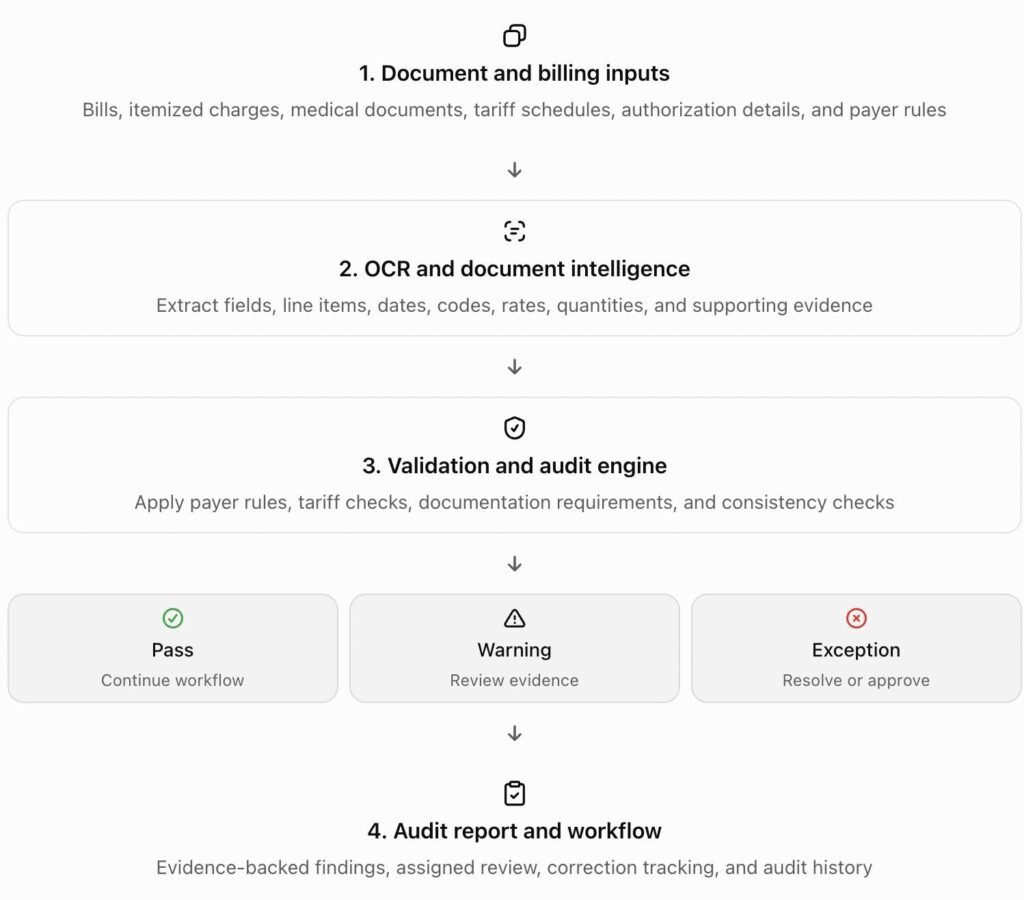
This workflow creates a consistent path from raw billing documents to reviewable audit results.
Step 1: Ingest documents and claim data
The platform receives the relevant billing information and supporting documents through approved integrations or document-upload workflows.
Depending on the implementation, inputs may include:
- Itemized bills
- Medical and treatment records
- Tariff schedules
- Authorization information
- Payer-specific billing instructions
- Relevant claim metadata
Data access should be restricted to the minimum information needed for the audit.
Step 2: Extract information using OCR
OCR converts scanned or image-based documents into machine-readable text. Document intelligence can then identify relevant fields, line items, dates, amounts, and other structured elements.
For example, an itemized bill might contain:
| Field | Extracted value — illustrative |
|---|---|
| Service | Diagnostic procedure |
| Quantity | 1 |
| Billed rate | ₹4,500 |
| Reference tariff | ₹4,000 |
| Potential discrepancy | ₹500 |
The system should preserve the source document and, where possible, the page or region from which each extracted value originated.
OCR confidence is important. If a digit is unclear or a table has been interpreted incorrectly, the system should flag the value for verification rather than treating it as fact.
Step 3: Validate extracted data
Once the document has been structured, the validation engine compares the extracted information with the relevant rules and reference data.
Checks may include:
- Required fields and documents
- Mathematical consistency
- Duplicate line items
- Rate and tariff comparisons
- Code consistency
- Applicable package or contract conditions
- Missing or conflicting information
- Payer-specific documentation requirements
Each check should record the rule applied, the input values, the outcome, and the evidence used.
Step 4: Generate an explainable audit report
Instead of returning a generic message such as “Billing error detected,” the platform should explain what it found.
An illustrative audit finding could read:
Potential tariff discrepancy: The billed rate for a listed service is ₹4,500, while the configured reference tariff is ₹4,000. The difference is ₹500. Confirm that the reference tariff, service mapping, and applicable contract terms are correct before making an adjustment.
This explanation gives the auditor a starting point for verification without assuming that every discrepancy is an actual billing error.
Step 5: Route exceptions for resolution
Exceptions can be categorized by type, severity, owner, and required action.
The workflow can then support correction, resubmission for validation, authorized override, and audit closure.
This is where automated analysis becomes operationally useful: the result is not just a report, but a review process with accountability.
Automated tariff audits: Protecting revenue integrity
Tariff validation is one of the most important capabilities of a claims and billing intelligence platform.
Healthcare billing can involve negotiated rates, package-based pricing, payer-specific rules, service codes, and other contractual conditions. Validating these consistently is essential to maintaining billing accuracy.
The AI Auditor helps identify discrepancies by comparing bill entries with the applicable reference data and configured rules.
Common audit scenarios
| Audit scenario | What the system checks | Potential business impact |
|---|---|---|
| Rate mismatch | Billed rate against the applicable reference tariff | Identifies potential overbilling or underbilling |
| Arithmetic error | Quantity × rate and line totals | Reduces avoidable calculation errors |
| Duplicate charge | Repeated entries that may represent duplicate billing | Prevents duplicate-charge errors |
| Coding inconsistency | Relationships between billing codes and configured mappings | Identifies records needing coding review |
| Missing documentation | Required documents or fields against payer rules | Reduces incomplete submissions |
| Package deviation | Bill items against applicable package conditions | Flags potential contract or policy exceptions |
These checks should be based on current, approved reference data. A rate difference is not automatically an overbilling violation: legitimate exceptions, updated contracts, and special pricing conditions must also be considered.
Why configurable rules matter
Billing policies change. Contracts are renewed, tariffs are updated, and payer requirements may differ across plans.
A configurable administrative rule engine allows authorized users to manage these changes without embedding every rule directly into application code.
A well-governed rule should include:
- A unique rule identifier
- Applicable payer, plan, service, or location
- Rule conditions and severity
- Effective and expiry dates
- Version history
- Approval status
- Test cases
- Audit history of changes
For example, a new tariff should be tested against representative claims before it becomes active. This helps prevent a rule update from generating incorrect exceptions across an entire hospital.
The key principle is controlled configuration rather than uncontrolled automation.
Pre-discharge validation and post-discharge auditing
The AI Auditor supports two complementary audit stages.
Pre-discharge validation
Objective: Identify preventable billing and documentation issues earlier in the workflow.
- Validate bills against applicable payer requirements.
- Check mandatory fields and supporting documentation.
- Identify potential tariff and coding discrepancies.
- Route unresolved exceptions to the appropriate team.
- Provide a reviewable audit summary before claim submission or financial clearance.
Post-discharge auditing
Objective: Identify recurring patterns and improve the overall billing process.
- Analyze historical billing exceptions.
- Identify recurring coding and tariff discrepancies.
- Compare exception patterns across departments or locations.
- Review correction and rejection reasons.
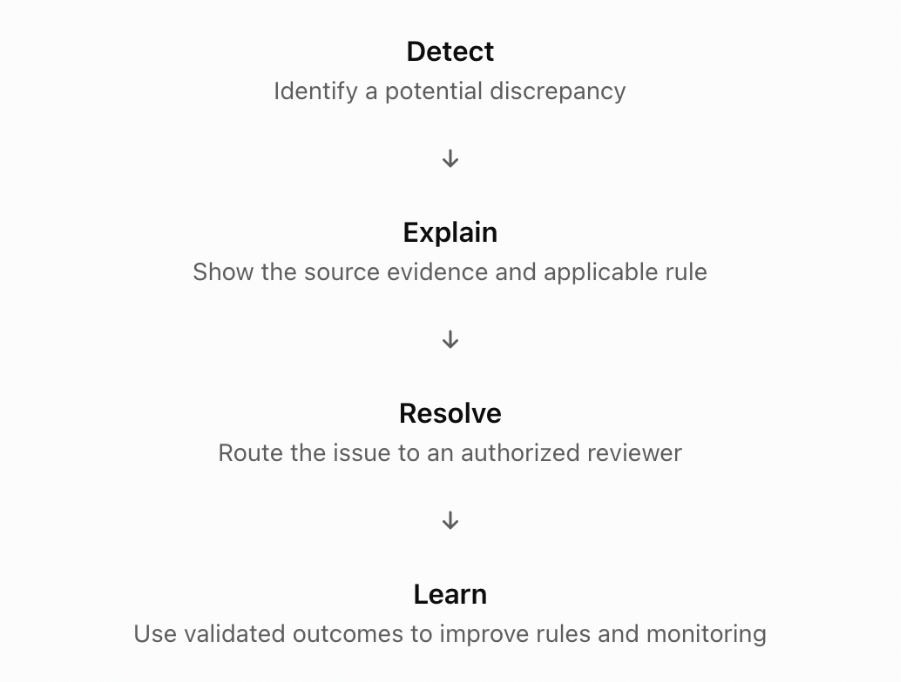
- Feed validated findings back into rule updates, staff training, and process improvement.
Pre-discharge checks focus on preventing avoidable issues in the current case. Post-discharge analysis helps organizations understand which problems recur across cases.
Together, these capabilities create a continuous improvement cycle:
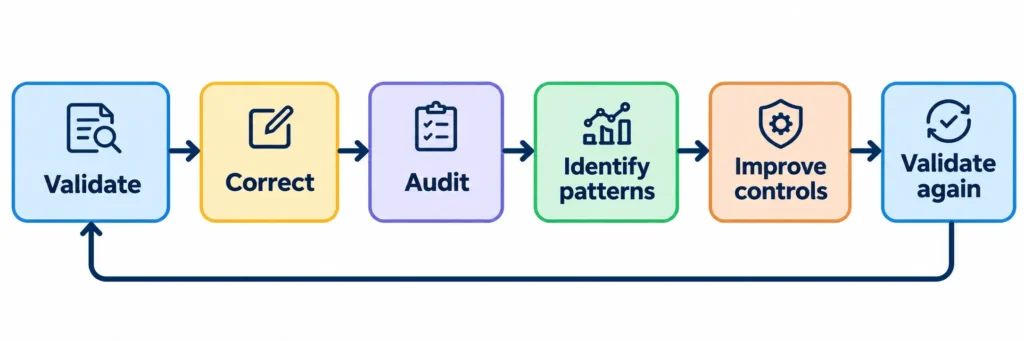
An important operational boundary remains: billing validation should support the discharge process, not determine clinical readiness for discharge. Actual discharge timing also depends on clinical decisions, patient needs, and other operational factors outside the scope of billing automation.
Explainable AI: Making audit findings understandable
In financial and healthcare workflows, a result is useful only when the responsible person can understand and verify it.
An AI Auditor should not simply classify a claim as “incorrect.” It should explain the specific discrepancy, identify the evidence used, and show the applicable rule.
A practical audit record could look like this:
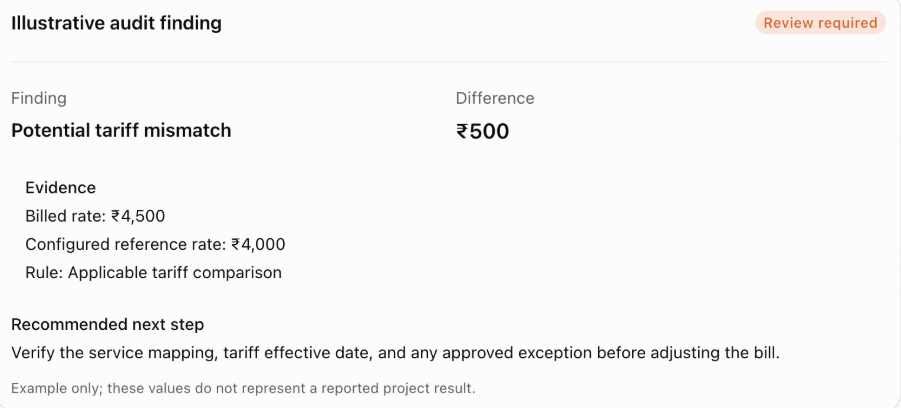
Explainability should include more than a natural-language explanation. Where feasible, the system should retain:
- The source document and relevant extracted fields
- The exact rule and rule version applied
- The values compared
- The validation outcome
- OCR confidence and extraction warnings
- The model or processing version where relevant
- Human reviewer decisions and overrides
This distinction is important because a fluent AI-generated explanation is not, by itself, proof that the underlying finding is correct.
For deterministic checks, the platform should rely on explicit rule execution and reproducible calculations. AI can help interpret documents and communicate findings, but it should not invent the basis for an audit decision.
Technical architecture: Building a reliable AI Auditor
A production implementation should combine document processing, deterministic validation, AI-assisted interpretation, workflow management, and auditable data storage.
The following is a recommended reference architecture based on the capabilities in the case study, not a claim that every component has already been implemented.
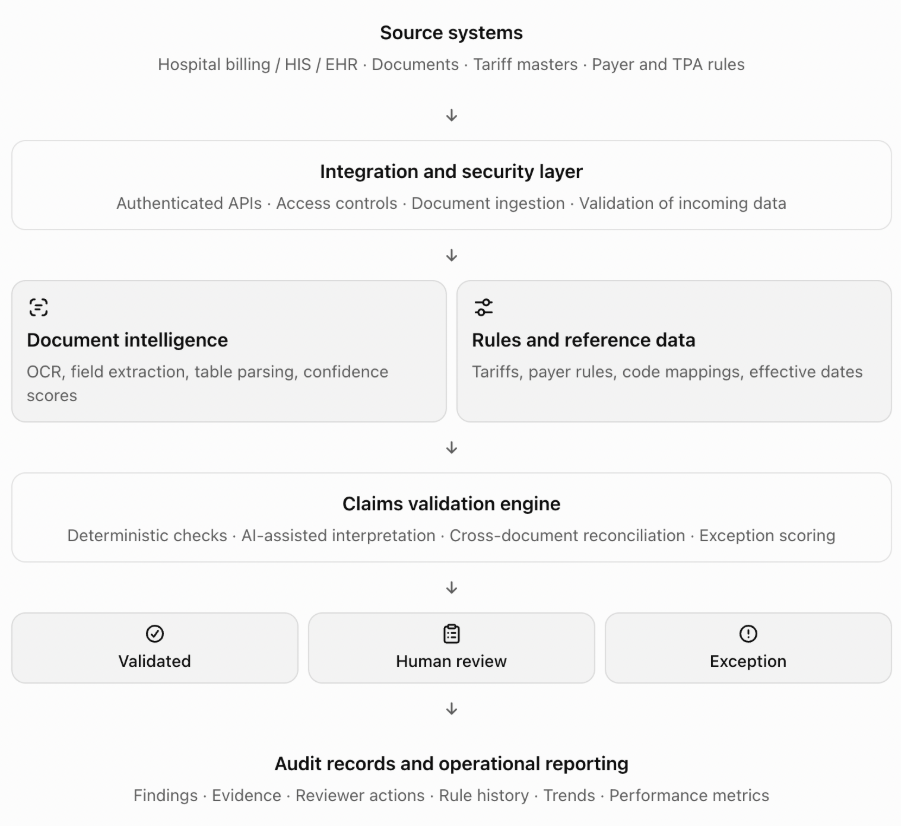
Recommended architectural principles
- Keep the rules engine authoritative. Use explicit logic for calculations, tariff comparisons, required fields, and other deterministic requirements.
- Treat OCR output as extracted evidence, not ground truth. Validate critical values and route low-confidence extraction for human verification.
- Separate models from business rules. A model upgrade should not silently alter the meaning of an approved tariff or payer requirement.
- Make validation reproducible. Store rule versions, reference-data versions, and relevant processing metadata so that a past audit can be reconstructed.
- Design for integration. Use approved interfaces to connect the platform with existing billing and hospital systems, rather than requiring staff to duplicate data manually.
- Monitor the complete workflow. Track extraction quality, rule failures, review queues, processing time, and downstream claim outcomes—not only model response time.
Business value across the healthcare ecosystem
The AI Auditor is designed to address a shared problem: billing errors and documentation gaps create avoidable work for multiple stakeholders.
For hospitals: Revenue integrity and operational efficiency
Hospitals can use pre-submission validation to identify potential errors before a claim reaches the insurer or TPA.
Potential benefits include:
- Earlier detection of billing discrepancies
- Reduced avoidable claim rework
- Better visibility into underbilling and overbilling risks
- More consistent application of approved tariff rules
- Improved audit readiness
- Better prioritization of complex billing cases
The business objective is not to maximize every bill. It is to improve accurate, compliant, and defensible billing.
For TPAs and insurers: Cleaner submissions
A submission that has passed meaningful completeness and consistency checks may require fewer avoidable clarification cycles.
Potential benefits include:
- Better-organized supporting documentation
- Fewer missing-field issues
- Improved consistency in claim submissions
- Reduced manual effort on preventable discrepancies
- Clearer explanations of exceptions
The platform does not replace payer adjudication. Coverage, medical necessity, contractual interpretation, and final payment remain subject to the applicable rules and authorized decision-making processes.
For patients: A better administrative experience
When billing errors and documentation gaps are resolved earlier, the administrative part of discharge may become more predictable.
Potential benefits include:
- Less avoidable waiting caused by billing rework
- Fewer repeated requests for information
- Better communication about unresolved administrative issues
- A smoother transition from treatment to discharge
These are intended outcomes, not guaranteed results. The overall patient experience also depends on clinical readiness, staffing, insurer response times, and other hospital processes.
How to measure the impact of AI Auditor
A credible healthcare AI case study should demonstrate business impact with measurable, auditable evidence.
The supplied case study describes intended benefits but does not provide baseline figures or measured results. The following metrics are therefore recommended for an implementation evaluation.
| Business objective | Recommended metric | How to measure it |
|---|---|---|
| Faster billing validation | Average audit turnaround time | Compare elapsed time before and after implementation |
| Fewer claim corrections | Avoidable rework rate | Track claims returned for correctable billing or documentation issues |
| Improved submission quality | First-pass acceptance rate | Measure the proportion of submissions accepted without preventable correction |
| Better revenue integrity | Confirmed billing discrepancy value | Measure validated discrepancies, separately identifying underbilling and overbilling |
| Improved documentation | Documentation completeness rate | Track required items present at the point of submission |
| More efficient reviews | Manual review time per claim | Measure staff time spent on routine checks and exceptions |
| Better discharge administration | Billing-related discharge delay | Measure time attributable specifically to billing or approval processes |
Establish a baseline before claiming improvement
A practical measurement process should include:
- Capture baseline performance before deploying the AI Auditor.
- Define what counts as an avoidable rejection, billing error, and billing-related delay.
- Pilot the system on a representative set of claims.
- Compare automated findings against expert-reviewed results.
- Measure false positives and false negatives, not only the number of flags generated.
- Compare post-deployment results against the baseline, accounting for changes in claim mix and payer requirements.
- Document the observation period and methodology before publishing any numerical claims.
For example, a future case study could report a reduction in billing-related rework if the result is supported by operational records and a clearly defined measurement period.
Until those results are available, it is more credible to describe the platform’s intended impact than to publish unsupported percentages.
Responsible AI, security and healthcare compliance
The AI Auditor processes information that may include patient identifiers, treatment details, financial data, and other sensitive records. Privacy and security must therefore be part of the architecture from the beginning.
The NIST AI Risk Management Framework identifies trustworthiness considerations including reliability, security, accountability, transparency, explainability, privacy, and management of harmful bias. These principles provide a useful framework for evaluating an AI-powered billing audit system.
NIST+1
Essential controls for a production implementation
Data protection
- Encrypt sensitive data in transit and at rest.
- Apply role-based access controls and least-privilege permissions.
- Minimize the patient information exposed to AI models.
- Define retention and deletion policies.
- Verify data-processing arrangements for external model providers.
Auditability
- Record the applicable rules and reference-data versions.
- Maintain a history of findings, corrections, overrides, and approvals.
- Restrict and log changes to administrative rules.
- Preserve the evidence needed to review disputed findings.
AI quality
- Test OCR on representative document types and scan quality.
- Validate extraction of high-impact fields such as amounts, dates, codes, and quantities.
- Measure precision and recall for important exception categories.
- Test for inconsistent behavior across document formats and relevant populations.
- Re-evaluate the system after material changes to models, rules, or source systems.
Human oversight
- Require human verification for uncertain extractions and consequential exceptions.
- Allow authorized reviewers to correct findings and record reasons.
- Avoid automatic billing adjustments based solely on an unverified AI inference.
- Define escalation procedures for disputed or ambiguous cases.
Regulatory alignment
Applicable requirements depend on the country, payer, organization, and data flows. For example, U.S. deployments must assess relevant HIPAA obligations and applicable claims and documentation standards; other jurisdictions have their own privacy and healthcare requirements. Compliance should be assessed for the actual deployment rather than inferred from the use of AI alone.
CMS guidance illustrates why claims validation must account for structured submission requirements and multiple layers of claim edits, including basic format checks and payment-policy requirements.
CMS+1
Implementation roadmap: From pilot to production
A phased rollout can reduce operational risk and help demonstrate value before expanding across departments or payer relationships.
Phase 1 – Process discovery and rule mapping
Document the current billing workflow, key payer requirements, tariff sources, exception categories, and the causes of avoidable rework. Identify the data owners responsible for each rule.
Phase 2 – Document intelligence pilot
Start with a defined set of common document types. Evaluate OCR and field-extraction performance using expert-verified examples, especially for high-impact fields.
Phase 3 – Rule-based validation
Implement deterministic checks for required fields, arithmetic, tariff comparisons, and approved payer requirements. Version the rules and test them against representative claims.
Phase 4 – AI-assisted exceptions and explanations
Introduce AI-assisted interpretation where document context or complex text requires it. Ensure that findings reference the evidence and rule that triggered the flag.
Phase 5 – Human review and workflow integration
Connect the platform to the relevant operational systems, assign exceptions to responsible teams, and capture resolution status, overrides, and audit history.
Phase 6 – Measurement and controlled expansion
Compare performance against the baseline, refine rules and extraction quality, and expand only after the pilot meets agreed quality, security, and operational thresholds.
A successful rollout depends on collaboration between billing specialists, finance teams, medical coders, IT, compliance, and payer-facing operations. AI accuracy alone cannot compensate for outdated reference tariffs or unclear ownership of billing rules.
Key lessons for organizations adopting healthcare billing AI
Lesson 1: Prevention is more valuable than late-stage correction
Identifying a discrepancy before submission can avoid downstream rework. The benefit depends on the issue being detected accurately and resolved in time.
Lesson 2: Document intelligence must be paired with deterministic validation
OCR extracts information; validation rules test it. Neither capability should be mistaken for the other.
Lesson 3: Explainability is an operational requirement
An auditor needs to know what failed, which rule applied, and where the evidence came from. A generic AI-generated conclusion is insufficient.
Lesson 4: Configurable rules require governance
The ability to change rules quickly is useful only when changes are authorized, versioned, tested, and auditable.
Lesson 5: Revenue integrity means correcting both directions of error
An effective billing audit should identify potential underbilling as well as overbilling. Its objective is accurate and compliant billing, not simply increasing charges or reducing claim values.
Lesson 6: The best AI systems measure downstream outcomes
A successful validation model should be evaluated against expert review and actual claim outcomes. The number of flags generated is not a meaningful measure of success by itself.
The future of claims and billing intelligence
The next stage of healthcare billing automation is likely to connect document understanding, rules-based validation, workflow orchestration, and operational analytics more closely.
Over time, organizations may extend this approach to exception prioritization, recurring discrepancy analysis, and recommendations for improving billing processes.
The important boundary is that additional automation should follow demonstrated reliability, appropriate authorization, and clear accountability. High-impact financial decisions should not become fully autonomous merely because the system can generate a confident explanation.
Conclusion: Building a more intelligent healthcare financial workflow
Healthcare billing is a complex operational process that directly affects hospitals, insurers, and patients.
When document checks, tariff audits, and payer-specific validations rely heavily on manual review, avoidable errors can create additional work and delay financial clearance.
The AI Auditor addresses this challenge by combining OCR-based document intelligence, configurable validation rules, automated tariff checks, explainable audit reports, and post-discharge analysis.
Its intended value is to help healthcare organizations identify potential discrepancies earlier, reduce avoidable rework, improve revenue integrity, and make billing workflows more predictable.
The broader lesson extends beyond healthcare: AI delivers the greatest operational value when it is integrated with authoritative business rules, verifiable evidence, human accountability, and measurable outcomes.
The objective is not to automate every billing decision. It is to make routine validation more consistent, make exceptions easier to investigate, and allow qualified professionals to focus their attention where judgment matters most.
Related Searches
- How To Reduce ETL Pipeline Costs Without Sacrificing Performance
- Why Enterprise Data Pipelines Fail at Scale and How to Build Reliable Data Engineering
- Top Generative AI Development Companies in 2026
- Top AWS Consulting Partner in India 2026