
The New Line Item Nobody Budgeted For
Six months into any serious LLM rollout, a familiar meeting happens: someone from finance asks why the AI bill tripled and nobody in engineering can answer with certainty. Not because the spend is unjustified, usually it isn’t but because nobody built the plumbing to see it coming.
LLM spend behaves nothing like traditional infrastructure cost. A misconfigured autoscaling group costs you money in a predictable, linear way. A single agent stuck in a retry loop calling GPT-4-class models can burn a month’s budget in an afternoon, and the first signal you get is the invoice.
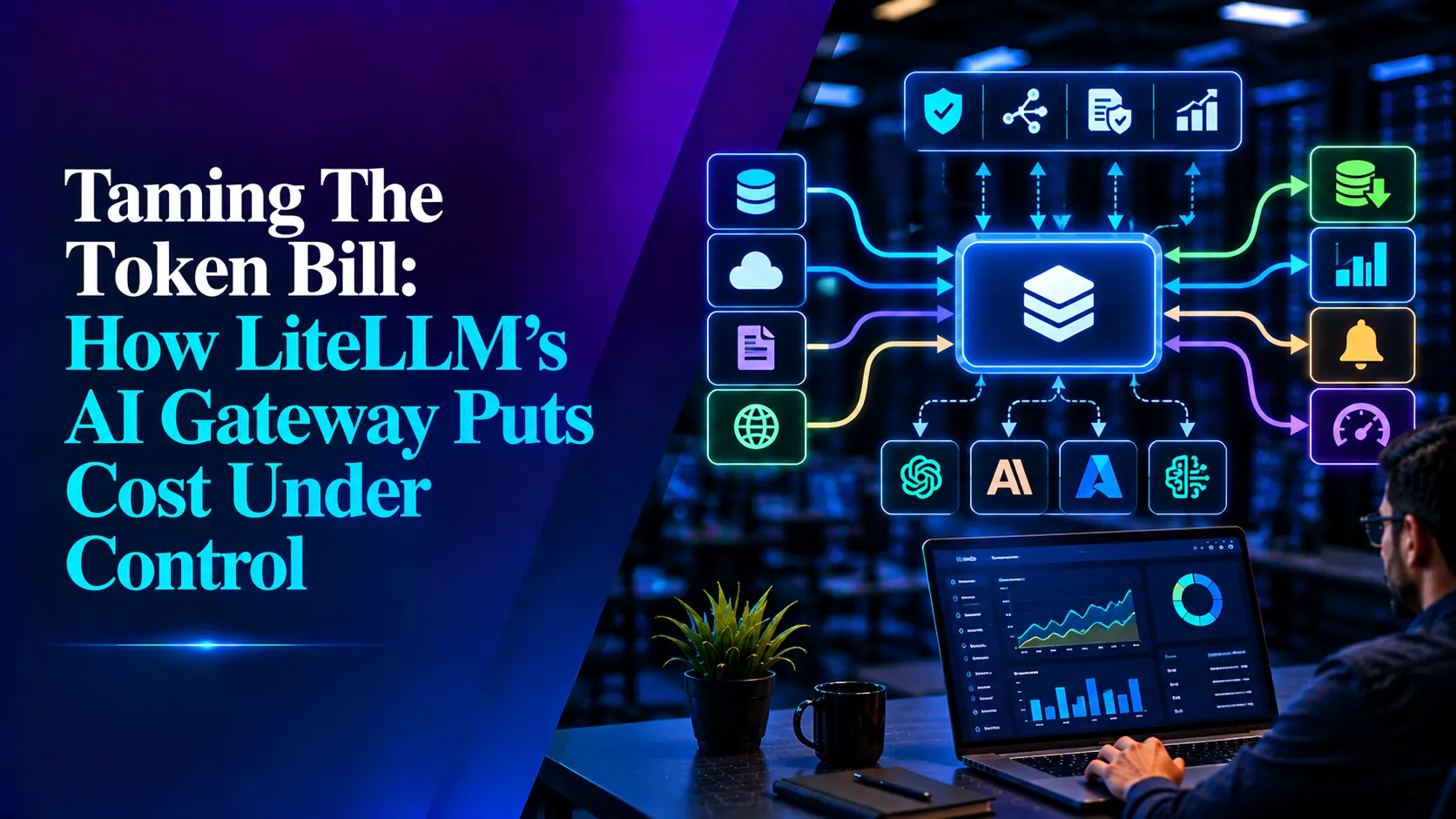
This is the gap an AI gateway like LiteLLM is built to close. Not routing, not reliability, though it does bothm but the fact that it turns LLM spend from something you discover into something you control. This post is narrowly about that: LiteLLM as a cost-management plane.
Token Economics 101 – Why This Is Actually Hard
Before getting into tooling, it’s worth being precise about why LLM cost is a harder problem than it looks.
Pricing isn’t per-request, it’s per-token and asymmetric. Input and output tokens are priced differently, sometimes by 3-5x. A workload that’s heavy on output generation (long-form drafting, code generation) has a fundamentally different cost profile than one that’s heavy on input (RAG pipelines stuffing context windows). Two teams can make “the same number of API calls” and have wildly different bills.
The multipliers are invisible until they aren’t. A few things quietly inflate token spend without anyone noticing in the moment:
- Context window bloat – chat histories, tool schemas, and RAG chunks accumulate across a session
- Tool-calling round trips – every intermediate step in an agentic loop is a full request with its own token cost, and agent frameworks can iterate many times per user-facing task
- Retries – a transient failure retried three times is three times the spend, silently
- Streaming vs. batch pricing, batch APIs are often 50% cheaper, but only if someone deliberately routes to them
Cost is fragmented across providers. A team using OpenAI for one workload, Anthropic for another, and a self-hosted open-weight model for a third has three separate billing surfaces, three separate pricing models, and zero unified view. Standard cloud cost dashboards (AWS Cost Explorer, GCP Billing) have no visibility into any of this, it’s a third-party SaaS spend, not infrastructure, so it lives entirely outside your normal FinOps tooling.
The Problems We Were Actually Facing
Strip away the tooling conversation and here’s what we were actually running into:
- No attribution. When the bill came in, we couldn’t break it down by team, project, or feature. Was it the new RAG pipeline, or the agent that had been in beta for two weeks? Without per-key or per-team tracking, every cost investigation turned into an archaeology exercise through logs.
- No enforcement, only observation. Our “cost control” was a dashboard someone checked weekly. There was no hard stop. A single buggy agentic loop , the kind that calls itself recursively or retries indefinitely on a malformed tool response, could blow through a monthly budget before anyone looked at the dashboard again.
- Provider sprawl multiplied the blast radius. Every new model integration meant a new API key, a new SDK, a new place spend could leak from, each with its own ad-hoc tracking or none at all.
- Shadow usage. Individual engineers were spinning up their own provider API keys to move fast, entirely outside any central governance. That spend was invisible until finance found it, a security and compliance problem as much as a cost one.
- We were entirely reactive. Our cost-management maturity level was “find out after the invoice.” We had no mechanism that intervened before the spend happened.
How We Solved It With LiteLLM
We put LiteLLM’s proxy in front of every application and every LLM provider, and used it as our cost-control plane rather than just a routing layer. Here’s what that solved, concretely:
Virtual keys fixed attribution. Instead of every team holding a raw OpenAI or Anthropic key, we issue virtual keys scoped to a team, project, or individual user. Every request routes through the proxy, which means every request is attributable. This alone solved the “who spent what” problem, spend is tied to a key, not buried in a shared credential.
Budgets and rate limits fixed enforcement. We put a hard budget daily, weekly or monthly, on every virtual key, team, and model, along with request-per-minute and token-per-minute caps. Once a budget is exhausted, the proxy rejects further requests instead of letting spend run unbounded. That turned “we saw the spike after the fact” into “the spike couldn’t happen.”
Real-time spend tracking fixed our reactive posture. LiteLLM maintains a pricing map across supported models and calculates cost per request as it happens, logging it centrally. We now have a live ledger instead of a monthly reconciliation exercise — spend is visible as it accrues, not after the provider’s invoice arrives.
Routing as a cost lever fixed provider sprawl. We use fallback routing not just for reliability but to route to a cheaper model when a budget threshold is approached, or to load-balance across providers to exploit pricing differences, instead of every team hardcoding “which model” independently.
Alerting fixed the “too late” problem. We wired up webhook and Slack alerting on budget thresholds, so a team gets a warning at 80% of budget instead of a postmortem at 150%.
Taken together, this changed the gateway from something sitting in the request path for speed and reliability into something that made our spend observable and enforceable at the point of consumption, instead of after the fact.
Open Source vs. Enterprise – Where the Line Actually Sits
This is where teams evaluating LiteLLM usually have the most confusion, so it’s worth being precise.
What’s available in the open-source proxy:
- Virtual key creation and management
- Budgets and rate limits at the key, user, or team level
- Per-request spend logging and cost tracking against the model pricing map
- Basic routing and fallback logic
What’s gated to the Enterprise tier:
- SSO and role-based access control for who can create or modify budgets and keys, governance over the governance layer
- Advanced analytics and reporting dashboards, beyond raw spend logs
- SLA-backed support
- Some audit-logging and compliance features aimed at regulated environments
The practical read: cost tracking itself is not paywalled. A small-to-mid-sized engineering org can self-host the OSS proxy and get real attribution, real budgets, and real enforcement without paying anything beyond infra costs. What Enterprise adds is organizational governance around that capability, who’s allowed to touch the controls, and audit trails proving they did it correctly. That distinction matters more once an org crosses from “a few teams using LLMs” to “LLM spend as a company-wide, compliance-relevant line item.”
Practical Takeaways
Here’s the sequencing that worked for us, if you’re standing this up for the first time:
- Put every provider behind the proxy first. No direct API keys in application code, this is the precondition for everything else.
- Issue virtual keys per team or project before scaling usage. Retrofitting attribution after the fact means reconstructing history you don’t have.
- Set budgets before you need them. A budget configured after a runaway-spend incident is a postmortem action item; configured before, it’s the thing that prevents the incident.
- Wire up alerting at the 80% threshold, not just the 100% hard stop. The goal is a warning with room to act, not just a wall.
- Know where OSS stops. Spend tracking and enforcement work fine on the free tier; if you need RBAC over who manages budgets or compliance-grade audit trails, that’s a deliberate Enterprise conversation, not a default.
Token economics means LLM cost scales with usage patterns that are much harder to predict than traditional compute, non-linear, provider-fragmented, and easy to lose visibility into inside an agentic loop. An AI gateway doesn’t make that complexity go away, but it moves cost control from something you reconstruct after the invoice to something enforced at the moment the request is made. That shift, from observability to enforcement, is really the whole value proposition.
Related Searches
- How Leading Telecom Enterprise Transformed Enterprise Analytics with Fractal GPT
- Real-Time Banking Data And AI-Powered Mule Detection with Confluent Platform
- Modernizing Healthcare Data Integration with Azure Event Hubs – OpsTree
- Implementing Supervisor Process Monitoring with Open Telemetry