

What Is ETL Process Optimization?
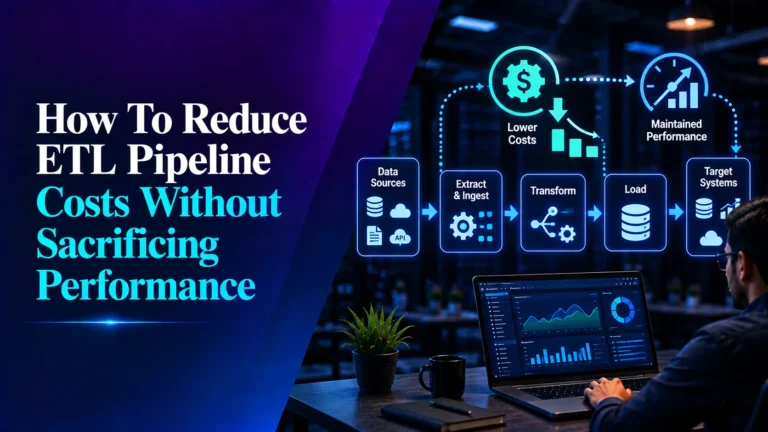
The primary objective of ETL process optimization is to improve the methods used to extract data from source systems, transform it, and load it onto target platforms. The goal is to ensure that data pipelines operate smoothly, processing costs are managed effectively, and accurate data is available in a timely manner.
For data engineering teams, the primary challenge often lies not just in handling large volumes of data, but in maintaining performance as that volume grows. A pipeline that efficiently processes thousands of records may encounter issues related to speed and cost when faced with larger datasets, evolving source systems, or more complex transformation logic.
To effectively optimize ETL pipelines, it is essential to first identify where bottlenecks are occurring. Potential causes include the repeated extraction of entire tables, inefficient SQL queries, uneven data distribution in Apache Spark, slow write operations to the database, or jobs being scheduled at the wrong times. Simply increasing compute resources without understanding the root cause will not solve the underlying problem; instead, it will only lead to higher costs.
A robust strategy for improving ETL performance encompasses several techniques, such as incremental data loading, efficient transformation, appropriate data partitioning, resource allocation based on workload, and continuous monitoring. The optimal combination of these techniques will depend on various factors, including the volume of data, requirements for data freshness, existing infrastructure, and specific business goals.
In this guide, we will show you how to identify common ETL bottlenecks, select the best optimization strategies, enhance pipeline reliability, and evaluate whether these changes yield significant improvements in performance and cost.
How Do You Optimize an ETL Process?
To effectively optimize your ETL process, first assess key metrics such as runtime, data volume, resource utilization, failure rates, and the costs associated with each stage of the pipeline. Once you have identified the bottlenecks, implement appropriate solutions to address them:
- Slow extraction: Consider implementing incremental loading, using Change Data Capture (CDC), applying filtering at the source, and selecting specific columns.
- Slow transformations: Strive to optimize your SQL queries, reduce unnecessary joins, address data skew issues, and avoid inefficient processes such as row-by-row processing.
- Slow loading: Leverage bulk writes, partition your data carefully, and choose efficient file formats like Parquet.
- High cloud costs: Right-size your computing resources, avoid unnecessary full-system refreshes, and reduce the consumption of idle resources.
- Unreliable pipelines: Implement data quality checks, incorporate idempotent writes, manage retries effectively, and monitor for schema drift.
- Recurring performance regressions: Keep a close eye on runtime metrics at every stage, while also monitoring data freshness, failure rates, and the costs incurred during each run.
Overview of The ETL Processes (Extract, Transform and Load)
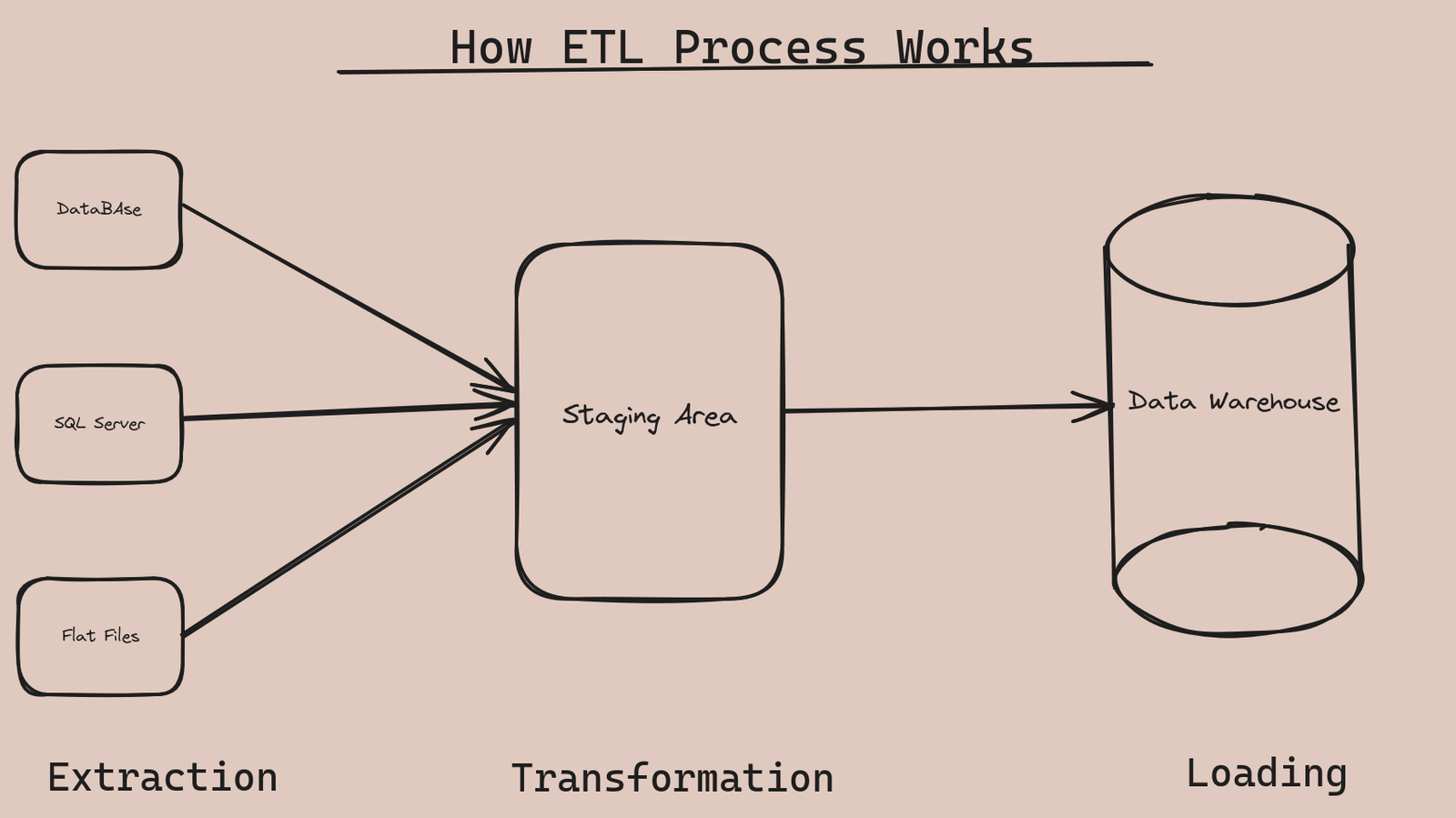
ETL stands for Extract, Transform, and Load. It is defined as a set of processes to extract data from one system, transform it, and load it into a central repository.
This central repository is known as the Data Warehouse.
The choice of ETL (Extract, Transform, Load) architecture can significantly impact efficiency and decision-making.
Two popular ETL approaches batch processing and real-time processing, offer unique advantages tailored to specific needs and scenarios.
Batch Processing: This traditional method involves collecting data over a period and processing it in large chunks at scheduled intervals. Batch processing is ideal for tasks that do not require immediate data updates, such as end-of-day reporting, data warehousing, and periodic data migrations.
Its main advantage lies in its ability to handle high volumes of data efficiently, often during off-peak hours, reducing the strain on system resources.
Stream (or real-time) Processing: Also known as streaming ETL, real-time processing deals with data as it arrives, providing near-instantaneous updates and insights.
This architecture is essential for applications that demand up-to-the-minute information, such as fraud detection, real-time analytics and personalized customer experiences.
The key benefit of real-time processing is its ability to respond quickly to changing data, enabling more agile decision-making and immediate action.
Why ETL Process Optimization Matters for Big Data
Data pipelines that should complete in just a few minutes can run for hours or days if left unoptimized. This often happens when the workload exceeds the memory capacity of a single machine, necessitating the use of distributed frameworks like Spark. Different types of data – whether structured records, semi-structured logs, unstructured content or IoT streams require specific transformation logic. When pipelines do not function correctly, it not only impacts performance but can also significantly increase cloud computing costs.
1. Incremental loading and change data capture (CDC)
Explain why repeatedly extracting an entire table wastes resources, how watermarks work, and when log-based CDC is preferable. Include a simple SQL example and discuss late-arriving updates and deletes.
2. SQL and transformation optimization
Cover set-based SQL, predicate pushdown, column projection, unnecessary joins, and Spark data skew. Also, explain how improvements can be verified using query plans and execution metrics.
3. Bulk loading, partitioning and file sizing
Explain when bulk writes are beneficial, how partitioning affects data scans, and why having an excessive number of small files can degrade performance in object-storage-based pipelines.
4. Orchestration, data quality and recovery
Incorporate dependency-aware scheduling, idempotent loads, retries, checkpoints, schema drift detection and validation, both during data ingestion and prior to data publication.
5. ETL cost optimization and observability
Include metrics such as cost per run, cost per unit of data, runtime trends, data freshness, failure rates, and resource utilization. Explain how to compare these metrics before and after a change.
ETL Cost Optimization: Reduce Spend Without Sacrificing Performance
Optimizing ETL costs is not just about choosing smaller compute instances. It requires a deep dive into your data processing metrics: how much data is processed in each run, how long resources remain active, the frequency of data transformations, and whether the final data meets the required standards for freshness and quality.
To begin, assess the cost incurred per pipeline run, and consider doing the same for each gigabyte or terabyte of data processed. This distinction helps in identifying actual shifts in workloads, rather than merely reflecting a decline in processing efficiency.
Here are several strategies to enhance cost efficiency:
- Right-size compute resources: Benchmark representative workloads before increasing cluster or warehouse capacity. More workers may not help when a single skewed task or source-system limit controls the runtime.
- Avoid unnecessary full refreshes: Use incremental processing when the source and business requirements support it.
- Schedule resources around workload demand: Configure suitable auto-stop or auto-suspend policies and avoid keeping expensive resources idle between scheduled runs.
- Separate competing workloads: Where appropriate, isolate scheduled ETL jobs from interactive analytics so that one workload does not consume capacity required by another.
- Reduce data movement: Filter at the source, select only necessary columns, and review cross-region or cross-network transfer costs.
- Review storage layout: Use suitable columnar formats, partition pruning, and file compaction where supported by the storage and processing engine.
When working with AWS, adopt a holistic approach rather than optimizing each service in isolation. This involves reviewing AWS Glue job execution, worker configuration, Amazon S3 data organization, and Amazon Redshift query and workload performance in an integrated manner.
After implementing the changes, compare the runtime, total cost, cost per data unit, and data freshness. The ideal configuration is one that meets the service-level requirements of your workload while keeping operating costs at a reasonable level, it is not necessarily the configuration that completes the task the fastest.
How to Identify ETL Pipeline Performance Bottlenecks
Before changing the architecture or increasing compute capacity, identify which stage consumes the most time or resources. Review execution logs, query plans, task-level metrics, and data volumes across the extraction, transformation, loading, and orchestration stages.
| Observed problem | Possible cause | Recommended action |
|---|---|---|
| Extraction takes longer as tables grow | Full-table reads or inefficient source queries | Implement incremental extraction, CDC, and source-side filtering |
| A few Spark tasks run much longer than others | Data skew or uneven partition sizes | Inspect task metrics, optimize join keys, and evaluate Adaptive Query Execution |
| Transformation consumes excessive compute | Repeated calculations, inefficient joins, or row-by-row processing | Rewrite queries, remove redundant operations, and reuse appropriate intermediate results |
| Loading is slow despite fast transformations | Row-by-row writes, excessive indexes, or small files | Use bulk loading, review indexes, and compact small files where appropriate |
| Jobs queue behind other pipelines | Scheduling conflicts or concurrency limits | Adjust schedules, dependencies, and workload allocation |
| Runtime is acceptable but costs continue to rise | Oversized resources, unnecessary refreshes, or data transfer | Review cost per run, compute sizing, refresh frequency, and transfer charges |
| Jobs succeed but reports contain incorrect or stale data | Missing validation or freshness monitoring | Add data quality checks, reconciliation, and freshness alerts |
Replace Unnecessary Full Loads With Incremental Processing
To improve ETL pipelines, it can be highly beneficial to focus solely on the data that has changed since the last successful run. Rather than performing a ‘full refresh’, which processes the entire dataset, even though most records remain unchanged, adopting ‘incremental loading’ is a more efficient approach. As the size of the source table increases, repeatedly processing the entire dataset can lead to longer execution times, higher network transfer volume, and greater consumption of computing resources.
Incremental loading uses a ‘watermark’ (such as a reliable timestamp of changes or a monotonically increasing identifier) to identify new and updated records. This allows the pipeline to extract only the necessary changes and apply them to the target, eliminating the need to rebuild the entire dataset.
For example, if you have a pipeline that manages the orders table, you can implement a timestamp-based extraction query.
SELECT order_id, customer_id, order_status, updated_at
FROM source_orders
WHERE updated_at > :last_successful_watermark
  AND updated_at <= :current_run_watermark;
Here, last_successful_watermark and current_run_watermark represent application-managed parameters. It is essential that the pipeline advances its checkpoint only after a batch has been fully processed and its successful completion has been confirmed. To handle scenarios where the order of source records may vary, it is advisable to implement a defined overlap or adopt another strategy to account for late-arriving data.
Relying solely on timestamp-based extraction may not be sufficient for every scenario. Situations can arise where deleted records fail to appear in your query, or updates with unreliable timestamps are missed. ‘Change Data Capture’ (CDC) offers a solution to these issues; it tracks inserts, updates, and deletions by monitoring the change logs or other change feeds of supported databases.
Opt for timestamp-based incremental loading when the source metadata is reliable and your scheduled refresh intervals align with your business requirements. However, if the volume of changes is very high, if it is necessary to consistently track deleted data, or if frequent querying makes it difficult to maintain the required level of data freshness, then CDC becomes a better choice.
Always validate the results against both the source and target data, especially when implementing a new incremental strategy. While incremental processing can reduce unnecessary effort, it does not entirely eliminate the need for reconciliation or regular recovery checks.
These symptoms are merely diagnostic indicators, not definitive proof. For instance, a slowdown in a Spark stage could be caused by data imbalance, insufficient resources, network I/O issues, or costly shuffle operations. Before implementing any solutions, verify the root cause using execution metrics.
Optimize SQL Queries Before Increasing Compute
When a transformation is delayed, it does not necessarily mean that your pipeline requires additional processing power. Issues such as inefficient joins, unnecessary scans, superfluous columns, and overly broad filters can force the engine to process more data than is actually needed.
For example, consider a reporting pipeline designed to extract order records, where only orders completed within a specific date range are required.
An incorrectly constructed query might look something like this:
SELECT *
FROM orders;
A more targeted extraction is:
SELECT order_id, customer_id, order_total, order_date
FROM orders
WHERE order_date >= :start_date
  AND order_date < :end_date
  AND order_status = 'completed';
The second query streamlines the requested columns and rows, assuming that the filters align with reporting requirements. The impact on physical reads can vary based on factors such as database design, indexing, partitioning, storage format, and the chosen query plan.
For critical analytical tasks, it is essential to analyze the execution plan both before and after making any changes to a query. Examine how filters are applied, how joins are executed, the volume of data scanned, and whether these operations trigger costly processes, such as moving or transferring data to disk.
In the context of Apache Spark workloads, it is also useful to examine task duration and shuffle metrics. If some tasks are significantly slower than others, you should investigate the possibility of data skew before deciding to increase the number of workers.
The goal is, first and foremost, to minimize unnecessary processing, and to increase computing resources only when profiling indicates that they are genuinely required for the workload.
What Enterprise Buyers Look for in an ETL Modernization Partner
Organizations modernizing their ETL processes often evaluate consulting partners on their ability to optimize data pipelines in terms of performance, scalability, governance and sustainable business growth. Decision-makers seek expertise in areas such as ETL optimization, AWS Glue, Amazon Athena, AWS Lake Formation, Amazon Redshift, metadata management, automated workflow orchestration, data quality validation and cloud cost management. Beyond improving batch and streaming ETL performance, businesses now expect modern data platforms to support AI initiatives, advanced analytics, and Retrieval-Augmented Generation (RAG) workloads without requiring major architectural changes. As an Best Data Engineering Company, OpsTree Global empowers organizations to create secure, governed and AI-ready data platforms that streamline data processing, simplify operations, and provide reliable insights at scale.
Strategies for Optimizing ETL Processes in Large-Scale Data Pipelines
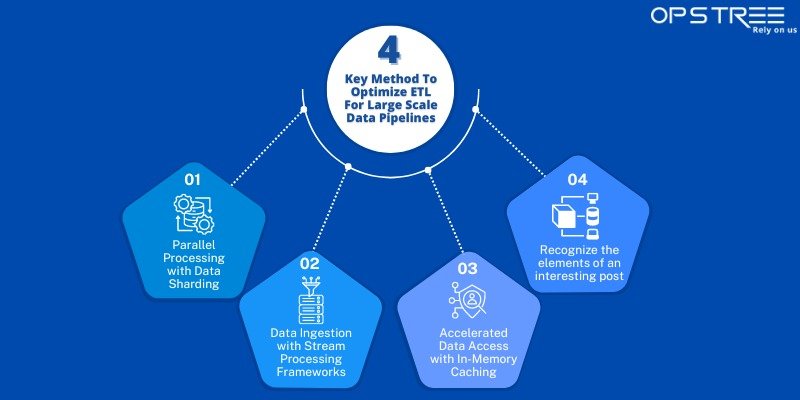
1. Parallel Processing with Data Sharding
Parallel processing with data sharding enhances the efficiency and scalability of ETL workflows by breaking down large datasets into smaller, manageable pieces called shards.
This allows organizations to process data concurrently across multiple nodes, significantly reducing processing time, especially with massive data volumes.
To implement parallel processing effectively, strategic planning is crucial. This involves carefully selecting appropriate sharding keys and ensuring balanced data distribution.
Tools such as Apache Hadoop, Apache Spark, and Google BigQuery provide robust frameworks for parallel processing, making it easier for organizations to adopt and scale this approach.
Real-world applications, like Facebook, use Hive on Hadoop in their data warehouse. This tells us about the scalability and efficiency achieved through parallel processing and data sharding.
2. Data Ingestion with Stream Processing Frameworks
Stream processing frameworks help in optimizing ETL processes by enabling continuous data ingestion and real-time processing.
Unlike traditional batch processing, stream processing handles data as it arrives, allowing for immediate insights and actions.
This approach is important for applications requiring timely data updates, such as real-time analytics and monitoring.
Popular frameworks like Apache Kafka, Apache Flink, and Apache Storm offer powerful tools for efficiently managing and processing streaming data.
These frameworks support a variety of use cases demonstrating the versatility and effectiveness of stream processing in modern ETL architectures.
However, implementing stream processing also comes with challenges, such as ensuring data consistency and managing high-throughput streams requiring careful consideration and planning.
3. Accelerated Data Access with In-Memory Caching
In-memory caching speeds up ETL processes by storing frequently accessed data in memory, reducing the need to repeatedly fetch data from slower disk storage.
This not only improves performance and accelerates data processing tasks but also proves essential for managing frequent read-and-write operations.
Popular solutions like Redis and Memcached are well-suited for this purpose, offering reliable and scalable options for integrating caching into ETL pipelines.
By caching intermediate data, ETL workflows achieve faster data access and reduced latency, thereby improving overall efficiency.
To effectively leverage in-memory caching, it’s essential to choose the right caching strategy, implement efficient cache eviction policies, and monitor cache performance closely to ensure optimal results.
This approach not only speeds up data retrieval but also enhances the responsiveness of applications, contributing to a smoother and more efficient data processing experience.
4. Cost-Effective Resource Management with Cloud Autoscaling
Cloud autoscaling plays a crucial role in optimizing ETL workflows by automatically adjusting resource allocation based on workload demands.
This capability ensures that ETL processes have the necessary computing power during peak times while minimizing costs during off-peak periods.
Cloud providers like AWS Auto Scaling and Azure Autoscale offer features that automate resource management, making it easier for organizations to handle fluctuating data volumes without manual intervention.
Implementing autoscaling involves strategies like setting appropriate scaling policies, monitoring usage patterns, and optimizing resource allocation to balance performance and cost-efficiency effectively.
How to Measure ETL Process Optimization Results
ETL process optimization should produce measurable improvements rather than rely on assumptions that a pipeline has become more efficient.
Before making changes, record a baseline and compare the results under a similar workload. As far as possible, ensure this includes an identical time frame, a comparable volume of data, and consistent cost-accounting rules.
| Metric | What to measure | Why it matters |
|---|---|---|
| Pipeline runtime | Total duration and time per stage | Shows where execution time is spent |
| Data throughput | Records or bytes processed per unit of time | Helps assess processing capacity |
| Cost per run | Compute, storage I/O, and applicable data transfer costs | Reveals the financial impact of each run |
| Data freshness | Time between source changes and target availability | Confirms whether the pipeline meets business requirements |
| Failure and retry rate | Failed runs, repeated tasks, and recovery frequency | Shows whether reliability is improving |
| Data quality | Validation failures, missing records, duplicates, and reconciliation differences | Ensures performance improvements do not compromise correctness |
| Resource utilization | CPU, memory, disk I/O, network usage, and shuffle activity where applicable | Helps distinguish resource constraints from inefficient processing |
Instead of applying a uniform performance threshold to every pipeline, use these metrics to set distinct targets tailored to the specific workload.
For instance, in a daily financial reporting pipeline, the priority might be ensuring that tasks are completed reliably before a morning deadline, whereas in a fraud detection pipeline, the focus would be on minimizing data latency. Consequently, their optimization strategies and success criteria will differ.
Wrapping Up
Optimizing ETL processes is paramount for businesses managing vast datasets. Continuous monitoring and refinement are key to sustaining optimal ETL performance. Regularly evaluating and optimizing ETL pipelines will ensure that organizations can adapt to changing data volumes, evolving business needs, and advancements in technology.
Frequently Asked Questions
1. What is ETL process optimization?
ETL process optimization improves data extraction, transformation, and loading workflows, thereby reducing unnecessary processing, controlling operational costs, enhancing reliability, and meeting requirements for data freshness. Common techniques include incremental loading, SQL optimization, efficient partitioning, and pipeline monitoring.
2. How can I improve ETL pipeline performance?
First, measure the runtime at every stage of the pipeline. Where appropriate, use incremental extraction, minimize unnecessary data scans, optimize SQL queries and joins, employ efficient data-loading methods, and check resource limits before scaling compute resources. Re-measure the workload after every change.
3. How does incremental loading improve ETL performance?
Incremental loading processes only new or modified records, rather than repeatedly processing the entire dataset. This helps reduce data transfer, transformation tasks, and the consumption of computing resources. Implementing it effectively requires reliable change tracking, checkpoint management, and a strategy for handling deleted or late-arriving data.
4. What is the difference between ETL optimization and ETL modernization?
ETL optimization improves the performance, cost, and reliability of an existing pipeline or platform. ETL modernization changes the underlying architecture, tools, or processing model when the existing platform cannot meet current requirements. The appropriate choice depends on measured bottlenecks, technical constraints, and the business case for change.
Related Searches
- LLM-Powered ETL: How GenAI is Automating Data Transformations
- The Complete Guide To Data Pipelines With Architecture, Types and Use Cases
- Building a Reliable Cloud Data Storage Architecture for Big Data
- How To Reduce ETL Pipeline Costs Without Sacrificing Performance