

The Scenario Every Engineering Leader Knows
Let’s assume your quarterly planning call is wrapping up and someone mentions that three senior engineers spent the better part of last sprint handling infrastructure access requests, debugging deployment pipelines, and writing runbooks for the fourth time. These are not junior engineers figuring things out. These are the people you hired to build your product.
You look at the velocity numbers. The sprint burned 40% of its capacity on work that had nothing to do with shipping features. Your product roadmap is slipping, your engineers are frustrated and somewhere in that frustration is a resignation letter waiting to be written.
This is not a DevOps failure. It is a scaling problem. And platform engineering services exist precisely to solve it.
What DevOps Actually Promised (And Where It Got Complicated)
DevOps made a compelling promise when it arrived, tear down the wall between the people who build software and the people who run it. Collaborate more. Ship faster. Fix things together. For a certain size of organization, that promise delivered handsomely.
The philosophy worked. Small, cross-functional teams took ownership of their services end to end. “You build it, you run it” became a rallying cry, and it gave developers real accountability. Deployment frequency climbed. Incident response improved. Things got better.
But here is what nobody warned you about. At scale, “you build it, you run it” starts to mean “you build it, you also configure the CI/CD pipeline, write the Terraform modules, manage the Kubernetes cluster, handle the monitoring alerts, coordinate with the security team, and then maybe find time to write some actual code.”
Every team reinvents the same wheel, slightly differently. Your Go team builds their pipeline one way. Your Python team builds theirs another way. Your data engineering team has a third approach entirely. None of them are wrong, but all of them are expensive to maintain.
DevOps, as a philosophy, was never designed to scale infinitely. It was a correction to a specific dysfunction. Platform engineering is the next correction.
What Platform Engineering Actually Means
Here is an analogy that works every time, imagine building a city. In the early days, each household digs its own well, installs its own water pipes, and figures out its own electricity. It is chaotic, inefficient, and every new resident has to solve the same basic problems from scratch.
Then someone decides to build a municipal infrastructure layer, running water, power grids, roads. Residents no longer need to worry about where their water comes from. They just turn on the tap.
Platform engineering services work exactly this way inside your organization. A dedicated platform team builds and maintains the internal infrastructure, tools, and paved roads that every other development team uses. Developers stop configuring cloud environments and start building features. They self-serve what they need through a well-designed internal interface. The cognitive overhead that was silently draining your teams disappears.
The platform is not a background IT function. It is a product. The customers are your own engineers. And like any good product, it should be intuitive, reliable, and constantly improving based on user feedback.
Central to this model is the internal developer portal, a single hub where developers can spin up environments, view service catalogs, access documentation, trigger pipelines, and check the status of their deployments, all without filing a ticket or waiting on another team.
DevOps vs. Platform Engineering: A Business Lens
| Dimension | DevOps | Platform Engineering |
|---|---|---|
| Primary Goal | Break silos between dev and ops, shared ownership | Reduce cognitive load on developers, enable self-service at scale |
| Who Owns Infrastructure | Shared across dev and ops teams | Dedicated platform team treats infra as an internal product |
| Developer Experience | Varies by team, often inconsistent | Standardized, curated, and continuously improved |
| Speed of Onboarding | New engineers inherit each team’s unique setup | Faster, new developers onboard via a shared, documented platform |
| Scalability | Becomes harder as team count grows | Designed to scale, one platform serves many teams |
| Tooling Approach | Often ad hoc or team-specific | Standardized via IaC Terraform and reusable infrastructure modules, enforced across teams |
| Best Suited For | Small to mid-size teams, early-stage product companies | Mid-to-large engineering organizations with multiple teams shipping in parallel |
Why CTOs Are Making the Switch Right Now
If you spend time talking to engineering leaders at growth-stage companies, a pattern emerges quickly. The conversations sound less like technology debates and more like operational ones. Here is what is actually driving the shift.
1. Developer productivity is measurable now
DORA metrics, deployment frequency, change failure rates, these are boardroom-level conversations today. When a CTO can see that their engineers spend 35% of their time on infrastructure and tooling rather than product work, it is no longer an abstract concern. It is a line item in the cost of engineering. Platform engineering moves that number.
2. Talent retention has a direct link to developer experience
Engineers leave when they feel like their skills are being wasted. Nobody joined your company to write YAML for the fifth time this month. When you invest in a platform that handles the repetitive infrastructure work, your best people get to do the work they actually care about. That matters in any talent market.
3. Faster time-to-market for new teams
When a new product team stands up, how long does it take before they can ship? In a DevOps-heavy environment without centralized tooling, it can take weeks. In a platform engineering model with a good internal developer portal, that same team can be deploying within days. The math on that compounds quickly across a growing engineering organization.
4. Cognitive load is a real operational risk
Engineers who are context-switching between building features and managing infrastructure are more prone to incidents. Not because they are careless, but because context-switching is genuinely cognitively expensive. A platform that handles the infrastructure layer lets engineers go deeper on product work. Incidents go down. Quality goes up.
The Role of IaC and Terraform in Platform Engineering
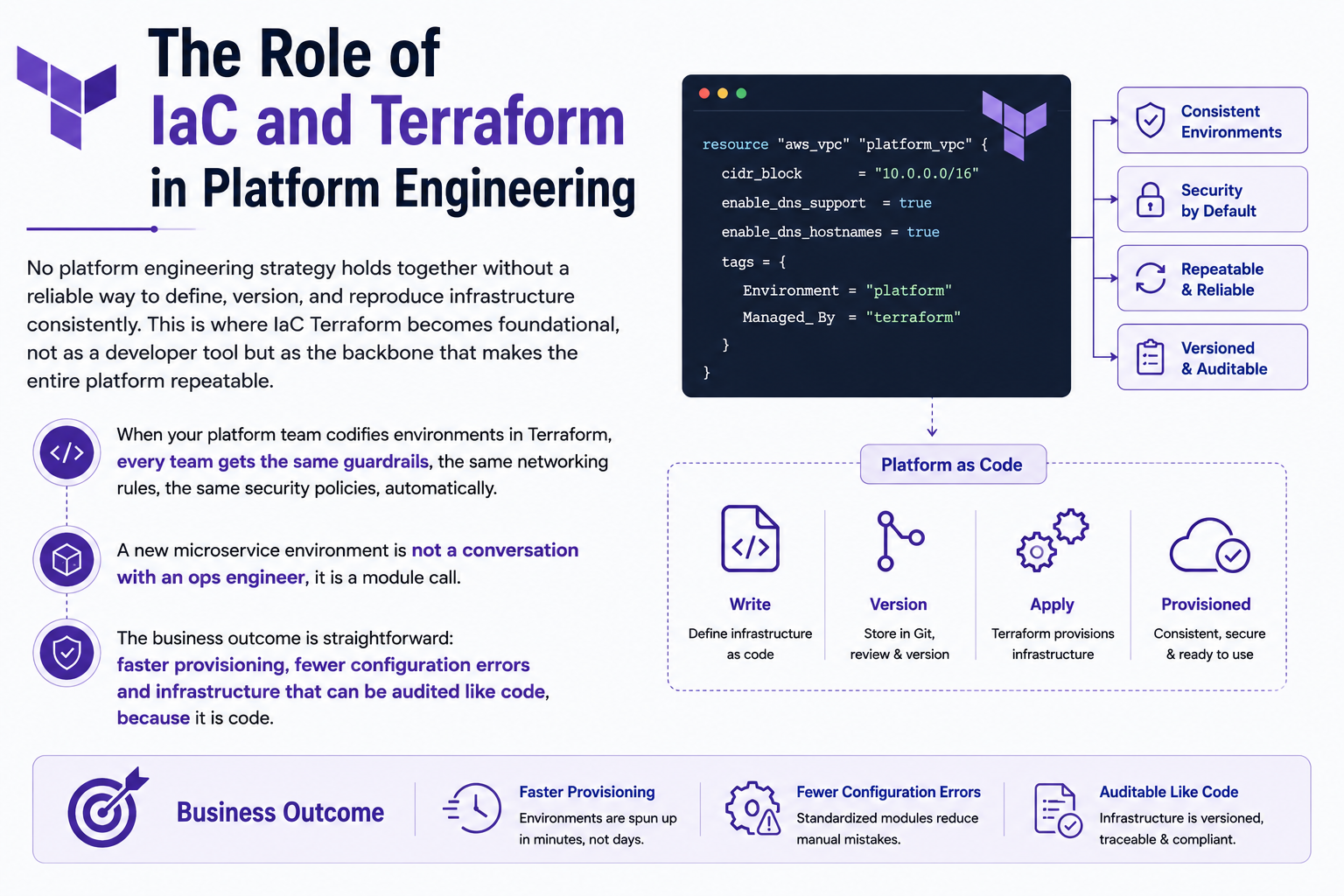
No platform engineering strategy holds together without a reliable way to define, version, and reproduce infrastructure consistently. This is where IaC Terraform becomes foundational, not as a developer tool but as the backbone that makes the entire platform repeatable. When your platform team codifies environments in Terraform, every team gets the same guardrails, the same networking rules, the same security policies, automatically. A new microservice environment is not a conversation with an ops engineer, it is a module call. The business outcome is straight forward : faster provisioning, fewer configuration errors and infrastructure that can be audited like code, because it is code.
What a Good Internal Developer Portal Looks Like
Think of the internal developer portal as the front desk of your engineering operations. When a new developer joins, or when an existing team needs to spin up a new service, they do not need to know who to email. They walk up to the front desk, find what they need, and get it done.
A well-built portal gives your developers a service catalog, letting them see every service running in your organization, who owns it, and how it connects to other services. It provides scaffolding templates so new projects start correctly from day one. It surfaces health metrics, deployment status, and documentation without requiring anyone to hunt through five different tools.
Spotify’s open-source Backstage platform is the most widely adopted reference for what a mature internal developer portal looks like in practice. It was built to solve Spotify’s own scaling problems and has since become the foundation on which hundreds of engineering organizations have built their own portals. If you want to understand what the ecosystem looks like before committing to a build-or-buy decision, it is worth exploring.
Is Platform Engineering Right for Your Organization?
How do you know when DevOps has hit its scaling ceiling?
Ask yourself four questions. First, are your developers spending more than 25 to 30 percent of their time on infrastructure-related tasks rather than building product? Second, do you have more than three or four independent teams deploying to production? Third, is your onboarding time for new engineers measured in weeks rather than days? Fourth, are you seeing the same infrastructure patterns being reinvented across teams?
If two or more of those answers are yes, you are likely at the inflection point where platform engineering starts paying for itself.
One more honest question worth sitting with: Is your engineering team growing faster than your ability to standardize how work gets done? Because if it is, and you continue scaling DevOps practices linearly, the inconsistency compounds. The platform engineering model is specifically designed for that inflection point.
This is not a question of DevOps being wrong. It is a question of whether your current model matches the complexity of the organization you are running today.
How an Auto-Commerce Platform Saved $45K and Reclaimed 500+ Developer Hours Monthly with OpsTree
A leading auto-commerce platform faced rising cloud costs, growing security risk, and the complexity of migrating from GCP to AWS. OpsTree stepped in to overhaul their engineering infrastructure end to end. The result: over $45,000 saved in under six months, more than 500 developer hours reclaimed every month, and a 72% reduction in risk exposure. Read the full story on the OpsTree case study page.
Frequently Asked Questions
Q: What is platform engineering, and how is it different from DevOps?
A: Platform engineering is a discipline focused on building internal infrastructure, tooling, and developer platforms that engineering teams use as a product. DevOps is a broader cultural philosophy about collaboration between development and operations. Platform engineering typically emerges as an evolution of DevOps at scale, when shared ownership of infrastructure starts creating inconsistency and inefficiency across multiple teams.
Q: What does a platform engineering team actually do?
A: A platform engineering team builds and maintains the internal tools, pipelines, deployment environments, and developer portals that other engineering teams rely on. They are responsible for making infrastructure self-service, standardizing how software is built and deployed, and reducing the operational burden on product engineering teams.
Q: When should a company invest in platform engineering services?
A: Most organizations start seeing the need between 50 and 150 engineers, or when they have more than three or four independent product teams deploying software in parallel. If onboarding new teams takes weeks, if infrastructure work is consuming more than 25% of developer time, or if you are seeing inconsistent tooling across teams, those are strong signals that a platform engineering model would deliver measurable returns.
Q: What role does IaC Terraform play in platform engineering?
A: Terraform is typically used as the foundational layer for defining and managing cloud infrastructure as code. In a platform engineering model, the platform team owns and maintains standardized Terraform modules that all product teams consume. This ensures consistency, security, and repeatability across every environment the organization operates.
Q: Does adopting platform engineering mean abandoning our current DevOps practices?
A: Not at all. Platform engineering builds on the culture of collaboration that DevOps established. The shift is additive, not disruptive. The goal is to centralize infrastructure concerns so that product teams can focus on shipping, while the platform team provides the reliable, self-service foundation they need to do that well.
Related Blogs
- Your MTTR Is High Because Your Observability Is Fragmented – Here’s the Fix
- Zero Downtime Cloud Migration: Is It Actually Possible? (Yes. Here’s How)
- The Hidden Cost of Building DevSecOps In-House VS. a Managed Partner