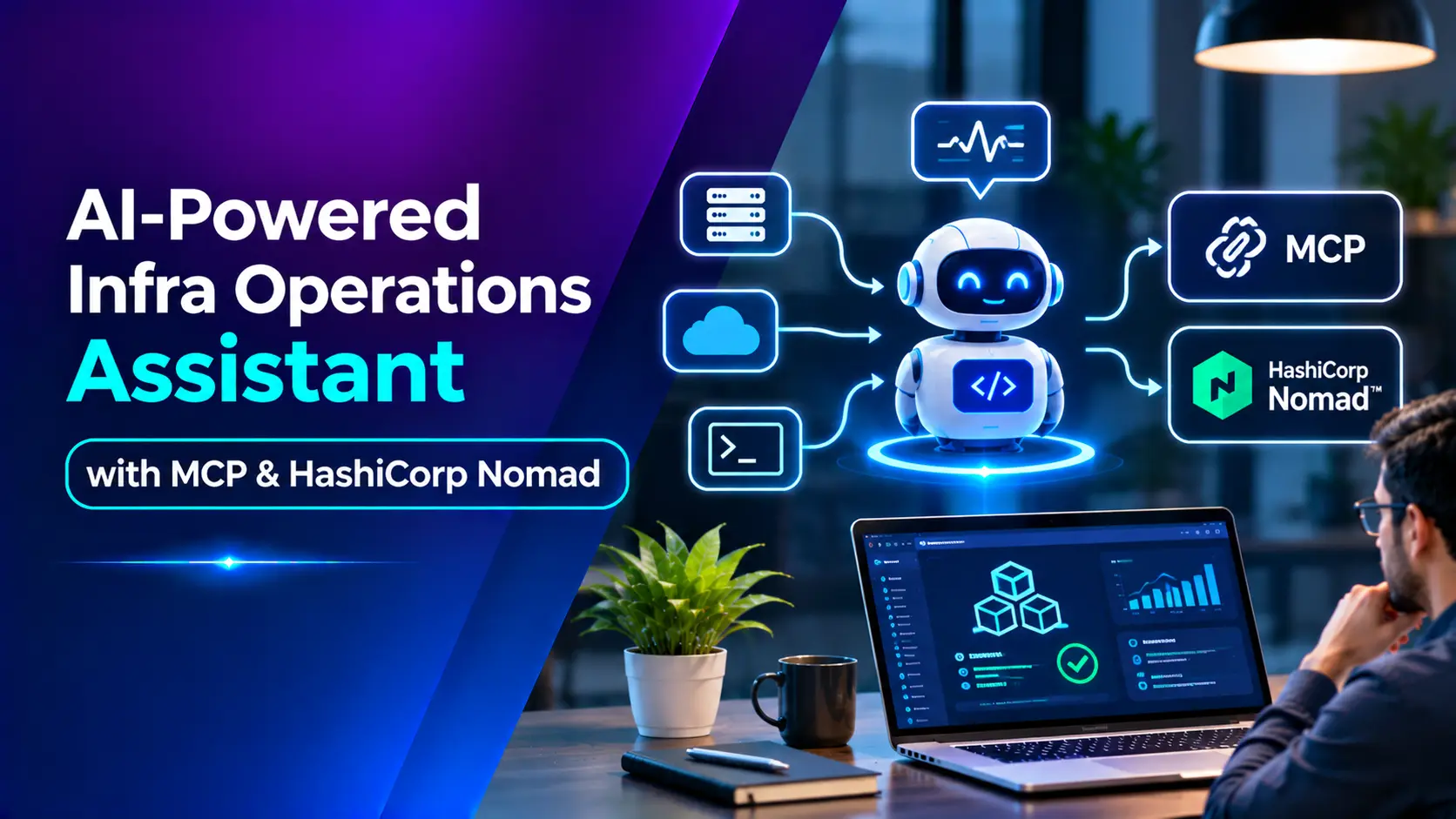

How Model Context Protocol (MCP) can connect AI agents with infrastructure platforms to accelerate incident triage, improve operational visibility, and support intelligent cluster management.
Executive summary
Modern infrastructure teams operate increasingly complex environments where application workloads are distributed across clusters, services depend on multiple infrastructure components, and incidents require engineers to correlate information from several monitoring and ticketing systems.
For teams managing large-scale HashiCorp Nomad environments, investigating job failures, allocation issues, deployment problems, and resource constraints can require substantial manual effort. Engineers often need to move between cluster management interfaces, incident management platforms, ticketing systems, logs, and dashboards before they can establish what happened and determine the appropriate response.
This creates operational friction, particularly during on-call rotations, when investigation speed and access to accurate infrastructure context are critical.
To address this challenge, an AI-powered infrastructure operations assistant is being developed using the Model Context Protocol (MCP). The solution introduces an MCP server that provides a controlled interface between AI agents and HashiCorp Nomad clusters.
Rather than requiring engineers to manually gather information from multiple systems, an AI agent can use authorized MCP tools to retrieve cluster information, inspect job and allocation details, review deployment status, and through planned integrations, correlate infrastructure data with observability platforms.
The initiative follows a phased implementation strategy:
- Phase 1 – Foundation: A proof of concept providing visibility into Nomad clusters, jobs, tasks, allocations, resource usage, and deployments. This phase is complete.
- Phase 2 – Tool integration and security: Planned integrations with HAProxy, Consul, Splunk, and Grafana, alongside formal security review.
- Phase 3 – Production scale and intelligence: Dependency mapping, historical trend analysis, capacity-planning recommendations, and deployment across four production environments with authentication and authorization.
The broader objective is to move infrastructure operations from fragmented, manual investigation toward a more contextual, evidence-based and AI-assisted incident management workflow.
Importantly, the AI assistant is intended to support engineers, not replace operational ownership, incident command, or authorized remediation decisions.
The challenge: Infrastructure operations across disconnected systems
Infrastructure incidents rarely exist in isolation. A failed application deployment may be related to resource constraints, an unhealthy allocation, a service-discovery issue, or a dependency that is unavailable.
When operational information is spread across different systems, engineers must manually connect these signals before they can understand the incident.
Manual incident triaging
When a PagerDuty alert or operational ticket is raised, engineers may need to:
- Identify the affected Nomad job and deployment.
- Inspect job and task execution details.
- Review allocation health and resource utilization.
- Determine whether the issue affects one workload or multiple services.
- Search logs and monitoring dashboards for supporting evidence.
- Correlate findings with the relevant incident or ticket.
Each investigation requires engineers to gather context from multiple sources. This adds overhead, particularly when several incidents occur simultaneously.
Higher mean time to resolution (MTTR)
Mean time to resolution (MTTR) is influenced by more than the time needed to fix an issue. The time spent identifying the affected component, gathering evidence, understanding dependencies, and validating a hypothesis can also be substantial.
When PagerDuty incidents, Radar tickets, Nomad cluster information, and observability data are reviewed independently, the investigation process becomes fragmented.
The result can be slower diagnosis and longer incident-resolution cycles.
Operational complexity and specialized knowledge
Large-scale workload orchestration environments require engineers to understand scheduling, deployments, allocations, resource utilization, service discovery, and application dependencies.
This knowledge is not always distributed evenly across an on-call team. Less experienced engineers may need additional support to interpret infrastructure signals, while experienced engineers can become a bottleneck for recurring investigations.
The need for contextual infrastructure intelligence
Traditional monitoring tools provide metrics, alerts, and logs. However, engineers still need to interpret these signals and connect them to the operational context of a specific incident.
The opportunity is to introduce an intelligence layer that can:
- Retrieve relevant infrastructure information.
- Organize it around the incident being investigated.
- Correlate evidence from multiple systems.
- Summarize likely causes and affected components.
- Recommend investigation steps with supporting evidence.
This is where MCP becomes valuable.
The solution: Connecting AI agents with infrastructure through MCP
The solution introduces a Model Context Protocol server that acts as a controlled integration layer between AI agents and infrastructure management systems.
MCP provides a standardized way for an AI application to discover and invoke tools exposed by an MCP server. In this implementation, those tools are designed to expose relevant Nomad operational information without requiring the AI agent to interact directly with the underlying infrastructure interfaces.
Integration & Data Ingestion: Strengthening AIOps Observability interlinksoftware.com
What is MCP and why does it matter?
The Model Context Protocol is an open protocol that standardizes how AI applications connect to external tools and context providers.
In a conventional integration, an AI application may require custom code for every external system it needs to access. MCP introduces a consistent interface through which compatible clients can discover and invoke tools.
For infrastructure operations, this means an AI agent can access specific capabilities—such as retrieving job details or inspecting allocation status—through a governed MCP server.
The MCP server does not independently make the AI model an infrastructure administrator. It exposes only the capabilities that the server implementation and its access controls permit.
Why MCP is suitable for infrastructure operations
| Operational requirement | How MCP helps |
|---|---|
| Access to cluster information | Exposes approved Nomad inspection tools |
| Multiple infrastructure integrations | Provides a consistent tool interface for different systems |
| Contextual incident investigation | Allows an agent to retrieve relevant information as needed |
| Controlled access | Supports a defined boundary between AI clients and infrastructure services |
| Extensibility | Enables additional tools and integrations to be introduced in phases |
The central design principle is to make infrastructure information accessible to AI agents through controlled, auditable interfaces.
Phased implementation: From cluster visibility to operational intelligence
The initiative is structured in three phases. This approach establishes a reliable foundation before introducing additional integrations, predictive capabilities, and broader production access.
Phase 1: Foundation — Establishing visibility into Nomad clusters
Completed: Proof of concept
The first phase focused on giving AI agents controlled visibility into the Nomad environment.
The objective was to expose essential cluster information through MCP tools so that an engineer could ask operational questions in natural language and receive structured information from the underlying platform.
Capabilities established in the proof of concept
| Capability | Operational purpose |
|---|---|
| Cluster overview | Retrieve information about the Nomad cluster |
| Job and task details | Inspect workload configuration and execution status |
| Allocation details | Understand the state of individual workload allocations |
| Resource utilization | Review available resource information |
| Deployment status | Inspect deployment progress and status |
For example, an engineer investigating a failed workload could ask:
What is the current status of this job, which allocations are unhealthy, and what resource information is available?
The AI agent can use the exposed MCP tools to retrieve relevant information and organize it into a readable response.
Instead of navigating several interfaces to collect basic cluster context, engineers receive a consolidated starting point for investigation.
Why this phase matters
The proof of concept establishes the integration pattern between an AI client and the Nomad environment. It demonstrates how infrastructure inspection capabilities can be exposed through a standardized interface.
It also provides a foundation for adding additional tools without rebuilding the entire integration approach for every new data source.
Phase 2: Tool integration and security — Building a broader operational context
Planned implementation
The second phase expands the assistant beyond Nomad cluster visibility by connecting it with supporting infrastructure and observability systems.
A Nomad job’s status provides only part of the incident context. Engineers may also need to understand service discovery, network routing, historical logs, and monitoring signals.
The planned integrations include:
| Platform | Planned role | Investigation value |
|---|---|---|
| HAProxy | Networking and traffic-routing context | Help investigate routing and availability-related issues |
| Consul | Service discovery and service health context | Help identify service registration and discovery problems |
| Splunk | Historical and operational log analysis | Provide evidence from relevant log events |
| Grafana | Metrics and dashboard context | Correlate resource and application trends with incidents |
These integrations are intended to help the AI assistant move from answering what is happening in Nomad? to helping engineers investigate what might be contributing to the incident?
Example: Correlating infrastructure signals
Consider a hypothetical incident in which a workload becomes unhealthy. An investigation could follow this sequence:
- Retrieve the affected job and allocation information from Nomad.
- Inspect relevant resource utilization.
- Check service-discovery information through Consul.
- Review network-routing context from HAProxy.
- Search historical logs in Splunk.
- Examine relevant metrics in Grafana.
- Summarize the evidence and identify investigation priorities.
This does not mean every incident will require every integration. The assistant should retrieve only the information relevant to the incident and the tools available to the requesting user.
The important shift is from isolated infrastructure checks to cross-system incident context.
Security review and governance
Security is a critical part of this phase because an MCP server creates a new interface through which AI applications can access infrastructure information.
The implementation is undergoing formal security review and signoff. Before broader deployment, the following controls should be addressed:
- Authentication for clients and service-to-service communication.
- Authorization at the tool and infrastructure-resource level.
- Least-privilege Nomad ACL policies.
- Environment-specific access boundaries.
- Secure credential storage and rotation.
- Request validation and input sanitization.
- Audit logging for tool invocation and access.
- Protection of sensitive information in model context and generated responses.
- Rate limits, timeouts, and controlled error handling.
A particularly important design decision is to distinguish read-only investigation tools from tools capable of changing infrastructure state.
The initial operational assistant should prioritize read-only access. If remediation capabilities are introduced later, high-impact operations should require explicit authorization, approval, and auditable execution.
Phase 3: Production scale and intelligence — Moving toward proactive operations
Planned future phase
The third phase expands the solution from infrastructure visibility and investigation assistance toward broader operational intelligence.
Three capabilities form the focus of this phase.
Application dependency mapping
A cluster incident does not always affect only the workload where the problem originated.
An application may depend on other services, routing components, discovery mechanisms, or shared infrastructure. Understanding these relationships helps engineers estimate the potential impact of an incident.
The planned dependency-mapping capability aims to identify relationships between applications and infrastructure components.
An illustrative dependency view could look like this:
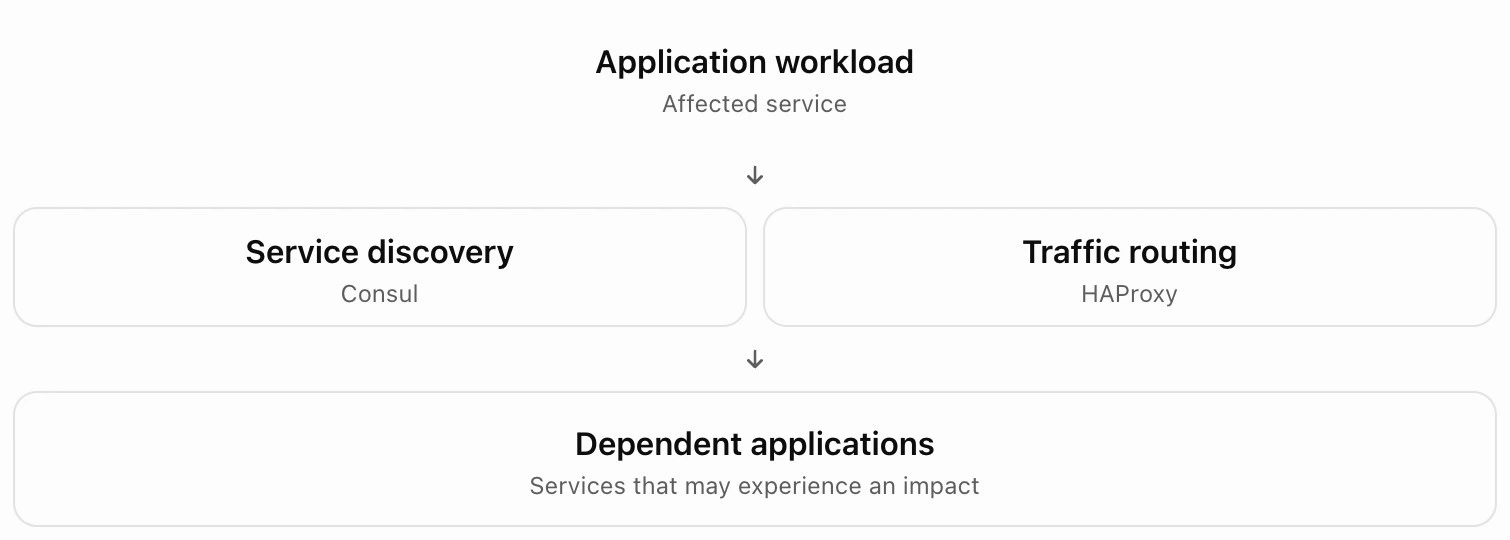
Conceptual example of dependency relationships, not a representation of the actual production topology.
With this context, an AI agent could provide an impact summary that identifies:
- The workload where the incident originated.
- The services that depend on it.
- The infrastructure components involved.
- The available evidence of downstream impact.
- The systems that may require further investigation.
Dependency mapping should be based on verified service relationships and current operational metadata. The assistant should distinguish confirmed dependencies from inferred relationships.
Historical trend analysis and capacity planning
The planned predictive capability uses approximately three months of historical trends to support capacity analysis and resource-change suggestions.
This moves the solution beyond individual incident investigations toward understanding how infrastructure behaves over time.
Potential analysis areas include:
- CPU and memory utilization trends.
- Resource allocation versus actual consumption.
- Peak workload periods.
- Allocation and job failure patterns.
- Capacity pressure across environments.
- Recurring resource constraints.
For example, if a workload repeatedly approaches its resource limits during specific periods, the assistant could highlight the pattern and suggest that the engineering team review its resource configuration.
However, historical correlation does not automatically establish the cause of a failure or guarantee future demand. Predictive recommendations should be evaluated against historical holdout periods, operational constraints, and engineering review before being applied.
Production deployment across four environments
The final planned deployment scope covers all four production environments, with authentication and authorization (AuthN/AuthZ).
Production readiness should include more than connecting the MCP server to additional clusters. It should establish consistent operational controls across environments.
Recommended production considerations include:
- Environment-specific endpoints and credentials.
- Separate authorization policies.
- Centralized audit logging.
- Monitoring of MCP server availability and latency.
- Rate limiting and concurrency management.
- Failure isolation between environments.
- Versioned tool definitions and integration contracts.
- Deployment, rollback, and incident-response procedures.
The aim is to make the solution reliable and governed enough to support real operational workflows at scale.
How an AI-assisted incident investigation could work
The most valuable part of this architecture is the ability to combine infrastructure information with incident context.
Consider a hypothetical PagerDuty alert associated with an operational ticket.
Illustrative incident investigation workflow
Incident received
PagerDuty generates an alert and the corresponding operational ticket provides the initial incident context.
Nomad investigation
The AI agent retrieves relevant job, task, allocation, deployment, and resource information through the MCP server.
Cross-system investigation
As integrations become available, the agent retrieves relevant networking, service-discovery, log, and metrics context.
Evidence correlation
The agent organizes findings by timestamp, affected workload, status, and supporting source.
Incident summary
The assistant produces a concise summary of the observed symptoms, potential contributing factors, affected components, and recommended next checks.
Engineer review and resolution
The on-call engineer verifies the findings, decides on remediation, and records the outcome in the incident workflow.
Example of an AI-generated incident summary
The following is an illustrative response, not a result from an actual incident:
Incident investigation summary Observed symptoms
- A workload allocation is reporting an unhealthy state.
- The associated deployment requires investigation.
- Resource utilization should be reviewed for potential capacity pressure.
Potential contributing factors
- Resource constraints.
- Deployment-related issues.
- Service-discovery or networking problems.
Recommended investigation
- Inspect allocation events and task state.
- Review resource utilization around the incident timestamp.
- Check relevant application logs.
- Verify service registration and routing.
- Confirm whether dependent services are affected.
The summary deliberately distinguishes observed symptoms from possible causes. A potential cause must be supported by evidence before it is treated as a diagnosis.
This is the difference between a basic chatbot and an operational assistant: the latter should retrieve live, relevant information and ground its conclusions in verifiable evidence.
Recommended technical architecture
The following reference architecture illustrates how the solution can evolve as integrations are introduced. It is a recommended logical design, not a claim that every component is already deployed.
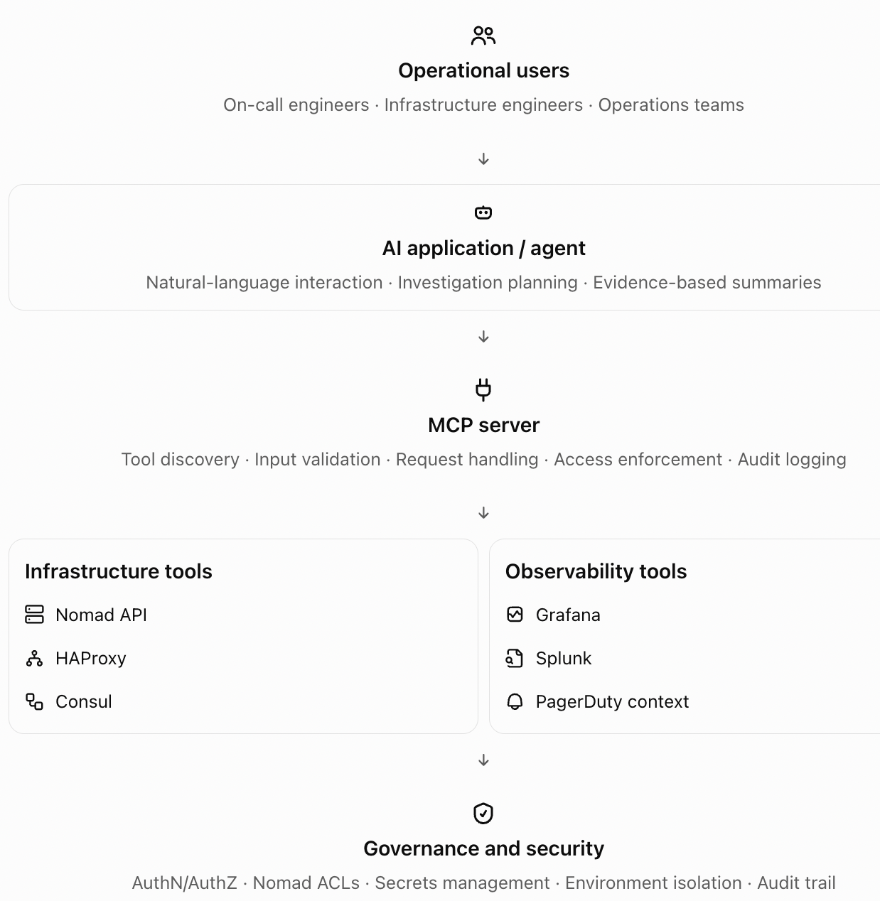
Conceptual architecture. Production implementation details and integration boundaries should be finalized during security and solution design reviews.
Architecture design recommendations
Use the Nomad API as the infrastructure integration boundary
The MCP server should use supported Nomad APIs to retrieve job, allocation, deployment, and resource information. Nomad provides dedicated API endpoints for these operations, with ACL requirements that can be used to scope access.
HashiCorp Developer+2
Separate the MCP interface from the AI reasoning layer
The MCP server should expose narrowly scoped tools with well-defined inputs and outputs. The AI agent should decide which information is relevant, while the server remains responsible for enforcing access restrictions and executing approved operations.
Use observability systems as evidence providers
Nomad telemetry, Grafana dashboards, and Splunk logs can provide complementary perspectives on infrastructure behavior. Metrics describe system behavior over time, while logs provide detailed event context. Combining them can make incident investigation more useful.
HashiCorp Developer+2
Introduce dependency context as a separate capability
Dependency mapping should be maintained through verified service relationships and refreshed as infrastructure changes. It should not rely exclusively on an LLM’s assumptions about which services depend on one another.
Make production deployment environment-aware
Each production environment should have its own approved access scope, credentials, configuration, and monitoring. A request authorized for one environment should not automatically grant access to another.
Security and governance: Making infrastructure access safe for AI
Infrastructure MCP servers deserve a stronger security model than ordinary information-retrieval applications.
A tool that can inspect production infrastructure has access to operationally sensitive information. A tool that can modify workloads or execute commands has even greater risk.
The MCP specification describes tools as capabilities that models can invoke, and emphasizes user control, consent, and human oversight for tool execution.
GitHub+2
Recommended security controls
| Security area | Recommended implementation |
|---|---|
| Authentication | Authenticate users and services before granting access |
| Authorization | Enforce role- and environment-specific permissions |
| Nomad access | Use scoped ACL tokens and read-only policies wherever possible |
| Secrets | Store credentials in an approved secrets-management system |
| Network security | Restrict MCP server access to authorized networks and clients |
| Tool governance | Expose only necessary, explicitly documented tools |
| Logging | Record user, tool, target environment, timestamp, and outcome |
| Data protection | Prevent secrets and sensitive infrastructure data from entering unnecessary model context |
| Human approval | Require confirmation for consequential operations |
| Monitoring | Alert on unusual access, failures, and unexpected tool usage |
Read-only first, controlled remediation later
A practical security progression is:
Observation
Retrieve cluster, job, allocation, deployment, and resource information.
Investigation
Correlate authorized logs, metrics, and service information.
Recommendation
Suggest investigation steps and potential remediation with evidence.
Controlled execution
If introduced, permit explicitly approved actions under narrowly scoped permissions, confirmation, and audit logging.
This progression helps organizations establish confidence in AI-assisted operations before allowing the system to perform infrastructure-changing actions.
Additional security risk: Prompt injection through operational data
Infrastructure logs, ticket descriptions, and other external data may contain untrusted text. An AI agent must not treat instructions found inside those sources as permission to invoke tools or reveal sensitive information.
The implementation should:
- Treat retrieved logs and tickets as data, not trusted instructions.
- Validate tool parameters independently of model-generated text.
- Restrict access at the MCP server rather than relying on prompt instructions.
- Prevent credentials and secrets from being returned in tool responses.
- Require approval for high-impact operations.
This is particularly important when an AI agent has access to multiple production systems.
Business impact: What the solution is designed to improve
The initiative targets three areas of operational value.
Faster incident triaging
By exposing infrastructure information through MCP, the assistant aims to reduce the manual effort required to gather basic cluster context.
Engineers can spend less time navigating different interfaces and more time evaluating the underlying issue.
Evidence-based investigation
The planned Splunk and Grafana integrations will allow the assistant to incorporate historical logs and metrics into its investigation summaries.
This creates an opportunity to move from generic troubleshooting suggestions toward evidence-backed investigation.
Operational scalability
As infrastructure environments grow, the number of jobs, allocations, services, and operational dependencies can also increase.
A standardized AI-assisted investigation layer can help teams handle repetitive information-gathering tasks without requiring every investigation to begin from scratch.
The business objective is to improve operational efficiency without compromising engineering ownership or security.
How to measure the business impact
The supplied case study does not include measured MTTR reductions, time savings, or productivity percentages. These should be established through a baseline and pilot evaluation.
The following metrics are recommended:
| KPI | Measurement approach | Business significance |
|---|---|---|
| Mean time to acknowledge (MTTA) | Alert creation to acknowledgement | Measures initial incident response |
| Mean time to resolution (MTTR) | Incident opening to resolution | Measures end-to-end resolution time |
| Investigation time | Time spent gathering and correlating evidence | Measures triaging efficiency |
| Time to first useful diagnosis | Incident opening to first evidence-supported diagnosis | Measures investigation effectiveness |
| MCP tool success rate | Successful tool calls against total calls | Measures integration reliability |
| Investigation coverage | Percentage of incidents with relevant evidence retrieved | Measures operational usefulness |
| Recommendation acceptance rate | Recommendations accepted after engineer review | Measures recommendation relevance |
| False-positive rate | Incorrect findings against reviewed findings | Measures quality of AI-generated analysis |
| Engineer effort per incident | Time spent on repetitive investigation tasks | Measures operational workload |
A practical measurement example
Suppose the team wants to evaluate whether the assistant reduces the time spent investigating recurring Nomad allocation failures.
A suitable evaluation would be:
- Select a representative set of historical incidents.
- Record the manual investigation steps and time required.
- Repeat the investigation using the AI assistant.
- Have engineers independently assess the evidence and findings.
- Compare investigation time, completeness, and accuracy.
- Document the evaluation period and limitations.
This is more meaningful than measuring only how quickly an AI model generates a response. A fast but incorrect incident summary does not improve reliability.
Implementation roadmap: Moving from proof of concept to production
The three-phase strategy provides a practical development path. The following recommendations can help make each phase measurable and production-ready.
| Phase | Primary focus | Recommended exit criteria |
|---|---|---|
| Phase 1 | Nomad visibility | Core read-only tools work reliably and return accurate cluster information |
| Phase 2 | External integrations and security | Integrations are tested, access controls are reviewed, and security approval is obtained |
| Phase 3 | Dependency mapping and predictive intelligence | Recommendations are validated, environment boundaries are enforced, and production readiness is demonstrated |
Recommended delivery priorities
Priority 1 — Tool reliability
Validate that each MCP tool returns accurate, structured information, handles errors consistently, and enforces authorization.
Priority 2 — Incident context
Establish a consistent way to associate an incident or ticket with relevant Nomad jobs, allocations, logs, and metrics.
Priority 3 — Evidence-backed summaries
Require every important conclusion to identify its supporting source and distinguish observed facts from possible explanations.
Priority 4 — Security signoff
Complete formal security review before expanding access to production environments.
Priority 5 — Controlled production rollout
Deploy incrementally, monitor tool reliability and access patterns, and retain rollback procedures.
Priority 6 — Predictive capability
Only introduce capacity forecasting and resource recommendations after historical data quality, feature definitions, and model evaluation criteria are established.
Key lessons: What organizations should consider when adopting MCP for infrastructure operations
Lesson 1: Start with visibility, not autonomous remediation
Infrastructure teams should first establish reliable, read-only access to operational data. This allows them to evaluate whether the AI assistant understands the environment before introducing higher-risk actions.
Lesson 2: MCP is an integration standard, not an intelligence guarantee
MCP provides a standardized mechanism for connecting AI applications with tools. The quality of the resulting investigation depends on the tool design, data quality, access controls, and AI reasoning.
Lesson 3: Context is more valuable than isolated alerts
An alert tells engineers that something may be wrong. Cluster state, deployment history, logs, metrics, and dependency information help them understand why.
Lesson 4: Security must be enforced outside the model
Prompts and model instructions are not security boundaries. Access must be enforced by the MCP server, infrastructure APIs, and identity and authorization systems.
Lesson 5: Predictive operations require validated historical data
Three months of historical trends can be a useful starting point for capacity analysis, but the value of forecasting depends on data quality, seasonality, workload changes, and model validation.
Lesson 6: Measure engineering outcomes, not AI activity
The number of tool calls, summaries, or generated recommendations does not demonstrate operational improvement. Investigation quality, time saved, and incident-resolution outcomes are better measures.
The future of AI-driven infrastructure operations
Infrastructure operations are evolving beyond traditional monitoring and alerting.
Monitoring platforms provide visibility into system health. Automation platforms execute predefined workflows. AI agents introduce another layer: the ability to interpret requests, select relevant tools, gather context, and organize information into an investigation.
An MCP-based infrastructure assistant can connect these capabilities through a standardized interface.
As the platform matures, potential extensions include:
- Incident-specific investigation workflows.
- Cross-environment operational summaries.
- Dependency-aware impact analysis.
- Historical capacity forecasting.
- Resource optimization recommendations.
- Automated incident documentation.
- Controlled remediation workflows with explicit approvals.
These capabilities should be introduced incrementally and validated against actual engineering workflows.
The long-term opportunity is to create infrastructure operations that are not only observable, but also easier to investigate and understand.
Conclusion: From manual infrastructure investigation to AI-assisted operations
Managing large-scale infrastructure environments requires engineers to understand more than the status of individual workloads. They need to correlate cluster health, deployments, resource utilization, networking, service discovery, logs, metrics, and application dependencies.
When this information is spread across disconnected systems, incident triaging becomes a manual and time-consuming activity.
The AI-powered Nomad MCP initiative addresses this challenge by introducing a standardized interface between AI agents and infrastructure systems.
With Phase 1’s proof of concept complete, the foundation for Nomad cluster visibility has been established. The planned integrations with HAProxy, Consul, Splunk, and Grafana will broaden the assistant’s operational context. The subsequent production and intelligence phase aims to introduce dependency mapping, historical trend analysis, and deployment across four production environments with authentication and authorization.
The larger lesson is that AI can make infrastructure operations more efficient when it is connected to reliable operational data through governed, secure, and well-defined interfaces.
MCP provides the integration layer. Infrastructure platforms provide the operational evidence. AI agents help engineers interpret that evidence and investigate incidents more efficiently.
Together, these capabilities create a path toward more contextual, scalable, and intelligent infrastructure operations—while keeping critical engineering decisions under human control.
FAQ section
What is an MCP server in infrastructure operations?
An MCP server provides a standardized interface through which AI applications can discover and invoke approved infrastructure tools. It can expose capabilities such as retrieving cluster information, inspecting workloads, or querying observability data.
How can AI help with HashiCorp Nomad cluster management?
AI agents can use authorized tools to retrieve Nomad job, task, allocation, deployment, and resource information. They can organize these results into incident summaries and investigation suggestions, reducing repetitive information-gathering work.
How does MCP improve incident management?
MCP allows AI applications to access multiple operational systems through standardized tools. When integrated with infrastructure and observability platforms, this can help correlate cluster state, logs, metrics, and service information during incident investigations.
Can an AI agent automatically resolve infrastructure incidents?
It can potentially execute approved operations if the implementation exposes those capabilities. However, production systems should enforce authorization, approval, validation, and audit logging. Read-only investigation is a safer starting point.
What is the difference between AIOps and MCP?
AIOps refers broadly to applying AI and machine learning to IT operations. MCP is a protocol for connecting AI applications to external tools and data. MCP can provide an integration layer for an AIOps solution, but it is not itself an AIOps platform.
Related Searches
- AI Auditor: Transforming Healthcare Claims and Billing into an Intelligent, Automated Process
- AI Agent Observability: Why 200 OK Doesn’t Mean Your AI Agent Got It Right
- From Fragmented Data to Faster Decisions: Building a Unified Business Intelligence Platform
- The Ultimate Guide to Postgres MCP for Claude Desktop