
Introduction
In today’s fast-paced digital landscape, IT operations teams are under immense pressure. The explosion of cloud services, hybrid infrastructures, and ever-growing user demands have made traditional monitoring and management tools insufficient. Enter AIOps Artificial Intelligence for IT Operations a transformative approach that’s reshaping how organizations manage, automate, and optimize their IT environments.
Table of Contents
What is AIOps?
AIOps leverages artificial intelligence, machine learning, and advanced analytics to automate and enhance IT operations. By ingesting and correlating massive volumes of data from across the IT ecosystem metrics, logs, events, tickets, and more AIOps platforms can:
- Detect anomalies and patterns
- Automate Root Cause Analysis
- Optimize performance and resource allocation
- Automate repetitive tasks
- Provide actionable insights in real time
- Decrease Human Workload
This means IT teams can move from reactive firefighting to proactive management, preventing issues before they impact users.

Why AIOps? The need for Intelligent IT Operations
Traditional IT operations relied on manual monitoring, static thresholds, and separated tools. As environments have grown in complexity, this approach has become too slow and reactive. AIOps addresses these challenges by automating analysis and prioritizing what’s truly important, enabling teams to respond faster and more strategically. Here’s why AIOps is becoming essential:
- Volume & Complexity: The sheer scale of logs, metrics, and events makes manual analysis impractical.
- Proactive Problem Solving: AIOps can predict incidents before they impact users, reducing downtime.
- Faster Resolution: Automated root cause analysis accelerates incident response.
- Cost Efficiency: By automating routine tasks, teams can focus on innovation rather than firefighting.
[ Good Read: The Future of Generative AI in Enterprise Applications]
Key Capabilities of AIOps
1.Intelligent Alerting
AIOps platforms can filter noise and correlate alerts, ensuring that IT teams are only notified about actionable issues.
2.Automated Remediation
Routine fixes and responses can be automated, reducing the mean time to resolution (MTTR) and freeing up valuable human resources.
3.Predictive Analytics
By analysing historical data, AIOps can forecast potential failures and capacity issues, allowing proactive intervention.
4.Enhanced Collaboration
AIOps tools often integrate with collaboration platforms, ensuring seamless communication during incident management.
AIOps Architecture Overview
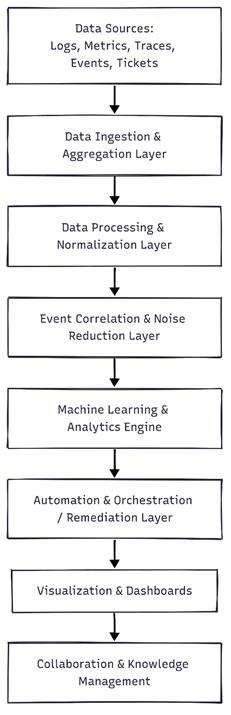
AIOps (Artificial Intelligence for IT Operations) platforms are designed to automate and enhance IT operations by leveraging big data, machine learning, and automation. A typical AIOps architecture consists of several interconnected layers and components that work together to deliver intelligent, automated insights and actions.
Key Components of AIOps Architecture
Data Ingestion & Aggregation
- Collects data from diverse sources: logs, metrics, traces, events, tickets, and configuration databases.
- Integrates with monitoring tools, network devices, applications, and cloud services to provide a unified data lake.
Data Processing & Normalization
- Cleans, parses, and transforms raw data into structured formats suitable for analysis.
- Ensures consistency and prepares data for downstream analytics.
Machine Learning & Analytics Engine
- Applies ML algorithms for anomaly detection, event correlation, and predictive analytics.
- Learns from historical data to improve accuracy and adapt to changing environments.
Event Correlation & Noise Reduction
- Groups related alerts and events to minimize alert fatigue.
- Identifies root causes and prioritizes incidents for faster resolution.
Automation
- Automates routine tasks, remediation actions, and workflow processes.
- Integrates with ITSM and DevOps tools for seamless operations.
Visualization & Dashboards
- Provides real-time, actionable insights through dashboards and reports.
- Enables IT teams to monitor key metrics, trends, and anomalies.
Collaboration & Knowledge Management
- Facilitates cross-team communication and stores best practices, incident resolutions, and documentation for future reference
Final Thought
As technology continues to accelerate, the demands on IT operations will only grow more complex. AIOps isn’t just a tool it’s a mindset shift, empowering teams to move from reactive problem-solving to proactive innovation. By embracing AIOps, organizations can transform their IT from a cost centre into a true driver of business value. The future belongs to those who are ready to let intelligence and automation lead the way. Are you prepared to join the AIOps revolution? The smartest journey in IT starts now.
Frequently Asked Questions
1.What is AIOps?
Answer: AIOps (Artificial Intelligence for IT Operations) uses AI, machine learning, and big data analytics to automate and enhance IT operations by detecting anomalies, predicting issues, and automating responses.
2.How does AIOps improve IT operations?
Answer: AIOps reduces manual effort by automating root cause analysis, filtering noise from alerts, predicting failures, and optimizing performance, leading to faster incident resolution and reduced downtime.
3.What are the key benefits of AIOps?
Answer: Key benefits include:
- Proactive issue detection
- Faster incident resolution
- Reduced alert fatigue
- Cost efficiency through automation
- Improved IT performance and scalability
4.What types of data does AIOps analyze?
Answer: AIOps processes logs, metrics, events, tickets, traces, and configuration data from various IT sources (servers, networks, applications, cloud services) to provide actionable insights.
5.Is AIOps only for large enterprises?
Answer: No, AIOps benefits organizations of all sizes by improving IT efficiency. While large enterprises handle more complexity, mid-sized businesses can also leverage AIOps for automation and cost savings.
