

It’s 9:00 AM on a Monday. The notification lands: “External Audit starts in 10 days.”
For most engineering teams, this triggers a predictable chaos:
- Feature Freeze: All innovation stops.
- The Scavenger Hunt: Your best engineers stop coding and start digging through logs to find evidence that Incident #402 was patched correctly.
- The Screenshot Factory: Senior Architects spend hours taking screenshots of AWS configurations to prove encryption is “On.”
It is expensive, demoralizing, and ironically – it doesn’t actually make you secure.
The Greatest Lie we tell ourselves: “Point-in-Time” Compliance
The traditional audit model is flawed by design. It proves that you were compliant on the day the auditor visited.
But in a modern Fintech environment, you are deploying code 50 times a day.
- Tuesday: Auditor checks the firewall. It’s Green.
- Wednesday: A junior dev opens Port 22 for debugging and forgets to close it.
- Thursday: You are non-compliant (and vulnerable).
- Result: You are exposed for the next 364 days until the auditor returns.
In the age of Microservices and UPI velocity, PDF policies are useless. You cannot govern a dynamic cloud environment with a static document.
The Solution: Stop Trusting, Start Enforcing
The shift we need is from “Compliance by Trust” (hoping devs read the PDF) to a Compliance & Risk-Driven engineering culture where it is impossible to break the rules.
Compliance as Code (CaC) means translating your governance rules – whether for RBI compliant monitoring or PCI DSS compliant observability – into executable code that lives in your pipeline.
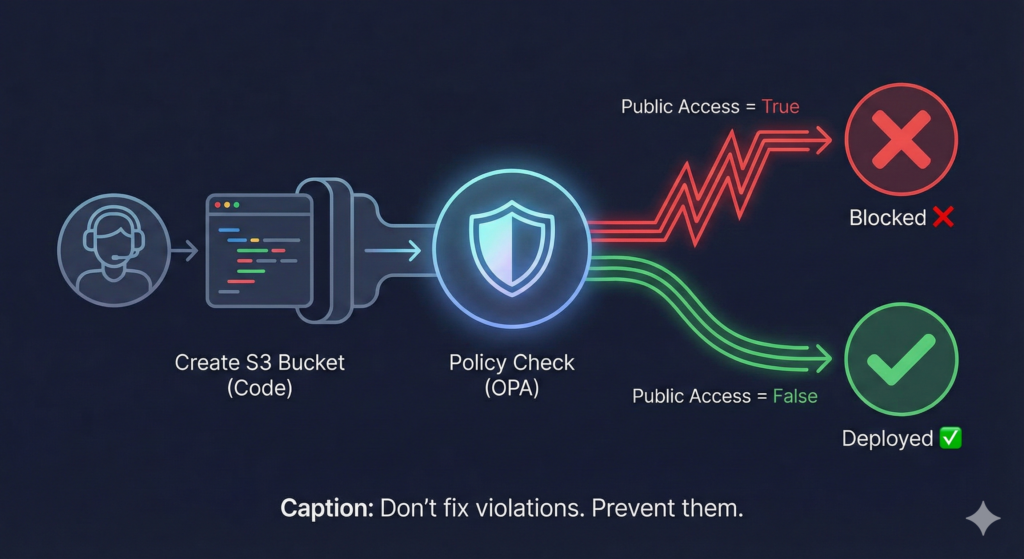
How it works in practice: Imagine a developer tries to deploy an S3 bucket with public access.
- Old Way: The bucket is deployed. InfoSec finds it 3 weeks later during a scan. Panic ensues.
- New Way (CaC): Your SOC 2 observability platform runs a policy check (using tools like OPA). It sees the violation. It blocks the build instantly.
The developer gets immediate feedback: “Deployment Failed: Policy Violation – Public Buckets are Forbidden.”
The AI Advantage: From”Blocked” to “Fixed”
While “Code” sets the rules, AI helps you follow them.
In a traditional setup, when a pipeline blocks a deployment, the developer is stuck. They have to stop, google the error, and rewrite the Terraform code.
In an AI-Led setup (like we build at OpsTree), the system doesn’t just block – it guides.
- The Pipeline: “Deployment Blocked. SQL Database is unencrypted.”
- The AI Agent: “I noticed you missed the encryption flag. Here is the corrected code snippet to fix this instantly. Shall I apply it?”
This turns Compliance from a Red Light (Stop) into a Co-pilot (Correction), keeping your velocity high even while your standards remain strict.
The Business Case: Audit-Ready by Default
When you move to FinTech compliance monitoring that is coded into your infrastructure, “Audit Season” disappears.
- Evidence is Automatic: You don’t need screenshots. Your code repository is the evidence. You can show the auditor exactly which policy was enforced on every single commit.
- Velocity Increases: This sounds counter-intuitive, but it’s true. When developers know the “guardrails” will catch them if they fall, they drive faster. They stop second-guessing every config change because the system provides safety.
- The “Sleep” Factor: As a CTO or CISO, you stop worrying about “What did we miss?” You know that the system is enforcing the rules 24/7/365, not just when the auditor is watching.
- The Ironic Truth: Brakes Let You Drive Faster
There is a saying in Formula 1: “The brakes aren’t there to stop the car; they are there to let you go fast into the corners.”
Automated compliance is your braking system. It doesn’t slow you down – it allows you to move at Fintech speed without crashing.
Stop treating compliance as a generic bottleneck. Start treating it as code.
Is your team stuck with manual audits? Discover how we help Fintechs implement Automated Governance & Compliance to stay secure without slowing down.