

Executive Summary
IT operations have reached a breaking point. Traditional monitoring tools can’t keep up with the complexity of cloud-native environments, microservices, and continuous delivery pipelines. Incidents are more expensive than ever with downtime costing enterprises between $300,000 and $1M per hour (Gartner).
Yet, AWS customers adopting GenAI-powered AIOps have seen a 60% reduction in mean time to resolution, 95% fewer out-of-hours incidents, and 99.9% availability across critical workloads. Meanwhile, DevOps and SRE teams are drowning in alert storms, spending more time reacting to noise than resolving real issues.
This is where AIOps (Artificial Intelligence for IT Operations) comes in. By combining advanced machine learning with automation, AIOps doesn’t just monitor (it predicts, correlates, and resolves). The promise is clear: faster Mean Time to resolution (MTTR), lower operational costs, and a more reliable digital backbone for the business.
From OpsTree’s perspective, AIOps is a necessary evolution for enterprises that want to stay competitive in an environment defined by velocity, scale, and customer experience.
The Evolution of IT Operations
IT operations have gone through multiple waves of transformation:
1. Manual Monitoring
-
- Operators relied on logs, spreadsheets, and war rooms.
- Extremely reactive (issues were addressed only after customer impact).
2. Traditional Monitoring Tools
-
- Platforms like Nagios, SolarWinds, or Splunk became the backbone.
- These provided dashboards and alerts but required manual correlation.
- Alert fatigue grew as infrastructure scaled.
3. Observability
-
- Shift to metrics, traces, and logs as first-class citizens.
- Tools like Prometheus, Grafana, and Elastic improved visibility.
- Still, humans had to stitch the story together.
4. AIOps
-
- Moves from “observe” to “understand and act.”
- Ingests massive telemetry data, detects anomalies, predicts failures, and automate remediation.
- Aligns with modern DevOps and SRE principles.
What this really means is that IT operations have moved from being a cost center to a strategic enabler. Without automation and intelligence, businesses can’t keep pace with the demands of always-on digital services.
What is AIOps?
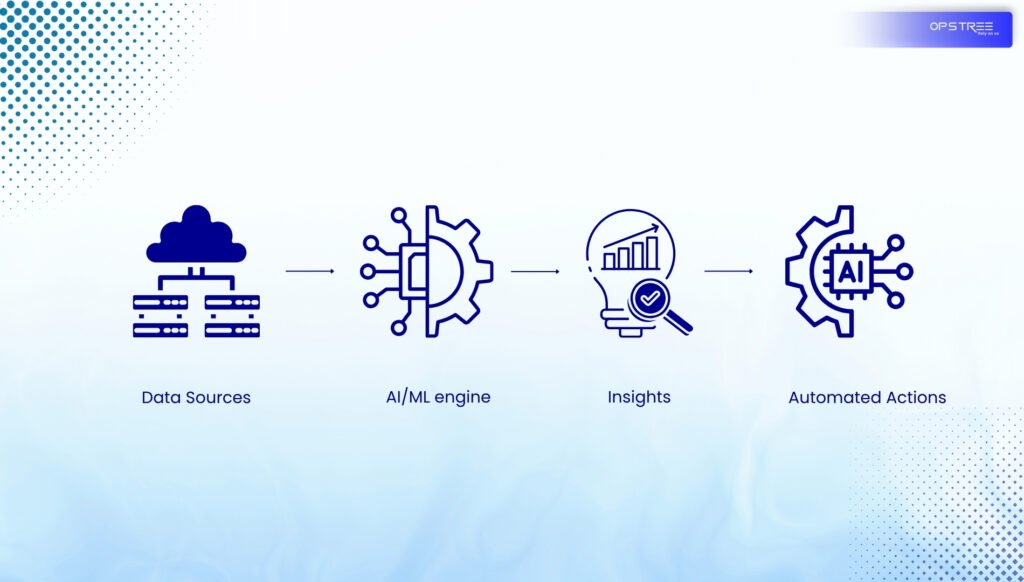
At its core, AIOps is the application of artificial intelligence and machine learning to IT operations data. The goal is simple: help teams move from reactive firefighting to proactive, predictive, and automated operations.
Key components include:
-
Data Ingestion
Pulling telemetry from logs, metrics, traces, and events across distributed systems.
-
Anomaly Detection
Identifying deviations from normal behavior before they cause outages.
-
Event Correlation
Cutting through alert noise by clustering related incidents and highlighting root causes.
-
Predictive Analytics
Forecasting failures, capacity bottlenecks, or security threats in advance.
-
Automation & Remediation
Triggering scripts, workflows, or platform responses to resolve issues without human intervention.
Instead of thousands of raw alerts, AIOps delivers actionable insights, telling you not just that “something is wrong,” but what, why, and what to do next.
Why AIOps Now?
Here’s the thing: digital environments are exploding with data, cloud services, microservices, and fractured visibility. That’s creating urgency, and here’s how it breaks down:
IDC finds 30%–40% of cloud spend is wasted without automated optimization – AIOps driven by AWS GenAI can turn these losses into substantial annual savings.
— GenAI agents and unified AWS AIOps platforms now enable autonomous remediation and rapid response, translating operational intent into direct action.
What this really means is: the market is roaring, downtime is crushing, and traditional methods aren’t scaling. AIOps isn’t just nice-to-have, it’s essential.
Key Use Cases of AIOps
Let’s break down how AIOps delivers value where it counts:
- Incident Prediction & Prevention
AIOps uses predictive models to spot trouble before it breaks production. Companies report up to 60% reductions in resolution time and significant prevention of outages. - Automated Root Cause Analysis
Instead of firefighting, AIOps correlates events, traces, and metrics from across the stack to pinpoint root causes automatically. - Intelligent Alerting (Cutting Noise)
It filters noise by clustering related alerts, so teams deal with cases, not chatter. - Proactive Capacity & Cost Optimization
AIOps forecasts capacity needs and highlights inefficiencies, letting IT leaders trim cloud waste and right-size their systems. - Security & Compliance Monitoring
By mining logs and metrics with AI, AIOps surfaces anomalies that could indicate security or compliance risks. - Automation & Self-Remediation
More than insights, that’s auto-triggered scripts, playbooks, or workflows that resolve issues before humans even know there’s a glitch.
On AWS, these use cases are accelerated by Bedrock Agents, providing natural language access, dynamic remediation creation and autonomy across environments.
Benefits & Business Impact
AIOps isn’t just a technical upgrade – it’s a business multiplier. It transforms how IT supports growth, resilience, and profitability. The real value shows up in metrics the board actually cares about:
- Faster Mean Time to Resolution (MTTR)
By cutting alert noise and automating root cause analysis, AIOps reduces MTTR by up to 60%, protecting revenue streams that depend on digital uptime. For a company generating $10M in daily online transactions, that’s equivalent to $250K–$500K in revenue protected annually through faster incident recovery.
- Reduced Downtime Costs
With Gartner’s estimate of $5,600 per minute of downtime; even small improvements in uptime translate into millions in savings annually.
- Improved Reliability & Customer Experience
Uptime is customer experience. Proactive incident prevention translates directly into fewer service interruptions and higher NPS scores. Forrester reports that enterprises adopting AIOps see 30–40% fewer incidents affecting end users.
- Cost Optimization
AIOps help identify underutilized resources and optimize cloud spending. IDC notes that organizations waste 30–40% of their cloud budgets without intelligent automation (idc.com).
- Empowering DevOps & SRE Teams
With AWS AIOps, engineering teams reclaim 10–20 hours per week from reactive triage to innovation. Freed from repetitive troubleshooting, they focus on building reliability features, improving automation, and accelerating digital transformation – while CFOs see real-time spend optimization and predictable IT performance.
Challenges in Adopting AIOps
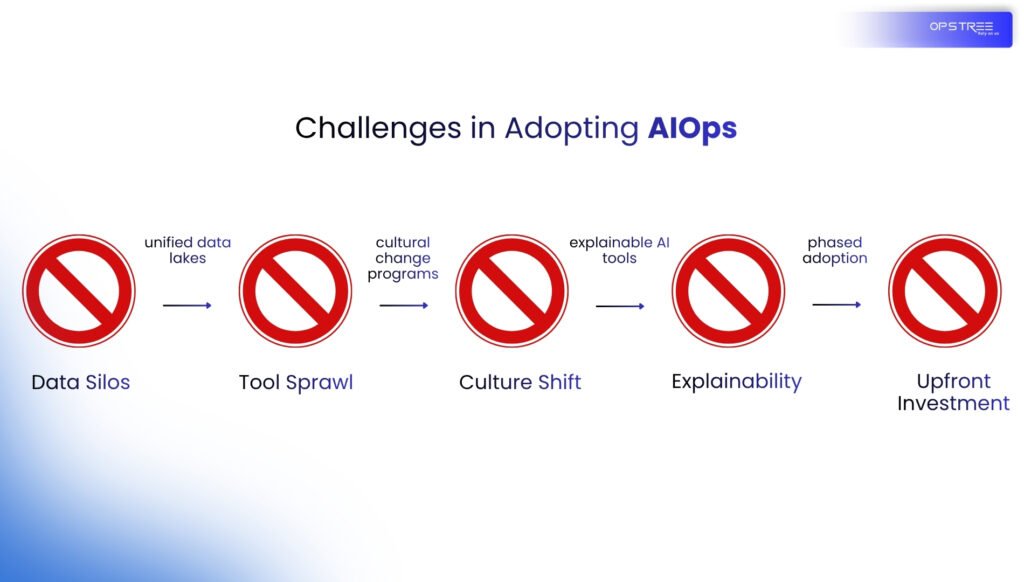
No transformation comes free of hurdles. Leaders should go in eyes wide open:
- Data Silos
AIOps thrives on diverse telemetry data, but many enterprises are still trapped in silos (network logs in one tool, application traces in another). Without unified ingestion, insights are limited. AWS unified data lakes and cross-account integration remove ingestion limitations. - Tool Sprawl
Most organizations already juggle 20+ monitoring tools. Integrating them into a coherent AIOps platform is often harder than the AI itself. AWS native services and OpenTelemetry help consolidate tools without mass migrations. - Culture Shift
Moving from human-driven operations to AI-assisted automation can create resistance. Trust in machine-led decisions takes deliberate change management. Phased GenAI agent rollouts with human-in-the-loop to keep teams in control and build trust. - Explainability
CXOs and engineers alike ask: Why did the AI make this call? Black-box recommendations for slow adoption. Vendors are racing to add interpretability features, but skepticism remains. Bedrock Agents’ stepwise reasoning and Audit Manager’s transparency address interpretability. - Upfront Investment
The ROI is strong, but initial setup (data integration, training models, building automation) requires both budget and executive sponsorship. AWS’s pay-as-you-go AIOps eliminates most upfront costs.
AIOps in Action: Real-World Scenarios
Theory is one thing, but leaders want proof. Here are some of the case studies (inspired by OpsTree’s consulting experiences and AWS):
-
Cutting CPU Utilization by 70% for an AI-Powered Content Research Platform
- Client: A U.S.-based AI-powered content research and copywriting platform that simplifies content creation by generating blogs and other materials from relevant keywords.
- Challenge: The platform was hitting 100% CPU utilization, dealing with database corruption, unresponsive APIs under traffic spikes, and DOS/DDoS attacks.
- Solution: OpsTree rebuilt its architecture, migrating to AWS infrastructure, redesigning server architecture, implementing load balancing, tuning performance, and introducing VPN-based protection and error tracking.
- Results:
-
- 70% reduction in CPU utilization
- 50% overall cost optimization
- 80% reduction in malicious traffic
- 100% removal of DOS & DDoS incidents
-
Migrating from On-Prem to AWS with Enhanced Observability, Security, and Cost Optimization
- Client: A leading technology-driven B2B company specializing in the procurement and supply of construction materials to infrastructure and real estate developers across 18 states.
- Challenge: The client’s existing on-prem setup limited deployment speed, scalability, and visibility, while driving up operational costs. To achieve faster innovation, stronger governance, and long-term efficiency, the company decided to migrate fully to AWS.
- Solution: OpsTree hosted workloads on Amazon EC2 for scalable control and used RDS (MySQL, Multi-AZ) for high availability. Data and backups were stored in Amazon S3 with cost-efficient lifecycle policies.
- Results:
-
- Increased application uptime by 99.9% with EC2 auto-recovery and RDS Multi-AZ for high availability.
- Reduced infrastructure costs by 15% using rightsizing and on-demand resource provisioning across AWS workloads.
- Achieved 40% faster deployments through Jenkins automation, reducing manual intervention and accelerating feature delivery.
- Enhanced observability with centralized Amazon CloudWatch monitoring, enabling issue detection and resolution 40% faster.
-
Modernizing Application & Platform Engineering for Cars24 with AWS
- Client: Cars24, India’s largest digital platform for buying and selling used cars, serves over a million users. With a technology-first approach, the company delivers transparency, convenience, and a trusted experience for both sellers and buyers.
- Challenge: The customer faced multi-cloud complexity, inconsistent CI/CD practices, and rising costs. Manual operations slowed delivery, while fragmented governance and security gaps increased risk, creating overhead that limited scalability and innovation.
- Solution: OpsTree unified the customer’s cloud by migrating from GCP to AWS, streamlining CI/CD with Jenkins, and strengthening security through IAM and Terraform standardization. With BuildPiper integration, the team enabled seamless migration and automated rollbacks.
- Results:
-
- Eliminating dual billing optimized costs, delivering $45K+ recurring savings.
- Automation and self-service pipelines save 500+ developer hours each month.
- A single cloud platform simplifies operations and ensures consistent deployments.
- Eliminating manual tasks improved ops productivity, saving 165+ BAU hours monthly.
AWS AIOps and GenAI: Building Autonomous, Governed Operations
In the GenAI era, AWS empowers organizations to move beyond traditional AIOps by combining robust machine learning with agentic generative AI capabilities. Today, services like Amazon DevOps Guru proactively monitor telemetry, detect anomalies, and provide actionable insights, but the next leap comes from integrating Amazon Bedrock Agents and Amazon Q for fully autonomous, collaborative IT operations.
CloudOps teams on AWS now orchestrate AI agents that reason over large knowledge bases, codify runbooks on the fly, and even automate complex multi-step remediations with supervised guardrails. The result is a living, learning operations platform that shrinks response times, continuously improves through feedback, and reduces operational toil for engineering teams.
AWS 2025 best practices for GenAI-powered AIOps solutions emphasize four key architectural pillars:
– Agentic Architecture: Leverage Amazon Bedrock Agentcore to build composable, secure multi-agent workflows that can collaborate and orchestrate complex operational tasks autonomously.
– Knowledge-Driven Operations: Implement Retrieval Augmented Generation (RAG) by connecting Bedrock Knowledge Bases to your operational runbooks, incident histories, and real-time data lakes for contextually aware decision making.
– Enterprise-Grade Security: Deploy multi-account architectures with AI agent isolation using Service Control Policies and AWS Audit Manager to ensure governance and compliance across your AI operations.
– Continuous Learning: Establish closed-loop feedback systems where DevOps Guru insights and GenAI agent actions continuously improve operational intelligence and response accuracy.
As organizations adopt this model, they experience sharper clarity in root cause analysis, near-instant remediation with documented steps, and measurable reductions in downtime and engineering effort all governed by compliance-ready frameworks to ensure security, fairness, and transparency.
The Road Ahead: AIOps & GenAI
AIOps is evolving fast, and Generative AI is the accelerant. What’s next is less about dashboards and more about AI copilots for operations:
- Natural Language Interfaces
Engineers will query systems with simple prompts: “Show me anomalies in latency for payments API in the last 6 hours.” The AI translates intent into queries across logs, traces, and metrics.
- Autonomous Remediation
GenAI agents will not just recommend but also generate and execute remediation playbooks. Picture an SRE copilot suggesting a patch script, simulating it, and then safely applying it. AWS leads in GenAI-driven AIOps with secure, modular agent frameworks and continuous learning that adapts to changing enterprise needs.
- Knowledge Codification
Institutional knowledge from runbooks, incident retros, and Slack threads can be ingested to create a living knowledge base. GenAI then applies it in real time to guide incident responses. Amazon Q and Bedrock Agents now routinely codify institutional knowledge into on-demand runbooks and automatically execute remediation with full monitoring and compliance tracking built into the process.
- Shift from Reactive Ops to Proactive Reliability
Instead of post-mortems, AIOps + GenAI will push organizations toward pre-mortems, forecasting failure modes and fixing them before they hit production.
Forrester and Gartner both point out that the convergence of AIOps and GenAI is not a 2030 vision. Enterprises are already piloting copilots for DevOps and ITSM, with adoption expected to rise sharply by 2026.
OpsTree’s Perspective on AIOps
At OpsTree, we see AIOps as more than a tool set. It’s a mindset shift that aligns perfectly with how we approach Platform Engineering, SRE, Observability, and DevSecOps.
Our implementation follows AWS’s recommended journey: unifying data with CloudWatch and X-Ray, enabling anomaly detection using DevOps Guru, progressing to automated remediation through Lambda and Bedrock Agents, and ultimately implementing generative copilots for self-healing infrastructure. This end-to-end approach ensures operational excellence powered by intelligence and automation.
The impact is tangible. Clients experience over 80% reduction in incident volume, faster deployment cycles, and significant cloud cost savings all within months of transformation. AIOps, when done right, becomes the cornerstone of proactive, efficient, and scalable cloud operations.
- Platform Engineering: We embed AIOps into CI/CD pipelines and platform tooling, ensuring proactive monitoring and self-healing infrastructure.
- SRE Practices: AIOps augments SRE teams with predictive incident detection, noise reduction, and intelligent alerting, helping them focus on reliability engineering, not firefighting.
- Observability at Scale: By layering AI-driven anomaly detection on top of modern observability stacks, we move teams from “monitoring what happened” to “predicting what’s next.”
- DevSecOps Integration: AIOps strengthens compliance and security pipelines, surfacing anomalies that could indicate policy violations or threats.
We’ve seen firsthand how this changes outcomes for clients (fewer incidents, faster recovery, lower costs, and happier engineers). In our experience, the most successful AIOps journeys are phased: start with data unification, layer anomaly detection, then graduate to automation and GenAI copilots.
Conclusion
The pressure on IT operations isn’t slowing down (cloud-native complexity, rising costs, and customer expectations) to demand a smarter approach. AIOps offers exactly that: predictive, automated, and intelligent operations that transform IT from a reactive cost center to a proactive business enabler.
But here’s the key: adopting AIOps isn’t about buying a tool. It’s about rethinking how your teams run operations. The winners will be those who combine AI with strong SRE culture, unified observability, and disciplined automation.
Why now? Because the cost of waiting is higher than the cost of acting. Every hour of downtime, every wasted cloud dollar, every burned-out engineer is avoidable.
Where OpsTree fits: We help organizations chart their AIOps journey with a blend of strategy and hands-on engineering. Whether you’re building your observability foundation, optimizing cloud spend, or piloting AI-driven remediation, our teams bring the expertise to make it real.
Ready to explore how AIOps can accelerate your operations?
With AWS GenAI and AIOps, the time to reimagine IT operations is NOW. Let OpsTree and AWS guide your journey to autonomous, governable, and business-aligned operations.
Author’s Bio
Gopal, Senior Partner Solutions Architect for Data & AI at AWS and Mehul Sharma, Solution Architect at OpsTree leading the AWS vertical, bring together extensive expertise in cloud, data and AI to drive large-scale digital transformation across India. Based in Gurugram, Gopal leverages his deep background as a data engineer, data scientist and machine learning engineer to help organizations build scalable, profitable and innovation-driven businesses on AWS.

Complementing this, Mehul architects secure, automated and high-performance cloud ecosystems for FinTech, BFSI, and enterprise SaaS customers with specialization in AWS, DevOps, CI/CD modernization, Kubernetes, and infrastructure automation. Together, they collaborate with AWS partner teams to design future-ready cloud and AI solutions, integrating Generative AI to enhance operational efficiency and accelerate business growth across the region.
Also Read –
Gemini CLI and Gemini Code Assist: Comprehensive SDLC Use Cases and Implementation Guide
Logs to Unclog: The Complete Guide to Logging
OpsTree’s Leading Service Areas — DevOps and DevSecOps Solutions | Cloud Engineering and Migrations | Database and Data Engineering | Observability, SRE & Production Engineering