A blog site on our Real life experiences with various phases of DevOps starting from VCS, Build & Release, CI/CD, Cloud, Monitoring, Containerization.
Author: Ruchita Varma
I am Ruchita Verma, a dedicated Tech Content Writer at Opstree Solutions, where I specialize in simplifying advanced concepts in DevOps, cloud technologies, and automation. With a keen interest in bridging the gap between technical jargon and practical understanding, my goal is to create content that not only educates but also empowers professionals to implement best practices in their work. Through my writing, I aim to provide valuable insights that help businesses optimize their systems, enhance security, and adapt to emerging technologies.
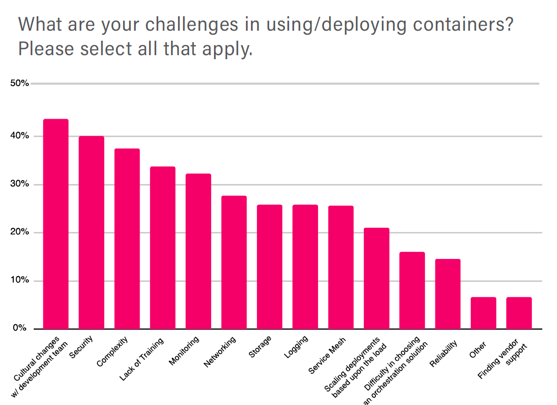
For many of us, Kubernetes is the solution for some of the never-ending microservices application delivery problems, but Kubernetes setup and management comes with its own set of challenges. According to a report, there are 9 key Kubernetes challenges. In this blog, I’m focusing on the two primary challenges, which are Security & Networking.
Why is Security becoming such a Big Challenge for Organizations?
It’s mainly because Kubernetes is very complex and highly vulnerable if not monitored properly. As we implement Kubernetes for container orchestration, more and more containers are deployed and due to its distributed nature, hence it gets difficult to investigate which container might have vulnerabilities. Hence as a result the organization will start to feel the threat of outsiders breaching in.
One of the best examples of this situation: In 2018 Tesla’s Kubernetes admin console (which was not password protected) was breached by Hackers and mining of cryptocurrencies was done by Tesla’s cloud resources on amazon web services (AWS).
With BuildPiper, Managing Kubernetes is no longer a pain now! Here’s how BuildPiper enables simple & hassle-free cluster management, Microservices management, product releases, and much more. Take a look now!
Kubernetes is not a buzzword anymore. In fact, it has become one of those tech wonders that has been making all the technologists around the world super excited!
While Kubernetes is creating great excitement across the technology community, the bigger question is how can businesses and their great products derive value by adopting it!
Why is Managed Kubernetes in demand these days?
The underlying crucial components of a Kubernetes cluster setup and implementation are the management of clusters, nodes, and pods. Intuitive and seamless management of these components plays a significant role in simplifying the overall development and deployment process for a digital product.
Only simplifying the development task isn’t enough, there arises a need for an automated system to deploy, scale, monitor, and securely manage these containerized applications. And managing all this is not a cakewalk! Here’s how the Kubernetes cluster setup step by step can be made easy.
If how to setup kubernetes cluster has become a bottleneck and hinders hassle-free and fast delivery of your software product, then Managed Kubernetes is the ideal solution.
With simplified and flexible ‘Managed Kubernetes’, businesses can easily handle, scale, and deploy the Kubernetes cluster to scale their products, while doing away with the pain of handling the Kubernetes cluster set-up and operation of Kubernetes.
Consider these DevOps practices for rapid application delivery, seamless management of Microservices, and hassle-free product release.
Enterprises both big and small, are focusing on modernizing applications and implementing Microservices & DevOps architecture to boost their businesses’ agility and productivity. Enterprises are competing against tighter time-to-market windows than ever before. Seeing how mercurial many markets have become now, there’s no time to waste when you have to create customer-facing applications that serve prospects and customers better than your competitors.
Today, migrating to the cloud, especially through cloud-native architectures such as Microservices, is a multidimensional problem. So, without a well-planned, sorted strategy and a well-devised DevOps roadmap in hand, migration could become a futile endeavour. You need to consider reliable strategies for adopting Cloud & DevOps architecture that can help deliver competitive strength to your organization and improve customer experiences through an agile & nimble tech platform.
Here, in this blog, I’ve discussed some important practices of adopting DevOps architecture to enable rapid application delivery, seamless management of Microservices, and hassle-free product release thus allowing your business to scale and exceed customer expectations!
Before we dive into specific DevOps techniques and approaches to help your business succeed with Microservices, let’s look at some of the core ideas behind these types of architectures:
Microservices should be deployed at a faster pace.
Security should be a major focus area.
Comprehensive Monitoring and logging
Moreover, applying these approaches can help your IT teams in designing the right DevOps roadmap best-suited to meet the requirements of Microservices implementation in your organization.
But, executing each of these approaches and ideas poses its unique challenges. Let’s read further to know why embracing these DevOps practices is important if you’re thinking about Microservices.
Microservices should be deployed at a Faster Pace!
In a monolithic approach, fewer deployments are happening as compared to Microservices. What earlier was a single monolith application, now becomes a large collection of 50–200 services. Therefore, with Microservices, your team needs to be prepared for 100 times or even more deployment than ever before. With increased challenges, a slow pace of deployment would fail to support fast-moving Microservices. Moreover, the independent nature of Microservices poses additional difficulties.
Microservices have their independent code which needs to be deployed individually for each of these microservices without affecting the other modules of the application. Microservices are loosely coupled and need not have the same technology stack, libraries, or frameworks.
The deployment process for services differs from each other and thus needs to be done at a faster pace to enable production-ready Microservices. Along with improving the pace of Microservices deployment, it’s important that teams have the adequate DevOps skillset required to manage Microservices in a secured and seamless manner.
Automate everything- Automation should become a crucial part of the development process.
Operational excellence is a must– Strategies for continual improvement are important to increase the velocity.
Operation activities must work closely with the Development process– Ensure that the basic operational activities work along with the development process. This helps in enabling a faster deployment process.
By executing these simple yet so important DevOps practices, you can be assured of the complete security of your business application. Implementing Microservices without changing the way you execute the business operations may put your projects at risk.
Besides a well-planned DevOps roadmap, there is a need for the IT teams to possess appropriate DevOps skillset for implementing practices of DevOps architecture.
Security should be a Major Focus Area!
Independent deployments, business-oriented capabilities, agile teams, functional orientation, and rapid application delivery are some of the unique characteristics of Microservices. With all these changes, brought in the Microservices-led DevOps architecture, it should come as no surprise that the approach to security needs to change as well. Here’s what you can do to adopt a Shift Left Philosophy and embed security early on!
Involve experts to monitor complete security- Experienced security experts to monitor iterative product features. This helps to get early feedback on the security status of the application.
Implement security measureswhile detecting errors– Robust security measures in the bug tracking process should be adopted.
Integrate best security practices in the code review– Authentic and reliable security practices in the code review process must be executed, especially if you have to deal with authentication flows, configurations, secret storage, etc.
Move towards automation as much as possible– Automation techniques for application security can be adopted. Automated security practices such as dependency scanning and static analysis can become part of your deployment pipeline.
It’s important that you first analyze and then select the best security practices for your business applications. Make sure to devise a plan to implement the security measures not towards the end but pro-actively during the development process.
Comprehensive Monitoring & Logging!
Last but not least make sure to select the right approach for logging and monitoring Microservices. When you’re working with a single application, you usually get a chance to look at the logs and have a clear picture of what exactly is happening.
But what, if you have to deal with 20 applications( to be scaled dynamically), you surely need a different strategy then. The same is the case with Microservices where you have to work with many services. Logging and monitoring these services is a cumbersome and tedious process.
Therefore, it is important to introduce state-of-the-art logging and monitoring practices for enabling production-ready Microservices. Being able to track all the requests across different microservices is a must. Viewing these logs in one place is the only way to make things work.
Implementing & configuring all of this often becomes a huge challenge and thus a need for the platform to seamlessly manage Kubernetes and Microservices is highly recognized. Take a look at how BuildPiperprovides out-of-the-box capabilities for Kubernetes & Microservices application delivery management.
With BuildPiper, you can benefit from comprehensive automation for the entire Microservices journey right from K8s cluster setup & config, onboarding microservices, robust security-enabled CI-CD engine, and complete observability that enables viewing of the overall performance, health status, availability, logs, and other important metrics of your services & Kubernetes components.
With the integration and set-up of infrastructure monitoring and log management tools such as Prometheus, Grafana, Alert Manager, ElasticSearch, Fluentd, and Kibana, BuildPiper enables complete observability with detailed information of build and deploy logs.
BuildPiper provides your DevOps team with deep insights into the services to monitor & analyze app performance and the right DevOps skillset for enhancing the application performance.
Wrapping it all
These are some of the DevOps practices to make your Microservices journey successful. So, before you plan to implement these DevOps strategies, make sure to look at the pros and cons of each of these. Analyze and then decide which would work the best for your platform
Kubernetes usage appears to be a popular pattern being adopted by enterprises these days. Recently, 56 percent of the organizations that polled for the 2020 edition of The State of Enterprise Open Sourcereport, said that they expected their use of containers to increase in the next 12 months. The report polled 950 IT leaders.
Kubernetes has practically become the new norm for container orchestration. Enterprises going cloud-native consider Kubernetes as one of the important elements contributing to the success of implementing a cloud-first strategy. If you’re planning to re-architect your business architecture, I’m sure Kubernetes is the first thing that comes to your mind, isn’t it? Let’s take a look at other interesting Kubernetes facts. Continue reading “How To Choose A Kubernetes Management Platform That Is Right For You?”
Explore and know more about the business benefits of Managed Kubernetes and why does your business need one! Read to know more!
There are multiple success stories out there that have leveraged a Kubernetes-based infrastructure to enable the scaling of business applications. Take Airbnb for instance; their transition from Monolithic architecture to Microservices had been much talked about.
The ultimate goal was to make continuous delivery available to hundreds of company’s engineers so that they could seamlessly add new services and enable the teams and ultimately the application to scale
The company adopted Kubernetes and Kubernetes components to manage the configuration and deployment of 250+ critical services to Kubernetes. The results were quite successful and allowed them to do over 500 deployments per day without any hiccups.
Containers have gained huge popularity in the business world due to their optimized performance and enablement of the speed of application delivery. They are rapidly being adopted by organizations both big and small.
With a 200% increase in Kubernetes adoption since the year 2017, it’s no doubt that Kubernetes is becoming the de-facto leader in container orchestration!
But with the increased demand for rapid growth and faster delivery in the competitive market space, there arises a need for an automated system to deploy, scale, monitor, and securely manage thousands of containerized applications.
A Kubernetes dashboard can help in deploying containerized applications to the Kubernetes cluster. Kubernetes offers an impressive set of features, including scalability, workload management, self-recovery, and progressive application deployment, but still, they require a significant manual configuration for better processing and controlled K8s cluster management processing and controlled K8s cluster management along with enhanced Kubernetes security.
Setting up an automated monitoring system that keeps a continuous check on Kubernetes components and its infrastructure is difficult. Managing all this can be taxing and challenging for the DevOps team already busy keeping up with multiple infrastructures and DevOps priorities.
Managed Kubernetes takes care of this and much more. With Managed Kubernetes, users can easily monitor and manage their Kubernetes cluster without having to set up and maintain it themselves.
Just like a Kubernetes Dashboard can help deploy containerized applications to a Kubernetes cluster, troubleshoot issues of containerized applications, and manage cluster resources, Managed Kubernetes can take care of the overall management of a complete Kubernetes cluster.
Once the cluster set-up is ready and operational, managed Kubernetes provide all the tools needed to automate routine processes such as updates, scaling, load-balancing, and monitoring within the cluster. It also ensures improved Kubernetes security that can be tracked through the Kubernetes dashboard.
In BuildPiper, we have created a microservices application delivery platform that allows seamless setup and management of Kubernetes as well!
BuildPiper allows multiple clusters to be managed by a consistent set of security and configuration policies enabling more compliance and lesser management costs. With BuildPiper, you can easily monitor the health status of the nodes, pods, and the complete node lifecycle management and keep an account of all Kubernetes security measures being taken within the system.
BuildPiper eases the task of the DevOps team as it frees them from the task of keeping a check on the implementation details of Kubernetes components and making sure that the cluster is healthy, secure, and up to date. With added functionalities like Managed Microservices, security, compliance, and observability, BuildPiper is the most suitable platform for deriving value from your microservices applications.