

Amazon ECR Container Images Across Accounts or Regions

Want to implement an AWS Elastic Container Registry Replication practice in your DevOps solution? But don’t know how to start and where to go. Folks, now you are on the right path.

We’re pursuing this to safeguard our production resources in the ap-south-1 (Mumbai) region from potential disasters and connectivity issues. Ensuring resource distribution across other AWS regions is critical. Our microservices-driven applications rely on Docker images, including custom ones crucial for disaster recovery. AWS Container Registry offers a secure, efficient solution for storing and managing Docker images, simplifying image storage, and enabling seamless sharing across private or public environments.

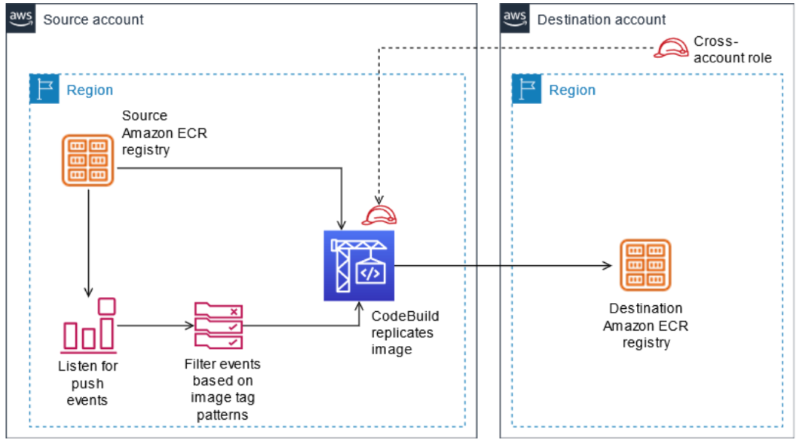
So, here you may wonder how we can replicate the same images from its registry to another AWS Account(cross-accounts) or in the same account in different regions(cross-region).

Pre-requisite: 

  1. Need two AWS Accounts with admin access to Amazon ECR service and programmatic access for it(to pull/push images).
  2. Login/Signup:  https://aws.amazon.com/console/

Note: 1st AWS Account: Source account

2nd AWS Account: Destination account

The architecture

Enough theory part let’s take action for this,

Continue reading “Amazon ECR Container Images Across Accounts or Regions”

Nifi Cluster Setup with External Zookeeper

Apache NiFi is an open-source data integration and automation tool that enables the automation of data flow between different systems. NiFi provides a user-friendly interface to design, control, and manage the flow of data between various sources and destinations. The tool is particularly useful in handling data from different sources, applying transformations, and routing it to different systems in real-time.

Why use the Nifi cluster over the standalone?

  • Performance: Clusters can handle higher throughput and provide better performance than standalone instances due to load distribution.
  • Fault Tolerance: Clusters provide high availability and fault tolerance such as if one node fails, the other nodes take over the processing.
  • Scalability: Clusters allow for scalability by adding more nodes, whereas standalone instances have limitations in scaling.


Continue reading “Nifi Cluster Setup with External Zookeeper”

The Fallacies of Platform Engineering

Delve into the intricacies of implementing platform engineering strategies and the misconceptions that surround it.

In today’s rapidly evolving tech landscape, the significance of platform engineering cannot be overstated. It serves as the bedrock upon which countless digital ecosystems are built, from mobile applications to cloud-based services and everything in between. Yet, for all its importance, the world of platform engineering is riddled with misconceptions & misunderstandings that can lead to costly mistakes, project delays and suboptimal outcomes. To navigate this complex terrain successfully, it is crucial to identify and address these fallacies head-on.

By exposing these fallacies and offering insights into platform engineering best practices, we aim to empower engineers, developers and decision-makers to make more informed choices and in turn, create more robust and effective platforms.

Throughout this exploration, we’ll delve into the intricacies of implementing platform engineering strategies, examining its core principles and the misconceptions that surround it. We’ll also discuss real-world examples and case studies to illustrate the consequences of falling prey to these fallacies. 

Continue reading “The Fallacies of Platform Engineering”

Securing Nifi Cluster with TLS Toolkit

Apache NiFi is an easy-to-use, powerful, and reliable system to process and distribute data. As data flows between different systems it’s a good practice to ensure the integrity of the data being processed. Securing a NiFi cluster is essential for various reasons, primarily to protect sensitive data, ensure system integrity, and prevent unauthorized access. Apache NiFi provides a TLS toolkit using which we can self-sign Certificate Authority (CA) and easily issue and sign certificates in the format expected by NiFi. Continue reading “Securing Nifi Cluster with TLS Toolkit”

Enabling CORS on Azure APIM

You can set up cross-origin resource sharing (CORS) using the built-in CORS policy in Azure API Management or by adjusting the automatically available settings in the overview of the developer portal.

What is Azure API Management?

Azure API Management is a comprehensive platform provided by Microsoft Azure that allows organizations to create, publish, secure, and analyze APIs. Whether you’re exposing APIs to external developers or managing internal APIs within your organization, Azure APIM simplifies the process and offers a range of features to ensure your APIs are both accessible and secure.

Key Features of Azure APIM:

1. API Gateway: Azure APIM acts as a gateway between your APIs and consumers. It handles requests, routing, and caching, improving API performance and reliability.

2. Security and Authentication: Secure your APIs with authentication, authorization, and OAuth support. Set up rate limiting and IP filtering to protect against abuse.

3. Developer Portal: Provide a developer-friendly portal where external developers can discover and consume your APIs. Publish documentation, code samples, and interactive API testing tools.

Continue reading “Enabling CORS on Azure APIM”