Adetailed, real–world comparisonof BuildPiperand Spinnaker covering architecture, features, complexity, governance, use cases, and enterprise adoption.
Introduction
Continuous Delivery (CD) is acore capabilityin modern DevOps- not just for faster releases, but forsafer deployments, governance, and scalability. Two platforms often discussed inenterprise CD decisionsare:
Spinnaker – a powerful, open–source, multi–cloud deployment orchestration platform
BuildPiper – a modern, opinionated CI/CD & CD platform focused onsimplicity, standardization, and governance
Container adoption is significantly increasing across various modern use cases, but it’s not a simple plug-and-play. Adopting containers becomes highly complicated, especially when it comes to executing them at scale as most enterprises have only limited skills and capabilities.
Many leading companies believe that Kubernetes is the first step to building scalable modern applications and they are adopting K8s to overcome container adoption barriers.
Spotify is one of these. Leveraging Kubernetes benefits, Spotify has observed significant cost-saving values as described in this case study. It has seen 2-3x CPU utilization by using the orchestration capabilities of K8s, resulting in better spend optimization.
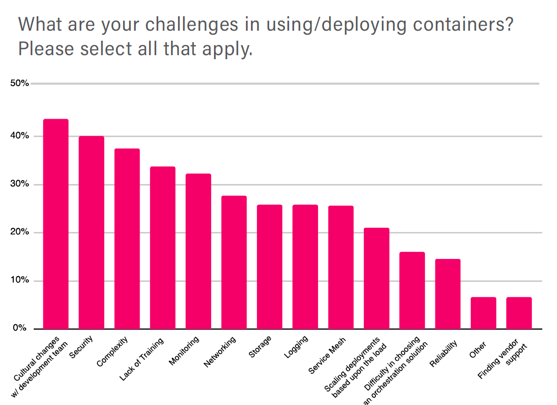
For many of us, Kubernetes is the solution for some of the never-ending microservices application delivery problems, but Kubernetes setup and management comes with its own set of challenges. According to a report, there are 9 key Kubernetes challenges. In this blog, I’m focusing on the two primary challenges, which are Security & Networking.
Why is Security becoming such a Big Challenge for Organizations?
It’s mainly because Kubernetes is very complex and highly vulnerable if not monitored properly. As we implement Kubernetes for container orchestration, more and more containers are deployed and due to its distributed nature, hence it gets difficult to investigate which container might have vulnerabilities. Hence as a result the organization will start to feel the threat of outsiders breaching in.
One of the best examples of this situation: In 2018 Tesla’s Kubernetes admin console (which was not password protected) was breached by Hackers and mining of cryptocurrencies was done by Tesla’s cloud resources on amazon web services (AWS).
With BuildPiper, Managing Kubernetes is no longer a pain now! Here’s how BuildPiper enables simple & hassle-free cluster management, Microservices management, product releases, and much more. Take a look now!
Kubernetes is not a buzzword anymore. In fact, it has become one of those tech wonders that has been making all the technologists around the world super excited!
While Kubernetes is creating great excitement across the technology community, the bigger question is how can businesses and their great products derive value by adopting it!
Why is Managed Kubernetes in demand these days?
The underlying crucial components of a Kubernetes cluster setup and implementation are the management of clusters, nodes, and pods. Intuitive and seamless management of these components plays a significant role in simplifying the overall development and deployment process for a digital product.
Only simplifying the development task isn’t enough, there arises a need for an automated system to deploy, scale, monitor, and securely manage these containerized applications. And managing all this is not a cakewalk! Here’s how the Kubernetes cluster setup step by step can be made easy.
If how to setup kubernetes cluster has become a bottleneck and hinders hassle-free and fast delivery of your software product, then Managed Kubernetes is the ideal solution.
With simplified and flexible ‘Managed Kubernetes’, businesses can easily handle, scale, and deploy the Kubernetes cluster to scale their products, while doing away with the pain of handling the Kubernetes cluster set-up and operation of Kubernetes.
Explore and know more about the business benefits of Managed Kubernetes and why does your business need one! Read to know more!
There are multiple success stories out there that have leveraged a Kubernetes-based infrastructure to enable the scaling of business applications. Take Airbnb for instance; their transition from Monolithic architecture to Microservices had been much talked about.
The ultimate goal was to make continuous delivery available to hundreds of company’s engineers so that they could seamlessly add new services and enable the teams and ultimately the application to scale
The company adopted Kubernetes and Kubernetes components to manage the configuration and deployment of 250+ critical services to Kubernetes. The results were quite successful and allowed them to do over 500 deployments per day without any hiccups.
Containers have gained huge popularity in the business world due to their optimized performance and enablement of the speed of application delivery. They are rapidly being adopted by organizations both big and small.
With a 200% increase in Kubernetes adoption since the year 2017, it’s no doubt that Kubernetes is becoming the de-facto leader in container orchestration!
But with the increased demand for rapid growth and faster delivery in the competitive market space, there arises a need for an automated system to deploy, scale, monitor, and securely manage thousands of containerized applications.
A Kubernetes dashboard can help in deploying containerized applications to the Kubernetes cluster. Kubernetes offers an impressive set of features, including scalability, workload management, self-recovery, and progressive application deployment, but still, they require a significant manual configuration for better processing and controlled K8s cluster management processing and controlled K8s cluster management along with enhanced Kubernetes security.
Setting up an automated monitoring system that keeps a continuous check on Kubernetes components and its infrastructure is difficult. Managing all this can be taxing and challenging for the DevOps team already busy keeping up with multiple infrastructures and DevOps priorities.
Managed Kubernetes takes care of this and much more. With Managed Kubernetes, users can easily monitor and manage their Kubernetes cluster without having to set up and maintain it themselves.
Just like a Kubernetes Dashboard can help deploy containerized applications to a Kubernetes cluster, troubleshoot issues of containerized applications, and manage cluster resources, Managed Kubernetes can take care of the overall management of a complete Kubernetes cluster.
Once the cluster set-up is ready and operational, managed Kubernetes provide all the tools needed to automate routine processes such as updates, scaling, load-balancing, and monitoring within the cluster. It also ensures improved Kubernetes security that can be tracked through the Kubernetes dashboard.
In BuildPiper, we have created a microservices application delivery platform that allows seamless setup and management of Kubernetes as well!
BuildPiper allows multiple clusters to be managed by a consistent set of security and configuration policies enabling more compliance and lesser management costs. With BuildPiper, you can easily monitor the health status of the nodes, pods, and the complete node lifecycle management and keep an account of all Kubernetes security measures being taken within the system.
BuildPiper eases the task of the DevOps team as it frees them from the task of keeping a check on the implementation details of Kubernetes components and making sure that the cluster is healthy, secure, and up to date. With added functionalities like Managed Microservices, security, compliance, and observability, BuildPiper is the most suitable platform for deriving value from your microservices applications.