

Your product is scaling. Releases are frequent. Customers expect zero downtime.
But behind the scenes, your DevSecOps team is stretched thin (juggling deployments, fixing vulnerabilities, managing infrastructure, and responding to incidents at odd hours).
This is where many organizations hit a wall.
DevSecOps is the backbone of modern digital businesses. Yet, maintaining it in-house is becoming increasingly unsustainable, especially with the growing lack of devsecops expertise in house.
What starts as a high-performing team often turns into a bottleneck. Burnout creeps in. Hiring slows you down. Costs spiral. Risks increase.
And suddenly, what was meant to accelerate innovation begins to hold it back.
PROBLEM: Why In-House DevSecOps Teams Burn Out
1. Hiring & Retention Is a Constant Battle
Finding skilled DevSecOps professionals is tough. Keeping them is even harder.
The demand far exceeds the supply. Skilled engineers are either unavailable or too expensive. Even when you hire, attrition is high due to workload pressure.
This creates a cycle:
- Long hiring cycles
- Increased workload on existing teams
- Declining morale
And the business pays the price through delayed releases and missed deadlines.
2. Skill Gaps: Lack of DevSecOpsExpertise in House
DevSecOps is not a single skill, it’s a combination of cloud, security, CI/CD automation and compliance.
Expecting a small in-house team to master everything is unrealistic.
The result?
- Incomplete implementations
- Security blind spots
- Inefficient processes
This lack of devsecops expertise in house often leads to reactive firefighting instead of proactive strategy.
3. 24/7 Operational Pressure Never Stops
Systems don’t sleep. Incidents don’t follow office hours.
Your in-house team ends up:
- Monitoring systems round-the-clock
- Responding to alerts late at night
- Handling outages under pressure
Over time, this leads to exhaustion. Burnout becomes inevitable. And burnout leads to mistakes, costly ones.
4. Security & Compliance Overload
Every release needs to be secure. Every system must comply with regulations.
But security isn’t a one-time effort. It’s continuous.
In-house teams struggle to:
- Keep up with evolving threats
- Maintain compliance standards
- Integrate security into pipelines
This adds another layer of stress and increases the risk of breaches.
5. Toolchain Complexity Slows Everything Down
Modern DevSecOps involves dozens of tools:
- CI/CD platforms
- Monitoring tools
- Security scanners
- Cloud management systems
Managing, integrating, and optimizing these tools requires time and expertise.
Without it, teams spend more time managing tools than delivering value.
6. Cost of Scaling : DevOps Team Scaling Challenges
Scaling your DevOps team isn’t just about hiring more people.
It involves:
- Training
- Onboarding
- Infrastructure expansion
- Process alignment
This makes devops team scaling slow, expensive, and inefficient. Instead of accelerating growth, it becomes a bottleneck.
PROOF: Data + Real Business Impact
The challenges above are backed by real-world data.
- Over 60% of DevOps professionals report burnout due to workload and on-call pressure
- The cost of downtime can exceed $300,000 per hour for large enterprises
- Cybersecurity skill shortages continue to widen globally
- Hiring skilled DevSecOps engineers can take 3–6 months
What This Means for Your Business
Burnout doesn’t just affect teams, it affects outcomes:
- Slower product releases
- Increased downtime
- Higher security risks
- Missed SLAs
- Rising operational costs
Impact of DevSecOps Burnout on Business Outcomes
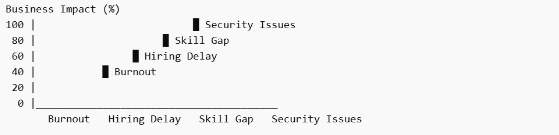
Insight: As challenges increase from burnout to security issues, the negative business impact rises sharply. Security gaps and skill shortages create the highest risk exposure.
In-House vs Managed DevSecOps Comparison
| Factor | In-House Team | Managed DevSecOps Services |
|---|---|---|
| Hiring Time | High | Low |
| Cost Predictability | Low | High |
| Scalability | Limited | Flexible |
| Expertise | Skill gaps | Multi-domain experts |
| Downtime Risk | Higher | Reduced |
Mini Case Example
A fast-growing SaaS company faced frequent release delays and rising infrastructure costs.
Their in-house team was overwhelmed :
- Deployment pipelines were inconsistent
- Security audits were delayed
- Engineers were working weekends
After shifting to managed devsecops services, they achieved:
- 40% faster release cycles
- Reduced downtime incidents
- Improved team morale
PATH: What Managed DevSecOps Fix
1. Instant Access to Expertise
With managed services, you don’t rely on a few individuals.
You get:
- Specialists across cloud, security and automation
- Proven frameworks and best practices
- Continuous knowledge updates
This eliminates the lack of devsecops expertise in house almost instantly.
2. Reduced Burnout, Better Productivity
An outsourced devsecops team shares the operational load.
Your internal team can:
- Focus on innovation
- Work normal hours
- Avoid constant firefighting
This improves productivity and retention.
3. Faster and Smarter DevOps Team Scaling
Scaling becomes seamless with managed services.
Instead of hiring:
- You expand capabilities on demand
- You scale up or down based on needs
This makes the DevOps team scale faster, more flexible and cost-effective.
4. Proactive Security & Compliance
Managed providers embed security into every stage:
This reduces risks and ensures business continuity.
5. Cost Optimization and Predictability
With managed devsecops services, you move from unpredictable costs to structured pricing.
No more:
- Unexpected hiring costs
- Tool mismanagement
- Resource underutilization
Instead, you get optimized spending aligned with business goals.
6. 24/7 Reliability Without Team Fatigue
An outsourced devsecops team ensures round-the-clock operations without exhausting your internal staff.
This leads to:
- Faster incident response
- Reduced downtime
- Higher system reliability
OpsTree POV: A Strategic Partner for Growth
At this stage, the question isn’t whether DevSecOps is important, it’s how you sustain it.
OpsTree approaches DevSecOps as a business enabler, not just a technical function.
The focus is on:
- Ensuring uptime and reliability
- Enabling seamless scalability
- Supporting continuous delivery without friction
Instead of replacing your team, the goal is to strengthen it.
Because the real value lies in creating a system where technology supports growth without burning out the people behind it.
Conclusion
DevSecOps burnout is a business risk. It leads to:
- Slower innovation
- Increased downtime
- Security vulnerabilities
- Rising costs
The traditional in-house model struggles to keep up with modern demands, especially with the persistent lack of devsecops expertise in house.
Shifting to managed devsecops services and leveraging an outsourced devsecops team is not about outsourcing responsibility, it’s about enabling resilience.
Because in today’s time, success doesn’t depend on how hard your teams work. It depends on how sustainably they can perform.
FAQs
1. Why do DevSecOps teams burn out?
DevSecOps teams burn out due to continuous operational pressure, skill shortages, and growing security responsibilities. They often handle 24/7 monitoring, incident response, and compliance tasks, which leads to long working hours, stress, and reduced productivity over time.
2. What are managed DevSecOps services?
Managed DevSecOps services provide external expertise to handle infrastructure, security, and deployment processes. They offer 24/7 monitoring, automation, and proactive security while reducing the burden on internal teams and improving operational efficiency.
3. When should you outsource DevSecOps?
You should consider outsourcing DevSecOps when your team faces burnout, hiring delays, skill gaps, or increasing downtime risks. It’s especially useful during rapid growth phases when scaling internal teams becomes slow and expensive.
4. How do managed services help with DevOps team scaling?
Managed services enable faster DevOps team scaling by providing on-demand expertise without the need for hiring. Businesses can quickly expand capabilities, handle increased workloads, and maintain performance without long recruitment cycles or training delays.